
Anthropic Launches Claude Fable 5.2 and Mythos 5.2 for Advanced Technical Projects
Anthropic has introduced Claude Fable 5.2 and Claude Mythos 5.2, two advanced AI models designed for demanding coding, scientific research and complex engineering work. The new models promise faster output, improved technical capabilities and lower standard API pricing, while Mythos remains restricted to verified organisations.
The November 9 announcement marks a new step in Anthropic’s efforts to build AI systems that can handle more than everyday chatbot requests. The company is targeting projects that require extended reasoning, multiple stages of work and coordination between AI agents.
What Are Claude Fable 5.2 and Mythos 5.2?
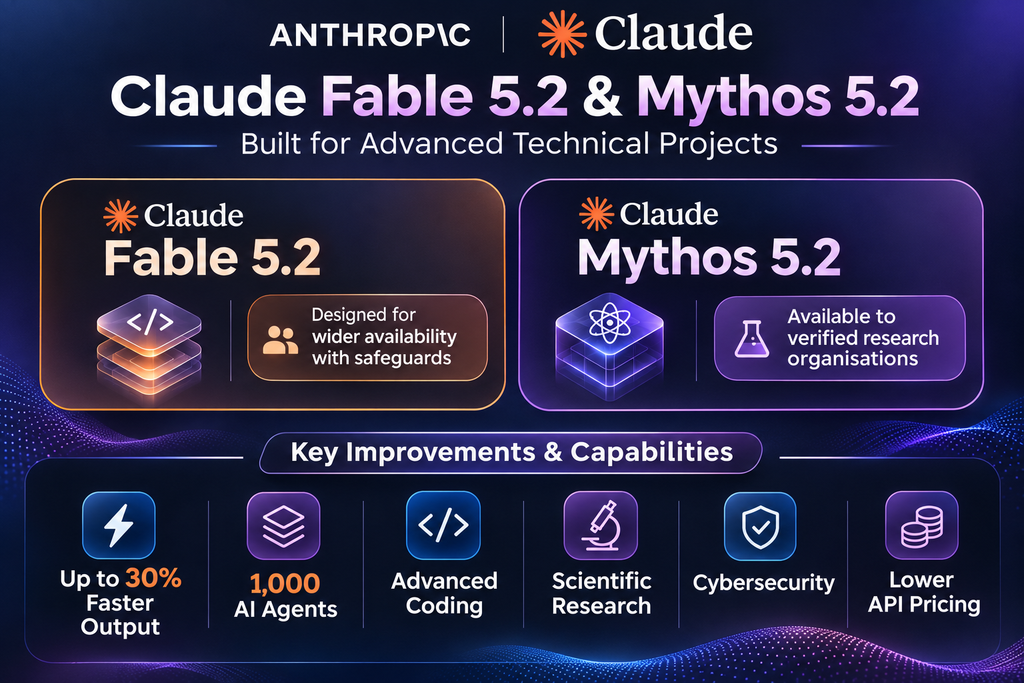
Anthropic describes Claude Fable 5.2 and Mythos 5.2 as the same underlying AI model, but with different safety controls and access rules.
Claude Fable 5.2 is the broadly available version. It includes safeguards designed to restrict high-risk cybersecurity and biological research requests. These protections allow Anthropic to offer the model to a wider range of users.
Claude Mythos 5.2 is intended for advanced cybersecurity and biomedical research. Organisations working on approved projects can apply through Anthropic’s Cyber and Life Sciences Verification Programmes. It has fewer restrictions for those specialised tasks, so access is controlled rather than generally available.
The distinction is important: Anthropic is not presenting Mythos as a completely different model with an unrelated architecture. Instead, the company is offering two access paths to the same underlying technology, with different safeguards based on the type of work being performed.
Faster Responses and Lower API Pricing
One of the main improvements in the 5.2 release is generation speed. Anthropic says the new models Claude Fable 5.2 and Mythos 5.2 can generate responses up to 30% faster than their respective 5.1 versions. The company also says they communicate more clearly than earlier Fable and Mythos models.
The standard API pricing has been reduced:
| Pricing | Claude Fable 5.2 and Mythos 5.2 |
|---|---|
| Input tokens | $8 per million |
| Output tokens | $40 per million |
| Fast mode input | $16 per million |
| Fast mode output | $80 per million |
The optional fast mode can increase token generation speed by up to 2.5 times, but it doubles the standard token rates. This gives developers a choice between lower-cost processing and faster output for time-sensitive workloads.
The lower pricing could make advanced AI workloads more accessible to development teams, research organisations and businesses. However, the actual cost of a project will depend on how many tokens it uses, how long the model runs and how many agents are involved.
Stronger Coding and Software Engineering Capabilities
Software development is one of the major areas Anthropic is targeting with Fable 5.2. The company says the model can work on complex engineering tasks, identify difficult bugs, improve performance and coordinate multiple agents to complete longer projects.
Anthropic shared an example in which an earlier version of Fable 5.2 helped migrate a critical production service from Python to Rust. The company reported that the migrated service became more efficient and reliable, with startup time around 26 times faster.
Another experiment involved building a prototype operating system. Starting from an empty folder, Fable 5.2 coordinated more than 1,000 subagents over eight days. The resulting system could boot on a laptop and included hardware drivers, file storage, windows, a login screen, an installer and built-in Claude functionality.
These demonstrations suggest that the model is designed to manage more than isolated coding prompts. It can divide a large assignment into smaller tasks, coordinate agents, test results and continue working towards a finished output.
That does not mean developers can hand over every software project without supervision. Complex systems still require human review, testing and security checks before they are used in production.
Improvements in Scientific Research and Mathematics
Anthropic is also highlighting the models’ potential in scientific research. According to the company, Fable 5.2 helped solve two open problems in theoretical physics involving black holes and the relationship between quantum mechanics and gravity.
One of the most notable demonstrations involved Fermat’s Last Theorem. Anthropic says a team of around 1,000 Fable 5.2 agents completed a computer-verified formalisation of the theorem in approximately 30 hours, with minimal human intervention.
The company compared this with an earlier effort using an unreleased Claude research model, which took 11 days. Formalisation translates a mathematical proof into a format that software can verify step by step. It is not the same as independently discovering and proving a mathematical theorem without human context or evaluation.
The model was also tested on hardware engineering tasks. Anthropic says it designed three electronic devices: a home voice-assistant hub, a USB speakerphone and a handheld virtual pet. The work included circuit-board layouts, 3D-printed enclosures and software. The company reported that all three devices worked without electrical modifications to their boards.
These examples show why Anthropic is positioning Fable 5.2 for technical projects that combine software, mathematics and physical engineering.
Mythos 5.2 Focuses on Cybersecurity and Biomedical Research
While Fable 5.2 is intended for wider use, Mythos 5.2 is designed for specialised work that requires fewer restrictions.
In cybersecurity, Anthropic says Mythos 5.2 performed better than its earlier models at identifying software vulnerabilities. On the company’s internal CVE Rediscovery evaluation, it found 10.2% more vulnerabilities than Opus 5.5 and 14.4% more than Mythos 5.1.
The evaluation used 1,829 published vulnerabilities from October 2026. These are Anthropic’s internal test results, so they should be viewed as company-reported performance rather than an independent guarantee of real-world security outcomes.
The model also demonstrated capabilities in biomedical research. Anthropic tested Mythos 5.2 on adeno-associated virus (AAV) capsids, which are protein structures used in some gene-therapy delivery systems. The company says the model accurately predicted 28 of the 34 capsid structures it attempted.
This work could help researchers investigate complex protein assemblies and explore new approaches to biomedical development. However, the results do not mean the model can replace laboratory experiments, specialist researchers or clinical validation.
Benchmark Results Show Progress Across Multiple Tasks
Anthropic published benchmark results comparing Fable 5.2 with Fable 5.1, Opus 5.5 and selected competing models. The results indicate improvements in coding, scientific research, computer use, robotics and reasoning.
| Benchmark | Fable 5.2 result |
|---|---|
| FrontierCode 2.0 | 49.1% |
| FrontierSWE v2 | 69.9% |
| Terminal-Bench-Science 0.1 | 74.6% |
| OSWorld 2.1 | 89.3% |
| RoboDojo Sim | 64.9% |
| Humanity’s Last Exam | 74.2% |
These figures are based on Anthropic’s published evaluation results. Some tests use different effort settings, tools or evaluation conditions, so the scores should not be treated as a direct ranking across every model or workload.
The robotics result is particularly interesting. Anthropic says Fable 5.2 scored 64.9% on its RoboDojo Sim evaluation, compared with 27.6% for Fable 5.1. The test measures how well an AI system controls a simulated two-arm robot using camera images.
The benchmark improvements do not guarantee that the model will perform equally well in every real-world environment. Still, they indicate that Anthropic is working to expand Claude’s capabilities beyond text and conventional software development.
Availability: Who Can Use the New Claude Models?
Anthropic announced the two models Claude Fable 5.2 and Mythos 5.2 on November 9, 2026.
Fable 5.2 is available through Anthropic’s Claude platform and API, with availability also announced across major cloud platforms. Developers can use it for advanced coding, research and engineering tasks.
Mythos 5.2 has a more limited release. Organisations working on cybersecurity and biomedical research can apply through Anthropic’s verification programmes. It is not intended as a general-purpose model that every user can access without approval.
Anthropic also recommends that users begin with Claude Opus 5.5 for most everyday coding and knowledge-work tasks. Claude Fable 5.2 and Mythos 5.2 are positioned for more ambitious, open-ended technical projects that need additional reasoning and coordination.
This approach gives developers a way to choose a model based on the complexity of their work rather than using the most expensive or capable option for every request.
The launch reflects a wider shift in AI development. Leading AI companies are increasingly focusing on systems that can complete long-running tasks, coordinate multiple agents and support specialised technical work.
Anthropic’s demonstrations suggest that it wants Claude to become a tool for larger engineering and research workflows, not just a conversational assistant. Its focus on coding, hardware design, robotics and scientific reasoning also places it in competition with other advanced AI systems targeting professional and enterprise users.
The separate Fable and Mythos access models also highlight an important challenge for advanced AI development: making powerful capabilities useful while limiting access to features that could create risks in areas such as cybersecurity and biology.
However, many of the most impressive demonstrations and benchmark results come from Anthropic’s own testing. Independent evaluations and broader customer experience will be important in determining how consistently these capabilities translate into practical results.
Expert Analysis
Claude Fable 5.2 and Mythos 5.2 signal Anthropic’s growing focus on AI systems that can manage complete technical workflows rather than simply answer questions.
The combination of agent coordination, coding improvements and research capabilities could be valuable for specialised teams.
However, company-reported demonstrations should be assessed alongside independent testing and real-world performance.
The restricted Mythos rollout also shows that access controls will remain an important part of deploying more capable AI models.

Conclusion
Anthropic’s Claude Fable 5.2 and Mythos 5.2 bring improvements in coding, reasoning, scientific research and engineering, alongside a reported speed increase of up to 30% and lower standard API pricing.
Fable 5.2 is the version intended for wider access, while Mythos 5.2 is reserved for verified cybersecurity and biomedical research organisations. The release could make Claude more useful for demanding technical projects, although its long-term impact will depend on independent performance testing, practical adoption and how safely these capabilities can be deployed.
Frequently Asked Questions
1. What are Claude Fable 5.2 and Mythos 5.2?
They are Anthropic’s new advanced AI models announced on November 9, 2026. They are designed for complex coding, scientific research, cybersecurity and engineering projects.
2. What is the difference between Claude Fable 5.2 and Mythos 5.2?
Both use the same underlying model. Fable 5.2 includes stronger safeguards for high-risk cybersecurity and biology requests and is available more widely. Mythos 5.2 is available to verified organisations working in specialised research areas.
3. How much faster are the new Claude Fable 5.2 and Mythos 5.2 models?
Anthropic says Claude Fable 5.2 and Mythos 5.2 generate outputs up to 30% faster than their respective 5.1 versions.
4. How much does Claude Fable 5.2 cost?
The standard API price is $8 per million input tokens and $40 per million output tokens. Optional fast mode costs $16 per million input tokens and $80 per million output tokens.
5. Can everyone use Claude Mythos 5.2?
No. Access is restricted to organisations that qualify through Anthropic’s Cyber and Life Sciences Verification Programmes.
6. Can Claude Fable 5.2 build software?
Anthropic says it can handle complex software engineering tasks, coordinate AI agents and help develop large projects. Human review and testing are still necessary before deploying generated software.
7. When were Claude Fable 5.2 and Mythos 5.2 announced?
Anthropic announced both Claude Fable 5.2 and Mythos 5.2 models on November 9, 2026.
Suggestions:
Anthropic’s Claude Discovers a CRISPR-Like Enzyme System
Claude Opus 5.5 Launches With Lower Costs and Fable-Level Performance
Grok 4.7 Review: Pricing, Benchmarks, Features and How It Compares
Source:
Anthropic – Official announcement
Reuters – Launch coverage
SiliconANGLE – Technical coverage
Claude X Account
Anthropic X Account