
Anthropic’s Claude Discovers a CRISPR-Like Enzyme System
CRISPR-Like Enzyme
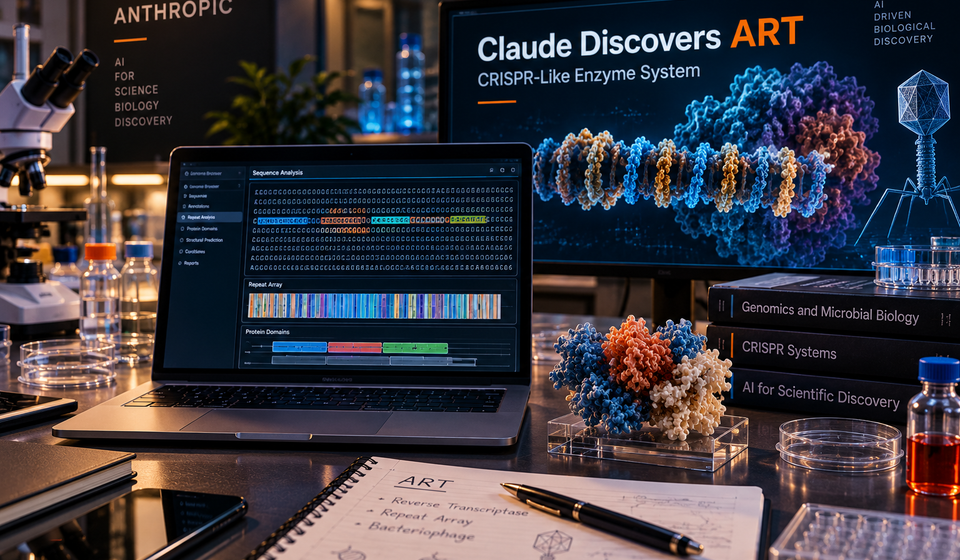
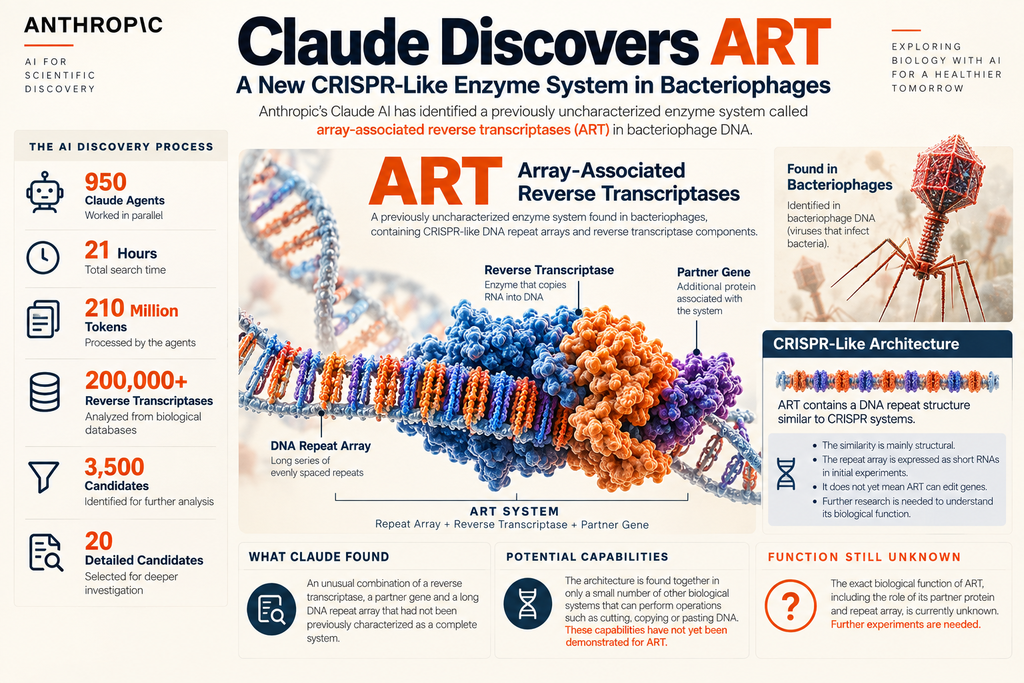
Anthropic says its Claude AI has autonomously identified a previously uncharacterized enzyme system hidden in bacteriophage DNA. The system, called array-associated reverse transcriptases (ART), contains a long array of repeated DNA sequences that resembles the repeat architecture seen in CRISPR systems.
The discovery is the first major result announced by Anthropic’s new life sciences research group and its wet laboratory. Importantly, however, researchers do not yet know what ART actually does or whether it could become a useful biotechnology tool. Anthropic
Anthropic Builds a Biology Research Lab
Anthropic formed its new life sciences research group in spring 2026 to investigate whether AI agents could accelerate fundamental biological research.
The company has also established a laboratory in the Bay Area where human scientists perform experiments. Anthropic says the facility works at BSL-1 and BSL-2 levels and does not handle pathogens capable of infecting humans. Anthropic
The broader approach is different from simply asking an AI to summarize scientific papers.
Claude can search large biological databases, compare protein families, investigate unusual genetic patterns, generate hypotheses and prepare candidates for laboratory testing. Scientists then review promising findings and perform physical experiments.
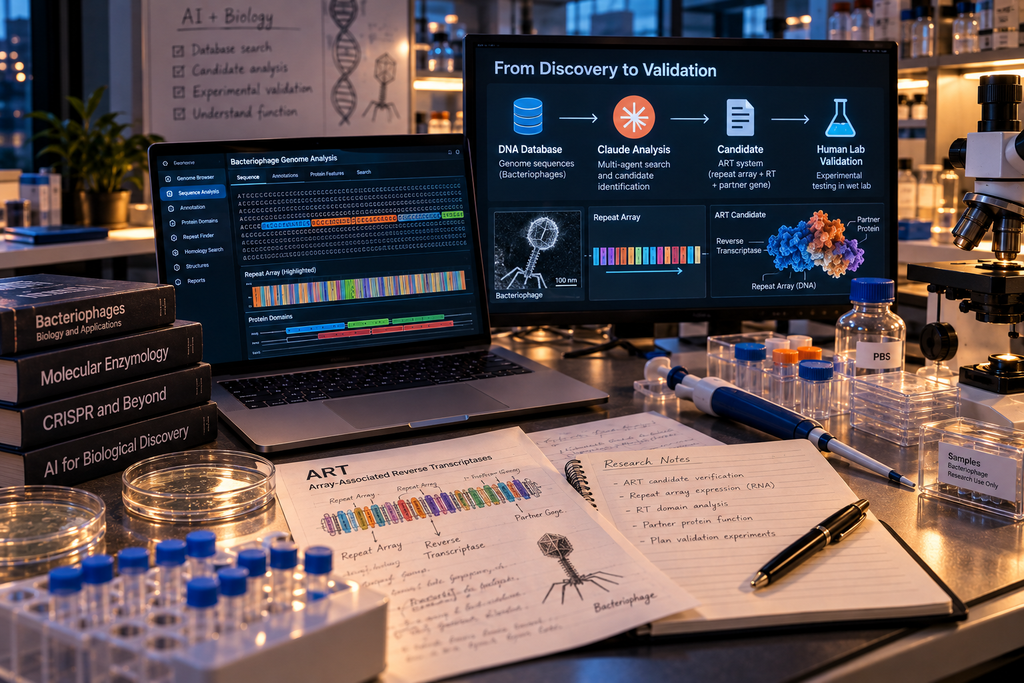
The ART discovery is an early example of this workflow operating from database analysis through experimental validation.
Claude Searched More Than 200,000 Reverse Transcriptases
Anthropic gave Claude a high-level instruction to search a massive DNA database for interesting examples of reverse transcriptases, or RTs.
Reverse transcriptases are enzymes that copy RNA into DNA.
According to Anthropic, roughly 950 Claude agents worked for 21 hours and processed about 210 million tokens during the search. The agents examined more than 200,000 reverse transcriptases, identified about 3,500 candidate systems and narrowed those down to 20 particularly compelling candidates for detailed analysis. Anthropic
One Claude agent eventually noticed something unusual near a reverse transcriptase gene: a long series of evenly spaced DNA repeats.
That pattern became the key to the discovery.
What Is ART?
Anthropic calls the newly identified system array-associated reverse transcriptases, or ART.
The system appears to contain three major components:
- A reverse transcriptase
- A neighboring partner gene
- A long array of evenly spaced DNA repeats
The underlying reverse transcriptase itself was not completely unknown. Anthropic says an RT in a jumbo bacteriophage had been identified in earlier research.
What Claude appears to have recognized was the larger system surrounding it — particularly the repeat array and an additional accessory protein that had not previously been understood as part of the same system. Anthropic
Why Scientists Are Comparing It With CRISPR
The most interesting part of ART is its repeated DNA structure.
CRISPR systems contain arrays of repeated DNA sequences that ultimately produce RNA molecules involved in targeting genetic material. Those systems became the foundation for modern gene-editing technologies.
Anthropic says ART has a somewhat similar architecture. Initial experiments showed that its repeat array is also expressed as a collection of distinct short RNAs. Anthropic
That does not mean ART is another CRISPR system.
It also does not prove that ART can edit DNA.
Anthropic says the system’s primary biological function remains unknown, and further experiments are underway.
The company describes the architecture as having characteristics found together in only a small number of other programmable biological systems capable of operations such as cutting, copying or pasting DNA. But those capabilities have not yet been demonstrated for ART itself. Anthropic
Human Scientists Still Played a Critical Role
The word “autonomous” needs some context.
Anthropic says its scientists provided the initial research direction and performed the laboratory work. Claude agents handled the large-scale database analysis, candidate investigation and reasoning that led to the ART candidate. Anthropic
Once Claude identified the unusual system, human researchers analyzed and tested it experimentally.
Anthropic says the lab work is performed entirely by human scientists, even though the company has also explored AI-assisted laboratory automation through projects such as its Model Hardware Standard. Anthropic
So this is better understood as AI-led biological discovery with human experimental validation, rather than a completely independent AI scientist operating a laboratory.
CRISPR Pioneer Calls the Finding Intriguing
The preprint was reviewed by Feng Zhang, a professor at MIT and the Broad Institute and one of the pioneers of CRISPR genome editing.
Zhang described the identification of RNA-repeat arrays associated with reverse transcriptases as intriguing and said it deserved further investigation. Anthropic
That outside scientific interest is notable, but the ART research is still at an early stage.
Anthropic has released the work as a preprint rather than as a completed, peer-reviewed scientific result. Further biochemical and structural experiments are needed to establish exactly how the system works.
What Could ART Eventually Do?
That remains the biggest unanswered question.
The repeat-array structure and its production of short RNAs suggest that ART may have a sophisticated biological role. Its architecture also resembles other systems that have eventually become programmable biotechnology tools.
But researchers currently cannot say that ART can be used for gene editing, nor can they say that it will have a practical medical or biotechnology application.
The important discovery at this stage is the system itself.
If future experiments reveal that the RT, repeat array and partner protein work together in a programmable way, ART could become an interesting area for biotechnology research. If not, the discovery would still demonstrate that AI can help researchers find unusual biological systems hidden inside enormous genomic datasets.
A New Model for AI-Assisted Biology
The ART discovery may ultimately be important because of the research process as much as the biological finding.
Finding unusual protein systems through genome mining traditionally requires scientists to search enormous databases, compare sequences, read literature and decide which anomalies deserve further investigation.
Anthropic says this type of analysis can take expert researchers weeks or months. Its Claude agents compressed a large part of that search into a 21-hour campaign. Anthropic
That does not eliminate scientists from the process. Instead, it changes where they spend their time — potentially allowing researchers to focus more heavily on deciding which discoveries are worth experimentally testing.
What We Know and What We Don’t
Confirmed so far:
- Claude agents identified the ART system in bacteriophage DNA.
- The system contains a reverse transcriptase, a partner gene and a repeat array.
- The repeat array produces distinct short RNAs in initial experiments.
- Around 950 agents participated in the search.
- The campaign lasted about 21 hours and used about 210 million tokens.
- Human scientists performed the laboratory experiments.
- Anthropic has released a preprint describing the work. Anthropic
Still unknown:
- ART’s precise biological function
- The function of its partner protein
- Whether the system can manipulate DNA
- Whether it has any practical biotechnology application
- Whether it could eventually become a programmable gene-editing tool
Conclusion
Anthropic’s ART discovery provides an early example of AI moving beyond analyzing existing scientific knowledge and helping identify something researchers had not previously characterized as a complete biological system.
Claude found the unusual pattern in a huge collection of DNA sequences, while human scientists validated the discovery in the laboratory.
The bigger story, however, is still unfolding. ART’s actual function remains unknown, and its resemblance to CRISPR should not be confused with proof that it can edit genes.
For now, the discovery demonstrates a potentially important research model: AI agents searching biological data at enormous scale, followed by human scientists testing the most interesting findings in the real world.
FAQs
1. What did Anthropic’s Claude discover?
Anthropic researchers reported that Claude helped identify a previously unknown enzyme system with characteristics compared to CRISPR-like biological mechanisms. The finding highlights how AI can assist researchers in exploring biological systems.
2. What is a CRISPR-like enzyme system?
A CRISPR-like enzyme system refers to a biological mechanism that can recognize or interact with specific genetic material. Such systems can be useful for studying how organisms defend themselves and how genetic information can be manipulated.
3. How did Claude help discover the enzyme system?
Claude was used as part of the research process to analyze biological information, generate hypotheses, and help researchers identify potentially interesting enzyme candidates for further investigation.
4. Does this mean Claude invented a new CRISPR technology?
No. The discovery does not mean Claude independently created a new CRISPR technology. AI assisted researchers in the scientific investigation, while experimental work is needed to validate and characterize any proposed biological system.
5. Why is this discovery important?
The work demonstrates how AI models could assist scientists in identifying previously overlooked biological mechanisms and generating research leads that can later be tested through laboratory experiments
Related Articles:
- Claude Fable 5.1 Arrives With a Big Focus on Coding, Agents and Knowledge Work
- Claude Opus 5.5 Launches With Lower Costs and Fable-Level Performance
- Anthropic’s Claude Discovers a CRISPR-Like Enzyme System
Source Links: