
Claude Opus 5.5 Launches With Lower Costs and Fable-Level Performance
Anthropic has launched Claude Opus 5.5, the first model in its new Claude 5.5 family. The company says the model delivers performance around the level of Claude Fable 5.1 on most work while costing 40% less to run than Claude Opus 5 on typical workloads.
The launch also brings lower API pricing, faster output, improvements for coding and knowledge work, and additional safety measures for models operating with greater autonomy.
Claude Opus 5.5 Is the First Claude 5.5 Model
Claude Opus 5.5 was announced on September 22, 2026, as the first release in Anthropic’s new Claude 5.5 family. Anthropic says it was designed to handle complex professional tasks while using fewer resources than Opus 5.
The company says Opus 5.5 performs at the level of Claude Fable 5.1 on most work. However, Anthropic also notes that benchmark differences at this level should not automatically be treated as a direct measure of real-world superiority.
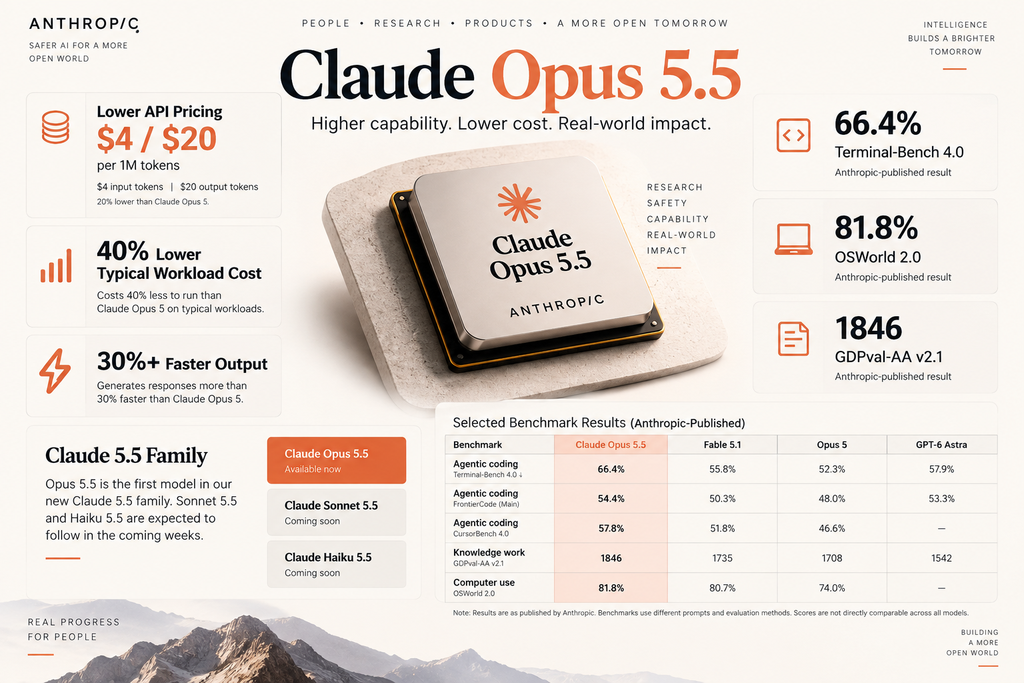
Anthropic says Claude Sonnet 5.5 and Claude Haiku 5.5 are expected to follow in the coming weeks.
Lower Pricing Is One of the Biggest Changes
The new model is cheaper to use through the API.
| Pricing per 1M tokens | Claude Opus 5.5 | Claude Opus 5 |
| Input tokens | $4 | $5 |
| Output tokens | $20 | $25 |
| Cache reads | $0.20 | $0.50 |
| Cache writes | $5 | $6.25 |
Anthropic says Opus 5.5’s input and output token prices are 20% lower than Opus 5, while cache reads are 60% cheaper. On typical workloads at default settings, Anthropic estimates that the model costs about 40% less overall to run than Opus 5.
There is also a Fast mode in Claude Code and the Claude Platform, offering up to 2.5x higher speed at higher token prices.
Coding Is a Major Focus
Anthropic is positioning Opus 5.5 heavily around agentic coding and large software projects.
On Anthropic’s published benchmarks, Opus 5.5 scored 66.4% on Terminal-Bench 4.0, compared with 55.8% for Fable 5.1 and 52.3% for Opus 5. It also scored 54.4% on FrontierCode and 57.8% on CursorBench.
Anthropic says an early tester used Opus 5.5 to complete a 680,000-line code migration in less than a day, while another test involved auditing and fixing a 200,000-line codebase in under three hours.
These examples come from Anthropic’s own testing and customer evaluations, so real-world results can vary depending on the workload, tools and configuration.
Stronger Performance Across Different Tasks
Coding is not the only area Anthropic highlights.
On its published evaluations, Opus 5.5 recorded:
- 1,846 Elo on GDPval-AA v2.1 for knowledge work
- 67.7% on Humanity’s Last Exam with tools
- 81.8% on OSWorld 2.0, partial
- 89.0% on Chartography with tools
- 40.0% on AutomationBench
- 58.7% on Terminal-Bench-Science 0.1
The company says these results place Opus 5.5 near the top of several evaluations involving professional knowledge work, computer use and agentic tasks.
At the same time, the results are not universally highest across every test. For example, Anthropic’s table shows GPT-6 Astra scoring higher on AutomationBench and Terminal-Bench-Science.
Anthropic Is Also Focusing on Safety
Opus 5.5 includes several safety features intended for autonomous systems.
Anthropic says a classifier screens actions before they are executed, while its sandbox can be audited by security teams. The company also reports improved resistance to prompt-injection attacks across coding, tool use, computer use and web browsing.
Anthropic also says Opus 5.5 attempted to circumvent containment boundaries around 85% less often than Opus 5 or Claude Mythos 5.1 in a new evaluation.
However, Anthropic explicitly acknowledges that reliably detecting every potential failure before deployment remains an unsolved problem. That distinction is important as AI systems become capable of performing longer sequences of autonomous actions.
Faster Output and More Natural Responses
Anthropic says Opus 5.5 generates output more than 30% faster than Opus 5.
The company has also worked on the model’s communication style. According to Anthropic, early testers found responses clearer and easier to follow, with the model putting important information earlier instead of producing unnecessarily long explanations.
For people using AI for coding, research, documentation and long-running projects, this could be as important as raw benchmark performance.
Claude Opus 5.5 Availability
Claude Opus 5.5 is available now across Anthropic’s major platforms, including the Claude Platform, Amazon Web Services, Google Cloud and Microsoft Azure. Developers can access it through the model identifier claude-opus-5-5.
Anthropic has also increased five-hour usage limits for Pro, Max and Team subscribers and introduced a rate-limit reset that subscribers can save and use when needed.
What Claude Opus 5.5 Means for AI Users
The biggest change is not simply another higher benchmark score.
Anthropic is combining three things in Opus 5.5: higher capability, lower operating costs and faster output. The company says that combination makes the model particularly suitable for agentic coding and other tasks where an AI system may need to make many tool calls.
For developers and businesses, the lower token prices could be particularly relevant because agentic workloads can consume significantly more tokens than simple chatbot conversations.
The arrival of Opus 5.5 also shows how quickly the frontier AI market is moving toward efficiency. Rather than only increasing model capability, companies are increasingly competing on the cost and speed of completing useful work.

Conclusion
Claude Opus 5.5 marks the beginning of Anthropic’s Claude 5.5 generation with a strong focus on performance, efficiency and safer autonomous work. Its lower pricing and faster output could be especially important for developers running AI agents at scale, while the published benchmarks show strong results across coding and professional tasks.
The next major step will be seeing how Sonnet 5.5 and Haiku 5.5 extend the same improvements across Anthropic’s broader model lineup.
FAQs
What is Claude Opus 5.5?
Claude Opus 5.5 is Anthropic’s first model in its new Claude 5.5 family, launched on September 22, 2026.
How much does Claude Opus 5.5 cost?
The API price is $4 per million input tokens and $20 per million output tokens. Cache reads cost $0.20 per million tokens.
Is Claude Opus 5.5 cheaper than Opus 5?
Yes. Anthropic says typical workloads cost about 40% less to run, while token prices are 20% lower.
Is Claude Opus 5.5 available now?
Yes. Anthropic says it is available through Claude Platform, AWS, Google Cloud and Microsoft Azure.
What is Claude Opus 5.5 best suited for?
Anthropic particularly highlights agentic coding, software engineering, knowledge work, research and computer-use tasks.
Related Articles: