
Bharti Airtel Q2 FY27 Results: Profit Rises 31%, ARPU Hits ₹271
Bharti Airtel Q2 Results: Profit Rises 31% to ₹8,888 Crore as ARPU Reaches ₹271
Bharti Airtel delivered another quarter of revenue growth in the September 2026 quarter, supported by stronger performance in India and Africa, rising average revenue per user (ARPU) and continued expansion of its postpaid and broadband businesses.
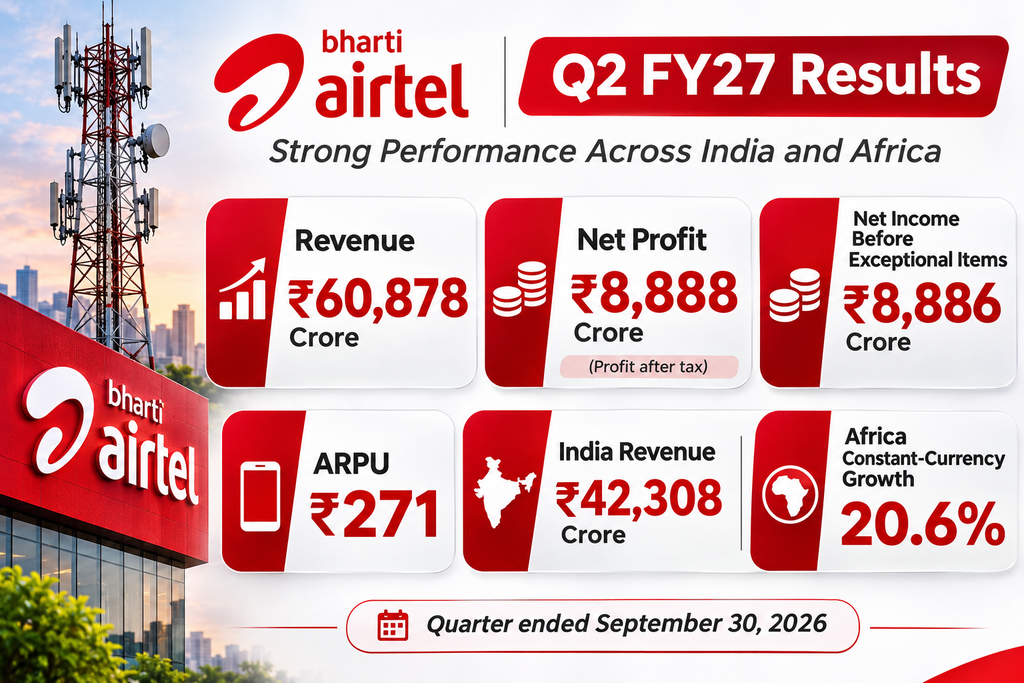
The telecom operator reported consolidated net profit of ₹8,888 crore, up 31% year-on-year, according to Reuters and Moneycontrol. Revenue from operations increased 16.7% to ₹60,878 crore, while mobile ARPU climbed to ₹271 from ₹256 a year earlier.
Africa remained an important growth contributor, while Airtel’s India business benefited from premiumisation and higher-value customer additions. However, higher network operating costs and licence fees weighed on earnings, and the company’s shares ended slightly lower after the results.
An important figures clarification: Some reports quoted profit of ₹10,710 crore and a 24% increase. However, Reuters reported consolidated net profit of ₹8,888 crore, while Airtel’s own results release lists net income before exceptional items at ₹9,015 crore. This article uses the Reuters-reported net profit figure and separately identifies Airtel’s disclosed measure.
Bharti Airtel Q2 FY27 Results at a Glance
Airtel announced its audited results on November 5, 2026, for the quarter ended September 30, 2026.
| Financial metric | Q2 FY27 result | Year-on-year change |
|---|---|---|
| Consolidated revenue | ₹60,878 crore | +16.7% |
| Consolidated net profit (Reuters-reported) | ₹8,888 crore | +30.8% |
| Net income before exceptional items (Airtel-reported) | ₹9,015 crore | +32.7% |
| Consolidated EBITDA | ₹35,240 crore | +17.8% |
| EBITDA margin | 57.9% | Up from 57.4% |
| Mobile ARPU | ₹271 | Up from ₹256 |
The figures show that Airtel expanded revenue and operating earnings while improving its customer monetisation. Its EBITDA margin also increased, indicating that operating earnings grew slightly faster than revenue.
However, the difference between the reported net profit figures and the company’s net income before exceptional items should be kept in mind when comparing results across financial reports.
India Business Supports Airtel’s Revenue Growth
India remained Bharti Airtel’s largest business and delivered revenue of ₹42,308 crore, increasing 9.4% year-on-year and 2.7% quarter-on-quarter.
India mobile revenue grew 10.1% compared with the same period last year. The company attributed the improvement to stronger customer additions and better realisation from its mobile plans.
Airtel’s strategy has increasingly focused on attracting higher-value customers rather than competing only through low-cost prepaid offers. This approach, often called premiumisation, encourages customers to move towards plans with higher data allowances, postpaid services and additional benefits.
The company’s postpaid business recorded its strongest quarterly net additions, adding 1.2 million customers during the September quarter. Its India postpaid customer base reached approximately 31.2 million.
Airtel also added 2.9 million smartphone data customers during the quarter. Over the past year, its smartphone data customer base increased by 18.8 million.
These additions matter because smartphone users generally consume more mobile data and may be more likely to choose higher-value plans.
ARPU Rises to ₹271 as Airtel Focuses on Premium Plans
One of the most important figures in Bharti Airtel’s latest results is its average revenue per user.
The company’s mobile ARPU increased to ₹271 in Q2 FY27, compared with ₹256 in the same quarter last year. That represents an improvement of approximately 5.9%.
ARPU measures the average revenue generated from each user over a given period. For telecom companies, it is an important indicator of how effectively they are monetising their subscriber base.
Airtel’s improvement reflects a combination of higher-value customer additions, plan upgrades and its premiumisation strategy.
The company has also discontinued certain lower-priced prepaid plans, encouraging some customers to select more expensive recharge options.
There have been no broad-based industry tariff increases since July 2024, according to Reuters. Analysts cited by the news agency expect possible industry-wide tariff increases of 12–15% over the coming months, although this remains an expectation rather than a confirmed announcement.
If telecom operators raise prices, Airtel could receive another boost to ARPU. However, higher tariffs may also affect customer affordability and competition between operators.
Africa Emerges as a Major Growth Driver
Airtel’s Africa business delivered another strong quarter, reinforcing the importance of its international operations.
The company reported that Africa’s revenue increased 20.6% year-on-year in constant-currency terms. Reported revenue growth was 25.7%.
Reuters separately reported a 37.6% increase in Africa business revenue, using its reported financial comparison. The difference reflects the distinction between reported revenue and the constant-currency growth measure disclosed by Airtel.
Constant-currency figures help investors understand business growth without the impact of exchange-rate movements.
Airtel Africa had approximately 193.9 million customers at the end of September 2026, up 11.6% from a year earlier. The business operates across 14 countries in sub-Saharan Africa.
Airtel’s management also highlighted the rollout of its in-house technology stack across African markets. The company said this is helping improve go-to-market capabilities and generate operating synergies.
The Africa business is important because it gives Airtel a second major growth engine beyond India. Its performance can also help balance differences in competition and customer economics across markets.
Airtel’s Homes and Enterprise Businesses Continue to Expand
Beyond mobile services, Airtel reported growth across its broadband, enterprise and digital television operations.
Homes business: Revenue increased 25.3% year-on-year. The company added approximately 676,000 net customers during the quarter, taking its total Homes customer base to 15.4 million.
Airtel Business: Enterprise revenue grew 11.4% year-on-year, supported by demand across its core business and digital services portfolio.
Digital TV: Revenue increased 2.4% year-on-year to ₹771 crore, with continued growth in IPTV adoption.
These businesses are important to Airtel’s strategy because they allow the company to generate revenue from multiple services rather than depending entirely on mobile recharges.
For customers, the company is increasingly positioning its offerings around connected services, including mobile, home broadband, entertainment and enterprise connectivity.
The strategy could help Airtel build stronger customer relationships and increase the number of services used by each household or business.
Airtel Continues to Invest in Its Network
Airtel continued expanding its telecom infrastructure during the quarter.
The company deployed:
- 497 new network towers.
- 11,684 mobile broadband base stations.
- Additional fibre infrastructure as part of its wider network expansion programme.
Over the past year, Bharti Airtel added 5,649 towers and expanded its fibre network by 44,718 kilometres.
These investments are intended to improve coverage, capacity and network resilience as mobile data consumption continues to rise.
Airtel reported that average mobile data usage increased 36.5% year-on-year to 36.5GB per customer per month.
The increase highlights the growing demand for video streaming, online gaming, social media, cloud services and other data-heavy applications.
For telecom operators, this creates a constant need to expand network capacity while managing the cost of operating and maintaining infrastructure.
Why Did Airtel Shares Close Lower Despite Strong Results?
Despite the improvement in revenue and profit, Bharti Airtel shares ended slightly lower on November 5.
According to The Times of India, the stock closed 0.2% down at ₹2,062.05 on the BSE, while the broader market gained approximately 2.6%.
One possible reason was that the earnings improvement did not fully satisfy market expectations.
Reuters reported that Bharti Airtel’s consolidated net profit of ₹8,888 crore was below analysts’ average estimate of ₹9,673 crore. Higher network operating costs and licence fees were among the factors weighing on the result.
Network operating costs increased 11%, while licence fees rose 13%. Total expenses increased approximately 15% to ₹25,932 crore.
This illustrates why investors look beyond headline revenue and profit growth. A company can report stronger earnings than a year earlier and still disappoint the market if costs rise faster than expected or results fall short of forecasts.
The share-price movement on one trading day does not, by itself, indicate a longer-term change in the company’s outlook.
Airtel’s Data Centre Ambitions Add Another Growth Opportunity
Bharti Airtel is also looking beyond its traditional telecom business.
During the quarter, the company invested ₹2,826 crore in a strategic land parcel for data-centre expansion in India.
Management said the investment represents another step towards its ambition of building 1 GW of data-centre capacity.
Data centres are becoming increasingly important as businesses adopt cloud computing, artificial intelligence and digital services. They require substantial investment in land, power, cooling, networking and computing equipment.
Airtel’s existing telecom infrastructure and enterprise relationships could provide opportunities as demand for digital infrastructure grows.
However, the 1 GW figure is an ambition, not capacity already operational. The commercial success of this expansion will depend on project execution, customer demand, investment requirements and the availability of power.
Bharti Airtel’s latest results show that India’s telecom market is increasingly focused on revenue quality, not simply subscriber numbers.
The company is growing through higher-value mobile plans, postpaid connections, home broadband and enterprise services. Its Africa business is also contributing meaningfully to overall growth.
However, higher network costs remain a challenge. Telecom operators must continue investing in 5G coverage, fibre and capacity while keeping services competitive.
The possibility of future tariff increases could support industry revenue, but operators will need to balance higher prices against customer retention and competition.
For Airtel, the next challenge is to maintain ARPU growth while controlling operating expenses and delivering returns from its expanding digital infrastructure.
Expert Analysis
Bharti Airtel’s results show that premiumisation and international growth are supporting its revenue expansion.
The rise in ARPU to ₹271 is particularly important because it reflects stronger customer monetisation.
However, higher network expenses and a profit figure below analyst expectations explain why the market response was muted.
Airtel’s ability to balance network investment, customer growth and profitability will remain central to its performance.
Conclusion
Bharti Airtel delivered a strong revenue performance in Q2 FY27, supported by growth across India and Africa. Revenue increased 16.7% to ₹60,878 crore, while mobile ARPU improved to ₹271. Its postpaid, broadband and enterprise businesses also recorded positive momentum.
However, higher network operating costs and licence fees affected profitability, and the reported net profit came in below analysts’ expectations. This helps explain why Airtel shares ended slightly lower despite year-on-year earnings growth.
Looking ahead, ARPU improvement, Africa’s performance, network expansion and data-centre investments will be important factors to watch. Airtel’s latest results demonstrate continued business momentum, but controlling costs will be essential to sustaining that growth.
Frequently Asked Questions
1. What was Bharti Airtel’s Q2 FY27 net profit?
Reuters reported consolidated net profit of ₹8,888 crore for the quarter ended September 30, 2026, up approximately 31% from ₹6,792 crore a year earlier. Airtel separately reported net income before exceptional items of ₹9,015 crore.
2. Why are some reports showing Airtel’s profit as ₹10,710 crore?
Some media reports quoted ₹10,710 crore. However, Reuters reported ₹8,888 crore as consolidated net profit, and Airtel’s results release listed ₹9,015 crore as net income before exceptional items. These figures should not be treated as interchangeable without checking the accounting basis.
3. What was Bharti Airtel’s revenue in Q2 FY27?
Bharti Airtel reported consolidated revenue of ₹60,878 crore, representing 16.7% year-on-year growth.
4. What is Airtel’s latest ARPU?
Airtel’s mobile ARPU increased to ₹271 in Q2 FY27, compared with ₹256 in Q2 FY26.
5. How did Airtel’s Africa business perform?
Airtel reported 20.6% year-on-year revenue growth in constant-currency terms in Africa. Reported revenue growth was 25.7%.
6. Why did Airtel shares fall after the results?
The shares closed 0.2% lower on November 5, despite the earnings improvement. Higher operating costs and profit below analyst expectations may have influenced investor sentiment.
7. How many customers does Airtel have?
Airtel reported a total customer base of approximately 693 million across 15 countries at the end of September 2026.
8. Is Airtel planning to expand its data-centre business?
Yes. Airtel said it invested ₹2,826 crore in a strategic land parcel during the quarter as part of its ambition to build 1 GW of data-centre capacity.
Suggestions:
TRAI Network Anubhav: Check Jio, Airtel & BSNL Network Quality with 3 Speed Metrics
Oracle Stock Nears $100 After Microsoft AI Cloud Deal Exit
AMD Hits $1 Trillion Market Cap for the First Time
China AI Stock Crash: Massive $480 Billion Market Loss
Source:
Bharti Airtel – Official Q2 FY27 Results Release
Reuters – Bharti Airtel Misses Profit Estimates on Higher Network Costs
The Times of India – Bharti Airtel Net Profit Up 24% to ₹10,710 Crore
The New Indian Express – Airtel Q2 Profit Rises
Moneycontrol – Bharti Airtel Q2 Results