
China AI Stock Crash: Massive $480 Billion Market Loss
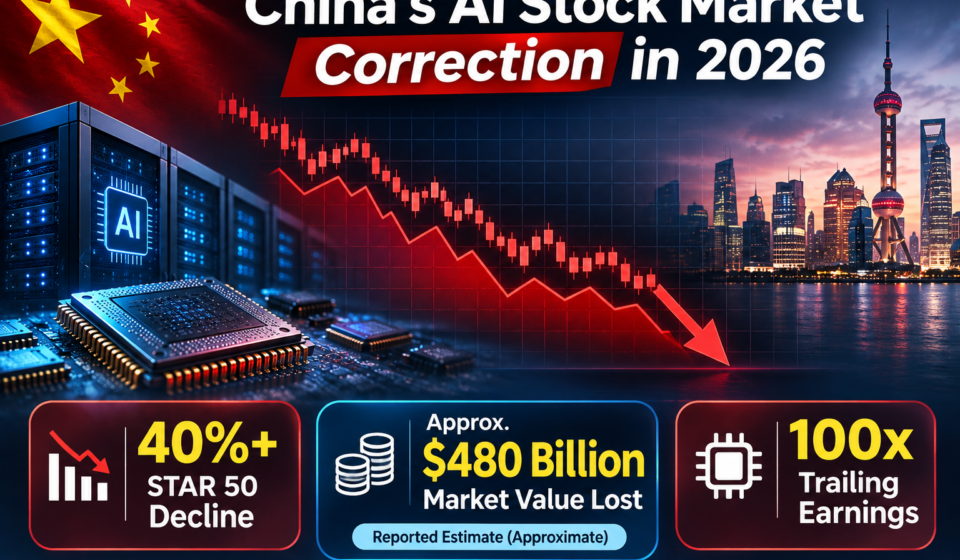
China AI stock crash has wiped out an estimated $480 billion in market value, sending shockwaves through the country’s technology sector. The STAR 50 index, which tracks major technology companies listed in Shanghai, plunged around 40% from its June 2026 peak as AI and semiconductor stocks faced heavy selling pressure. The sharp correction has raised fresh concerns about China’s AI boom, company valuations and investor confidence. Here’s what triggered the sell-off and what it means for China’s technology industry.
China’s AI Stock Crash Wipes Out $480 Billion as STAR 50 Falls More Than 40%
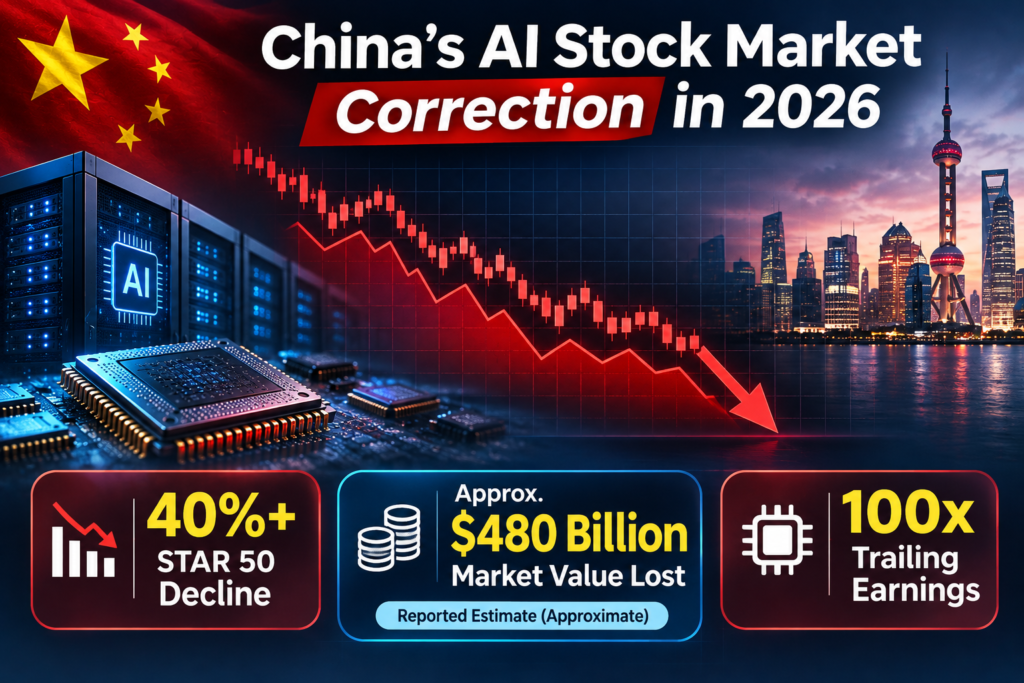
China’s artificial intelligence and semiconductor stocks have suffered a dramatic market correction, with the Shanghai STAR 50 index falling more than 40% from its June 2026 peak in less than four months. The decline has reportedly erased around $480 billion in market value, reversing a powerful rally that had pushed several Chinese technology companies to extraordinary valuations.
The sell-off has affected chipmakers, AI infrastructure suppliers and robotics companies that attracted significant investor attention during the technology boom. It has also raised concerns about retail investor losses, the future of technology listings and Beijing’s efforts to encourage households to invest in the stock market.
The correction is not simply a story about falling share prices. It highlights a wider challenge facing China’s technology sector: turning ambitious AI investment and government-backed technology development into sustainable business growth and profits.
However, it is important to separate confirmed market movements from explanations offered by analysts and traders. The STAR 50’s decline is measurable, but there is no single confirmed trigger for the entire sell-off.
What Happened to China’s STAR 50 Index?
The STAR 50 is a major index tracking 50 large companies listed on Shanghai’s STAR Market, which focuses on science and technology businesses. Its constituents include companies operating in areas such as semiconductors, advanced technology and AI-related industries.
The index reached a record closing level of 2,207.86 on June 30, 2026. By October 26, it had fallen to 1,315.50, representing a decline of approximately 40.4%. It continued falling after that date, closing at 1,252.28 on October 27.
This is a significant correction for an index that had attracted investors during China’s technology rally. However, the decline should not be interpreted as a 40% fall across every Chinese technology company. It specifically measures the STAR 50 index, while individual stocks and broader market indices have experienced different movements.
The broader CSI 300 index, which tracks major companies listed in Shanghai and Shenzhen, had also fallen approximately 20% from its June peak, demonstrating that the pressure extended beyond the technology sector.
Why Are Chinese AI and Semiconductor Stocks Falling?
There is no single officially established reason behind the collapse. Instead, several concerns appear to have contributed to the change in investor sentiment.

1. Extremely High Stock Valuations
One of the biggest concerns was the rapid increase in share prices during the AI investment boom.
Investors had poured money into companies associated with artificial intelligence, semiconductor manufacturing, robotics and data centre infrastructure. Expectations about future demand pushed valuations considerably higher, even when some companies had not yet demonstrated profits capable of supporting those prices.
Before the correction, the STAR 50’s price-to-earnings ratio reportedly approached 250 times trailing earnings. Following the decline, it remained close to 100 times.
For comparison, reports placed the Nasdaq 100’s valuation at around 30 times earnings during the same period. Although differences in index composition and growth expectations make direct comparisons imperfect, the gap illustrates why investors were questioning Chinese technology valuations.
A falling share price does not automatically make a company inexpensive. If earnings fail to grow as quickly as expected, even a substantial correction may leave its valuation elevated.
2. Concerns About Sustainable AI Demand
Artificial intelligence has become one of the biggest investment themes worldwide. Companies developing chips, optical components, data centre equipment and AI infrastructure have benefited from expectations of continued spending.
However, investors are increasingly questioning whether future demand will justify the valuations already assigned to these businesses.
The concern is not necessarily that AI adoption has stopped. Rather, investors are trying to determine which companies will generate sustainable revenue and profits from the technology.
Businesses supplying AI infrastructure may face pressure if customers reduce spending, delay projects or negotiate lower prices. This uncertainty can affect suppliers even when the broader AI industry continues expanding.
It is important to distinguish between concerns about future demand and evidence of an actual decline in current AI demand. The available reporting identifies investor concerns, not proof that China’s AI market has already contracted.
3. US Restrictions and Export Concerns
International trade restrictions have added another layer of uncertainty for Chinese technology companies.
US policymakers have been considering restrictions that could prevent certain Chinese technology suppliers from selling equipment to American data centres. Companies such as Zhongji Innolight and Eoptolink, which supply optical components used in data centre infrastructure, have attracted attention in this discussion.
Such restrictions could affect companies that expect to generate revenue from international customers.
For technology businesses, access to overseas markets can be important for expanding production, increasing sales and achieving economies of scale. Losing access to a major market could change their long-term growth expectations.
The possibility of tighter restrictions has therefore contributed to investor concerns. However, the risk of future restrictions should not be confused with a blanket ban already imposed on every Chinese technology supplier.
4. Tax Payments and Investor Selling
Tax payments have also been mentioned by market participants as a possible contributor to the selling pressure.
When investors need additional cash, they may sell shares to meet financial obligations. If many investors attempt to sell simultaneously, prices can fall rapidly, particularly in stocks that have already experienced substantial gains.
However, tax payments are one explanation cited by traders, not a confirmed explanation for the entire market decline.
The broader issue is that heavily traded speculative stocks can become vulnerable when investor confidence changes. Once buyers become cautious, even relatively small selling pressure can contribute to larger price movements.
Retail Investors Are Facing Heavy Losses
One of the most important consequences of the correction is its impact on individual investors.
Chinese retail investors played a significant role in the AI stock rally. According to figures attributed to Goldman Sachs, AI-related companies represented approximately 42% of China’s stock market capitalisation and 57% of trading turnover across mainland A-shares and Hong Kong H-shares.
These figures indicate how strongly AI-related companies had become embedded in market activity.
Some investors purchased shares because of expectations that artificial intelligence, robotics and semiconductor manufacturing would remain major growth opportunities. But when prices began falling, investors who entered near the highs faced substantial losses.
The impact has been particularly visible in several popular technology companies.
Major Chinese Technology Stocks Hit by the Sell-Off
| Company | Business | Reported market movement |
|---|---|---|
| Unitree | Robotics and humanoid robots | Lost around half its value since its August trading debut |
| CXMT | Memory semiconductor manufacturing | Fell more than 25% over a month |
| MetaX Integrated Circuits | Graphics processors and semiconductors | Lost around half its value from its July peak |
| Moore Threads Technology | Graphics processors and AI computing | Lost around half its value from its July peak |
| Zhongji Innolight | Optical communication components | Fell approximately 60% from its peak |
| Eoptolink | Optical communication components | Fell approximately 60% from its peak |
These figures are reported declines from different reference dates, not identical four-month returns. Individual stock prices can also change after publication.
Unitree is particularly notable because its public offering attracted extraordinary investor interest. Its IPO subscription demand was reportedly around 8,000 times the shares available. Yet the company’s share price subsequently lost approximately half its value from its trading debut.
The episode demonstrates how strong demand during an IPO does not guarantee that a stock will maintain its valuation after listing.
China’s Technology Fundraising and IPO Plans Face Pressure
The market correction could also affect companies planning to raise money through public offerings.
Technology businesses often depend on external funding to expand research, develop new products, increase manufacturing capacity and compete with international companies.
When stock-market valuations are high, companies may find it easier to attract investors and raise capital. But when market sentiment deteriorates, investors can become more selective.
This creates difficulties for companies preparing to list their shares. They may delay IPO plans, reconsider their expected valuations or wait until market conditions improve.
The correction also creates a challenge for China’s broader technology ambitions. The country wants to strengthen its domestic semiconductor industry and expand its AI capabilities. These objectives require substantial investment, but investors also want evidence that businesses can generate sustainable financial returns.
A weaker stock market does not necessarily stop technological development. However, it can make funding more expensive and increase pressure on companies to demonstrate commercial results.
Why Beijing’s Slow Bull Market Strategy Is Facing Challenges
China has been attempting to encourage more stable participation in its stock market through policies intended to support investor confidence and long-term investment.
The idea of a slow bull market is different from a rapid speculative rally. A healthier market would ideally see share prices rise alongside improving company earnings, business performance and economic conditions.
The AI rally complicated this objective. Technology stocks attracted substantial investor attention, but some valuations increased much faster than the underlying businesses could justify.
The subsequent correction has therefore created a challenge for policymakers seeking to encourage households to invest in equities.
If investors experience substantial losses after buying popular technology stocks, they may become more cautious about investing in the market again. Some may prefer defensive assets or companies with more established earnings.
Reports in early November also describe efforts by Chinese authorities and financial institutions to support market liquidity and encourage share buybacks. Such measures may help reduce pressure, but they do not automatically restore confidence in highly valued technology stocks.
Are Chinese AI Stocks Still Worth Investing In?
Despite the sharp correction, some analysts and institutional investors believe that selected Chinese technology companies could offer opportunities over the longer term.
Goldman Sachs has reportedly included dozens of Chinese AI-related stocks in a revised recommendation list, while HSBC research indicates continued institutional interest in Chinese equities.
These positions suggest that some investors still see potential in China’s AI and semiconductor industries, even after the recent losses.
However, a market correction does not mean every stock has become attractive.
Investors need to consider several factors before evaluating individual companies:
- Revenue growth: Is the company generating consistent revenue from its products and services?
- Profitability: Can it convert growing sales into sustainable profits?
- Valuation: Does the current share price reasonably reflect its financial performance?
- International exposure: Could export restrictions affect its customers or supply chain?
- Competition: Can the company maintain margins as competitors reduce prices?
- Long-term demand: Is its business supported by actual customer demand rather than market speculation?
Another concern is the possibility of price wars among Chinese technology manufacturers. If several companies compete aggressively for the same customers, they may reduce prices to protect market share. That could make it harder to generate profits even if demand continues growing.
The distinction between companies with strong fundamentals and businesses driven mainly by market excitement will become increasingly important.
What Happens Next?
The direction of China’s technology stocks will depend on several factors, including corporate earnings, AI infrastructure spending, government policy and international trade developments.
If companies demonstrate stronger revenue growth and profitability, investor confidence could gradually improve. A more stable market may also help technology businesses return to fundraising and IPO activity.
However, if demand expectations weaken or competition intensifies, some companies could face further valuation pressure.
The next important development will be whether Chinese AI and semiconductor businesses can translate their technological progress into sustainable commercial performance.
For investors, the key question is no longer simply which company is connected to AI. It is which company can build a profitable business from it.
Conclusion
China’s technology stock crash has become one of the most significant market corrections of its 2026 AI investment cycle. The STAR 50 index fell more than 40% from its June peak, while an estimated $480 billion in market value disappeared during the sell-off.
Extreme valuations, uncertainty around AI demand, tax pressures and international trade risks have all contributed to concerns among investors, although no single trigger has been established.
The correction has also exposed the risks of speculative investing, particularly for retail investors who entered the market during the rally.
China’s AI and semiconductor industries still have long-term growth potential. But the market is increasingly demanding something more important than ambitious technology announcements: sustainable revenue, profits and business performance.
Frequently Asked Questions
1. Why did China’s AI stocks crash in 2026?
China’s AI and semiconductor stocks fell sharply amid concerns about high valuations, the sustainability of AI demand, tax payments and potential international restrictions on Chinese technology suppliers. No single confirmed trigger explains the entire decline.
2. How much money was wiped out in China’s tech stock crash?
A Reuters report published on October 26, 2026, estimated that approximately $480 billion in market value had been erased. The methodology behind this estimate has not been publicly detailed, so it should be treated as a reported estimate.
3. How much did the STAR 50 index fall?
The STAR 50 fell approximately 40.4% between its record closing level of 2,207.86 on June 30 and its closing level of 1,315.50 on October 26, 2026. It declined further on October 27.
4. Which Chinese technology companies were affected?
Companies mentioned in reports include Unitree, CXMT, MetaX Integrated Circuits, Moore Threads Technology, Zhongji Innolight and Eoptolink.
5. What is the STAR 50 index?
The STAR 50 is an index tracking 50 major companies listed on Shanghai’s STAR Market, which focuses on technology and innovation-driven businesses.
6. Are Chinese AI stocks still overvalued?
Despite the correction, the STAR 50 was reported to be trading at around 100 times trailing earnings, suggesting valuations remained elevated compared with many broader market indices.
7. Could China’s AI stock market recover?
A recovery is possible if company earnings improve, AI demand remains strong and investor confidence returns. However, international restrictions, competition and high valuations could continue to create uncertainty.
8. Does China’s AI stock crash mean the global AI boom is ending?
No. China’s market correction does not establish that the global AI industry is contracting. It highlights the risks of investing in companies whose share prices may have risen faster than their underlying financial performance.
Suggestions
- Meta Connect 2026: Muse AI Is Coming to Smart Glasses
- ColorOS 17 Update: Exciting Complete Phone List & Dates
- OpenAI Engineer Arrested: 5 Key Facts About Hidden Recorder
Source
- Reuters – In China, the AI bubble has already burst
- Seoul Economic Daily – China’s AI rally unravels as Unitree halves and CXMT slides
- Mint – China’s AI stock bubble bursts: $480 billion wiped out
- Business Insider – China moves to stabilise its stock market