Grok 4.7 Review: Pricing, Benchmarks, Features and How It Compares
Grok 4.7 review
xAI has released Grok 4.7, its latest flagship AI model for coding, agentic tasks and knowledge work. The model keeps the same headline API price as Grok 4.6 — $2 per million input tokens and $6 per million output tokens — while xAI says it uses a larger base model, longer reinforcement-learning training and improved self-verification.
But price alone does not tell the whole story.
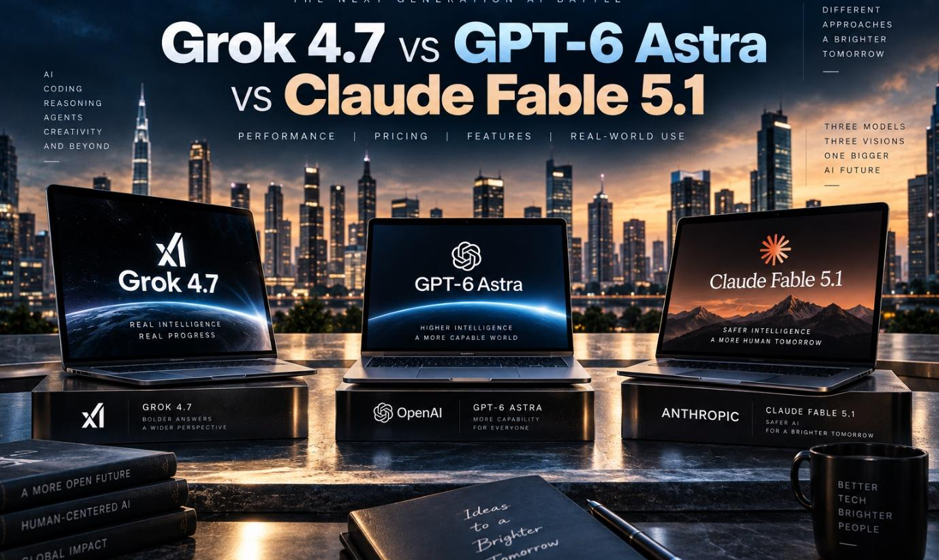
Grok 4.7 is entering a much more competitive market, with models such as GPT-6 Astra and Claude Fable 5.1 competing heavily on coding, reasoning, research and long-running agent tasks. Independent testing shows Grok 4.7 has made meaningful progress, particularly in agentic work and coding, but its results vary considerably depending on the benchmark and reasoning setting.
Here is a closer look at what Grok 4.7 actually offers.
What Is Grok 4.7?
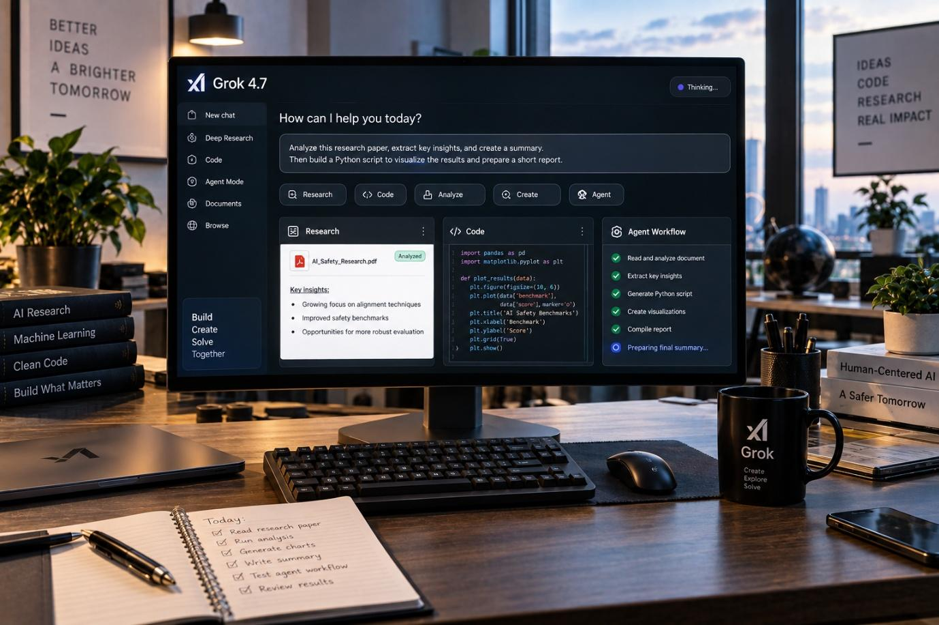
Grok 4.7 is xAI’s newest frontier model, designed primarily for coding, knowledge work, reasoning and agentic tasks.
xAI says the model is built on a larger base model than Grok 4.6 and was trained with a longer reinforcement-learning run focused on difficult tasks that can take hours to complete.
One of the important improvements is self-verification. Grok 4.7 is designed to spend more time checking its work rather than immediately producing an answer. xAI also says the model was trained to understand the Grok Bot harness natively, improving conversational and general knowledge-work tasks.
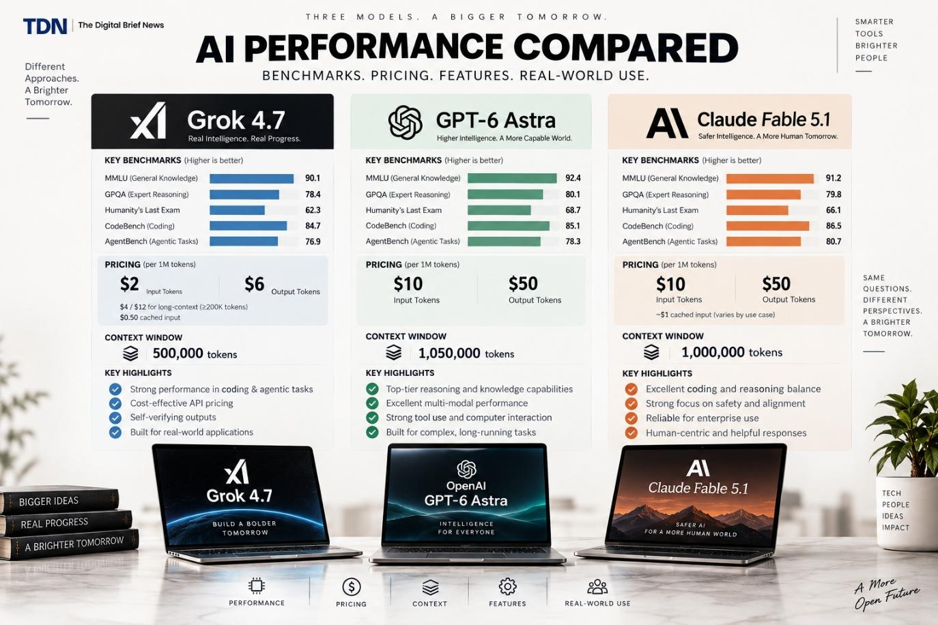
The model has a 500,000-token context window, supports text and image input, and offers configurable reasoning levels from low through xhigh.
Grok 4.7 Pricing
Pricing is one of Grok 4.7’s biggest talking points.
For the standard API:
| Model | Input / 1M tokens | Output / 1M tokens |
| Grok 4.7 | $2 | $6 |
| GPT-6 Astra | $10 | $50 |
| Claude Fable 5.1 | $10 | $50 |
Grok 4.7 therefore starts at one-fifth of the input and output-token price of GPT-6 Astra and Claude Fable 5.1.
There is an important catch: requests reaching the long-context pricing threshold are charged at higher rates. xAI lists $4 per million input tokens and $12 per million output tokens for requests at or above 200K prompt tokens.
Cached input is priced at $0.50 per million tokens under the standard threshold.
Grok 4.7 Benchmark Scores
The benchmark results are more interesting than the headline pricing.
xAI’s launch comparison reports:
| Benchmark | Grok 4.7 | GPT-6 Astra | Claude Fable 5.1 |
| CursorBench 4.0 | 46.3% | 41.7% | 51.8% |
| DeepSWE v1.1 | 71.0%* | 72.7% | 70.0% |
| AA Briefcase | 1,657 | 1,487 | 1,678 |
| Terminal-Bench 4.0 | 38.0% | 37.3% | 57.9% |
| Harvey Legal Agent | 19.6% | 2.5% | 6.7% |
| HealthBench Professional | 56.7% | 60.5% | 62.1% |
| EEBench | 64.0% | 39.4% | 56.4% |
*Grok’s DeepSWE figure uses high reasoning effort in xAI’s table. These are vendor-reported comparisons and should not be treated as a universal ranking because benchmarks, harnesses and settings can differ.
The results show a mixed picture.
Grok 4.7 performs particularly well on EEBench and Harvey Legal Agent, while Claude Fable 5.1 leads several of the coding and professional-work measurements in xAI’s comparison.
Independent Testing Tells Another Story
Artificial Analysis tested Grok 4.7 at xhigh reasoning and gave it an Intelligence Index score of 46.
Its AA-Briefcase score reached 1,657 Elo, a gain of 111 points over Grok 4.6 high. Artificial Analysis also reported a major improvement in coding-agent performance when Grok 4.7 was paired with Grok Build.
However, there is an important cost consideration.
Artificial Analysis found that Grok 4.7 used approximately 81,000 output tokens per Intelligence Index task, compared with about 36,000 for Grok 4.6 and 27,000 for GPT-6 Astra.
That means a lower token price does not automatically translate into a lower cost per completed task.
This is one of the most important points when evaluating Grok 4.7.
Coding Performance
Coding is clearly one of Grok 4.7’s major targets.
Artificial Analysis reported that Grok 4.7 with Grok Build scored 56 on its Coding Agent Index, up from 47 for Grok 4.6.
Its DeepSWE v1.1 result increased from 65% to 73%, while Terminal-Bench 4.0 increased from 18% to 33% in that evaluation.
xAI also reports a 71% DeepSWE result at high reasoning effort and a 38% Terminal-Bench 4.0 score.
For developers, the combination of strong coding performance, a large context window and relatively low token prices makes Grok 4.7 particularly interesting.
Reasoning and Long-Running Tasks
Grok 4.7 is designed less around instant answers and more around completing complicated tasks.
The model can use different reasoning levels, with high as the default and xhigh available for harder work.
Artificial Analysis found that Grok 4.7 improved substantially on long-horizon professional tasks, including document, spreadsheet and presentation-style work.
The trade-off is time and token consumption. More reasoning can mean better results, but it can also mean higher usage and longer completion times.
Safety and Cybersecurity
xAI says Grok 4.7 comes with a new safeguard stack and improved jailbreak resistance.
Its launch testing reported 62.4% on LatchBio’s biosafety benchmark and said only 3.3% of risky dual-use prompts passed its HackerBench v0.3 evaluation.
These are xAI’s own reported safety results, so they should be considered alongside independent testing rather than treated as a final measure of real-world safety.
Grok 4.7 vs GPT-6 Astra vs Claude Fable 5.1
The biggest difference is not simply which model has the highest benchmark number.
Grok 4.7: Strong price-performance, coding, agentic work and a 500K context window.
GPT-6 Astra: Higher API pricing, but OpenAI reports very strong results across computer use, professional work, science and software engineering. Its context window is 1.05 million tokens.
Claude Fable 5.1: Positioned around complex coding, knowledge work and long-running tasks, with $10/$50 token pricing and substantially cheaper cache reads.
So Grok 4.7’s biggest advantage is arguably cost and accessibility relative to frontier competitors, rather than simply winning every benchmark.
Our Grok 4.7 Scorecard
For a practical TDN comparison:
| Category | TDN Score |
| Coding | 9/10 |
| Reasoning | 8.5/10 |
| Agentic Work | 9/10 |
| Context Window | 9/10 |
| Speed | 8.5/10 |
| Pricing | 9.5/10 |
| Knowledge Work | 8.5/10 |
| Safety | 8.5/10 |
| Overall | 8.8/10 |
These are editorial scores, not benchmark measurements. They are based on the published capabilities, pricing and benchmark evidence discussed above.
Who Should Use Grok 4.7?
Grok 4.7 makes the most sense for developers, technical teams, researchers and advanced users who need strong reasoning or coding without paying GPT-6 Astra or Claude Fable 5.1’s headline API rates.
It is especially interesting for agentic coding and long-running workflows.
For casual users, however, the decision depends more on the features available through the Grok product and subscription tiers than on API token pricing alone.
Final Verdict
Grok 4.7 is a significant upgrade over Grok 4.6, but the most interesting part of the launch is its price-performance strategy.
At $2 input and $6 output per million tokens, it is substantially cheaper than GPT-6 Astra and Claude Fable 5.1 at standard API rates. At the same time, independent testing shows meaningful gains in agentic knowledge work and coding.
The biggest caveat is token usage. A model that costs less per token can still become expensive if it needs substantially more tokens to finish a task.
That makes Grok 4.7 less of a simple “cheaper AI” story and more of a cost-versus-capability competition.
FAQs
Is Grok 4.7 free?
xAI offers ways to try Grok through its consumer products and Grok Build, while API usage is billed separately.
How much does Grok 4.7 cost?
The standard API price is $2 per million input tokens and $6 per million output tokens, with higher rates for long-context requests.
Does Grok 4.7 have a large context window?
Yes. The model supports a 500,000-token context window.
Is Grok 4.7 good for coding?
Coding is one of its main target areas, and independent testing reported significant improvements over Grok 4.6 in coding-agent performance.
Is Grok 4.7 better than GPT-6 Astra?
The benchmark evidence is mixed. Grok 4.7 has a major price advantage, while GPT-6 Astra leads on several published professional, computer-use and reasoning measurements.
Related Articles
- Grok AI: What It Can Do, How It Works and How Much It Costs
- Plaud One Explorer Edition: AI Earbuds That Work Without Your Phone
- AI in Smartphones: Everything You Need to Know in 2026
For more info visit