
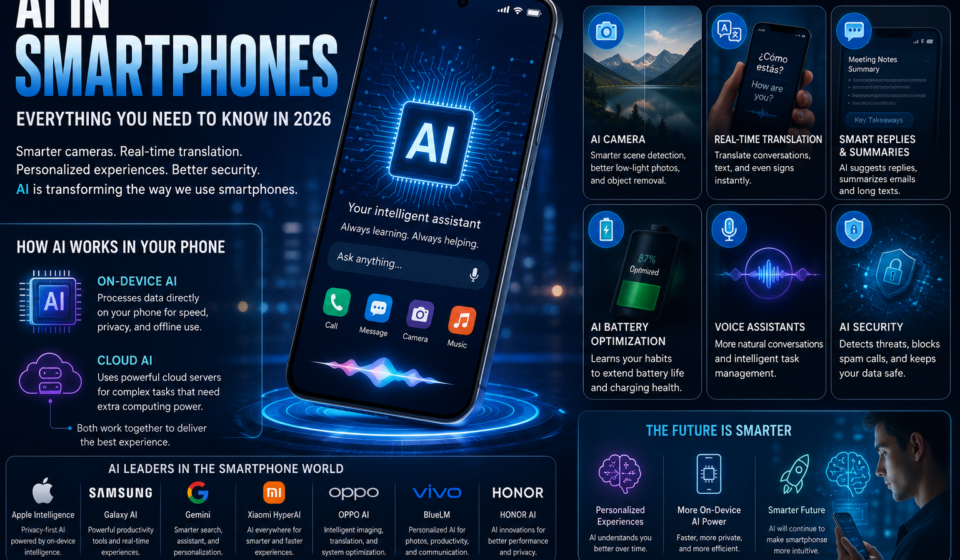
AI in Smartphones: Everything You Need to Know in 2026
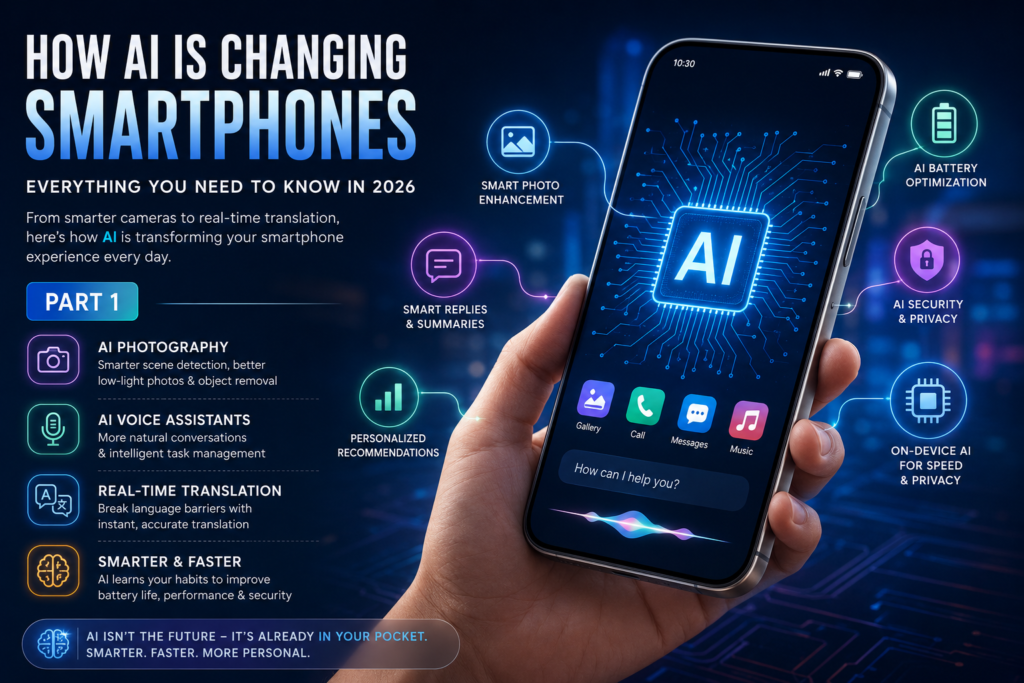
From smarter cameras to real-time translation, here’s how AI is quietly changing the way you use your smartphone every day.
AI in Smartphones
A few years ago, seeing “AI-powered” printed on a smartphone box didn’t mean much. Almost every brand claimed its phone had AI cameras, AI battery optimisation or AI beauty mode, but for most people, those features felt more like marketing than meaningful upgrades.AI in Smartphones
That’s no longer the case.
Today, AI has become one of the biggest reasons people upgrade their smartphones. It isn’t just improving one or two features—it’s changing how the entire phone works. Whether you’re taking photos, translating conversations, writing messages, searching for information or even managing your battery, AI is working quietly in the background to make everyday tasks faster and easier.
The biggest difference is that smartphones are no longer waiting for your commands—they’re beginning to understand your habits. Instead of manually searching for an app every morning, your phone can recommend it before you even think about opening it. Instead of spending time editing photos, AI can remove unwanted objects, improve lighting and sharpen details within seconds. Even writing emails, summarising articles and translating conversations can now happen with just a few taps.
This shift is also changing how smartphone companies compete. For years, brands focused on faster processors, higher-resolution cameras, brighter displays and larger batteries. Those improvements still matter, but they’re no longer enough to stand out. Today, Apple, Samsung, Google, Xiaomi, Oppo, Vivo and Honor are all investing heavily in AI because software has become just as important as hardware.AI in Smartphones
So what exactly is AI in smartphones? How does it work? And more importantly, how does it make your phone smarter without making it more complicated?
Let’s break it down.
What Does AI in Smartphones Actually Mean?
When people hear the words Artificial Intelligence, they often imagine robots, self-driving cars or futuristic machines. In reality, the AI inside your smartphone is much simpler—and much more useful.
Think of AI as a smart assistant that helps your phone understand information, recognise patterns and make decisions based on how you use it. Unlike traditional software that follows the same instructions every time, AI learns from data and improves its performance over time. AI in Smartphones
You’ve probably used AI today without even noticing it.
When your phone unlocks using Face ID or facial recognition, AI identifies your face in a fraction of a second. When your keyboard predicts the next word you’re about to type, AI is analysing your writing habits. When your gallery automatically groups photos of the same person together or suggests creating a memory video, AI is recognising faces, locations and dates.
Even spam call detection, live captions, background noise cancellation during calls and voice assistants rely on AI.
One of the biggest advantages of AI is that it saves you time. Instead of completing repetitive tasks manually, your phone handles many of them automatically. Over time, it learns your preferences and adapts to your daily routine.
For example, if you usually listen to music during your morning commute, your phone may suggest opening Spotify before you search for it. If you regularly open Google Maps after work, your phone can automatically display traffic updates before you leave.
This doesn’t mean your phone is “thinking” like a human. It’s simply recognising patterns based on your behaviour and using that information to make your experience smoother. AI in Smartphones
That’s why AI isn’t just another smartphone feature anymore—it’s becoming the technology that connects everything together.
Machine Learning: How Your Phone Learns From You
Behind many AI features is a technology called Machine Learning (ML).
Instead of programmers writing separate instructions for every possible situation, machine learning allows AI models to learn from large amounts of data. The more examples they process, the better they become at recognising patterns and making accurate predictions. AI in Smartphones
Imagine taking hundreds of photos over several months. Your phone gradually learns what you’re photographing most often—people, pets, landscapes or food. The next time you open the camera, AI automatically adjusts colour, brightness, exposure and focus to produce a better image before you even press the shutter.
The same principle applies to battery management. If your phone notices that you rarely use certain apps, it limits their background activity to save power. If you charge your phone overnight every day, AI can delay the final stage of charging until just before you wake up, helping preserve long-term battery health.
Machine learning also powers features like spam call detection, voice recognition, personalised app recommendations, handwriting recognition and smart typing suggestions.AI in Smartphones
The important thing to remember is this: machine learning isn’t replacing your decisions—it’s helping your phone make better ones based on your habits.
Why AI Has Become the Biggest Smartphone Upgrade
Not long ago, upgrading to a new smartphone usually meant getting a faster processor, a slightly better camera or a brighter display. While those improvements are still important, they’re becoming harder to notice in everyday use.
A flagship smartphone from three or four years ago is still powerful enough for social media, streaming, gaming and photography. That has made it more difficult for manufacturers to convince people to upgrade every year. AI in Smartphones
This is where AI changes everything. AI in Smartphones
Instead of focusing only on better hardware, companies are using AI to improve how people interact with their phones. The goal is no longer just faster performance—it’s creating a smarter and more personalised experience.
Think about how much time you spend performing small tasks every day. Searching for old photos, organising files, replying to messages, editing pictures, translating text or finding information all take time. AI reduces that effort by automating many of these tasks in the background.AI in Smartphones
That’s why AI has become one of the biggest selling points for modern smartphones. It’s not about adding complicated features—it’s about making everyday activities simpler, faster and more convenient.
AI Features You Already Use Every Day
Many people believe AI is something they’ll use in the future, but the reality is that millions of smartphone users already rely on AI every single day without realising it.
The camera is one of the best examples. The moment you press the shutter button, AI starts working instantly. It recognises scenes, adjusts exposure, balances colours, reduces image noise and combines multiple frames to create a clearer photo. That’s why two phones with similar camera hardware can produce completely different results—the difference often comes down to AI image processing rather than the camera sensor itself. AI in Smartphones
AI also improves communication. Voice assistants understand natural language better than ever, live translation helps people communicate across different languages, and smart keyboards predict words and correct mistakes while you type. These features may seem small individually, but together they save time and make smartphones much easier to use.
Productivity is another area where AI is making a noticeable impact. Modern smartphones can summarise long emails, organise notes, rewrite messages, generate meeting summaries and even suggest replies based on the context of a conversation. Instead of spending several minutes completing routine tasks, users can often finish them in seconds. AI in Smartphones
This is only the beginning. As AI becomes more advanced, smartphones will continue to move beyond being simple communication devices and become intelligent assistants that help users manage everyday life more efficiently.
AI Photography: Your Camera Is Smarter Than Ever
For years, smartphone companies competed by adding more megapixels. While camera hardware is still important, the biggest improvements now come from AI rather than the camera sensor itself.AI in Smartphones
The moment you tap the shutter button, AI begins analysing the scene. It identifies whether you’re photographing a person, food, a pet, a sunset or a document, then automatically adjusts exposure, colour, contrast, white balance and sharpness to produce a better-looking image.
AI also combines multiple photos taken in milliseconds into a single image. This process helps improve detail in bright and dark areas while reducing blur and image noise, especially in low-light conditions.
Modern AI features go even further. Many smartphones can remove unwanted objects from the background, erase reflections from glass, improve blurry photos, expand images beyond their original borders and even create slow-motion videos from ordinary recordings. AI in Smartphones
The result is simple: you don’t need to be a photography expert anymore. AI handles much of the technical work, allowing you to focus on capturing the moment.
AI Is Making Everyday Tasks Faster
Photography isn’t the only area benefiting from AI. Smartphones are increasingly helping users complete everyday tasks in less time. AI in Smartphones
Writing an email? AI can rewrite awkward sentences, correct grammar and suggest better wording.
Reading a long article? AI can generate a summary in seconds. AI in Smartphones
Attending a meeting? Your phone can record the conversation, create a transcript and highlight important points automatically.
Travelling to another country? Live translation allows two people speaking different languages to communicate almost instantly.
Even searching your phone has become smarter. Instead of remembering a file name, you can search for something like “the PDF my friend sent last week” or “photos from my Goa trip” and AI understands what you’re looking for.
These features don’t just save time—they reduce the number of small tasks you have to do manually every day.
On-Device AI vs Cloud AI: What’s the Difference?
Not all AI features work in the same way. Some are processed directly on your phone, while others rely on powerful cloud servers.
On-device AI runs entirely on your smartphone. Features such as facial recognition, photo enhancement, offline voice commands and battery optimisation are often processed locally. Because your data doesn’t leave the device, these features are usually faster and offer better privacy. They can also continue working without an internet connection.
Cloud AI, on the other hand, sends your request to remote servers with much greater computing power. This is useful for more demanding tasks like generating long pieces of text, analysing complex questions or creating AI-generated images. AI in Smartphones
Rather than replacing each other, these two approaches work together. Everyday tasks happen on your phone for speed and privacy, while more advanced requests are handled in the cloud when additional processing power is needed.
This combination allows smartphones to deliver powerful AI features without compromising performance.
How Smartphone Brands Are Using AI
Almost every major smartphone company is investing heavily in artificial intelligence, but each brand has its own approach.
Apple focuses on privacy by running many AI features directly on the device whenever possible. Its AI tools help users rewrite text, summarise notifications, improve photos and organise information while keeping personal data more secure.
Samsung continues expanding Galaxy AI with features such as Live Translate, Note Assist, Writing Assist and advanced photo editing. These tools are designed to improve communication and productivity without requiring additional apps.
Google combines its AI expertise with Android to deliver smarter search, photo editing, voice recognition and productivity features. AI is deeply integrated into Pixel smartphones, making everyday interactions feel faster and more natural.AI in Smartphones
Chinese smartphone brands including Xiaomi, Oppo, Vivo and Honor are also rapidly introducing AI-powered writing tools, image editing, translation features and intelligent assistants to compete with Apple, Samsung and Google.
The competition is no longer about who builds the fastest smartphone. It’s about who creates the smartest user experience.
Should You Buy an AI Smartphone?
If you’re planning to upgrade your phone, AI is definitely something worth considering—but it shouldn’t be the only factor.
A good smartphone still needs reliable performance, strong battery life, a quality display and capable cameras. AI works best when it enhances these features rather than replacing them.
If you frequently edit photos, attend online meetings, travel internationally, write emails or rely on productivity tools, AI features can genuinely improve your daily experience. They save time, reduce repetitive tasks and make many everyday activities more convenient.
However, if you mostly use your phone for calls, messaging and social media, upgrading solely for AI may not be necessary. Consider AI as an added advantage rather than the only reason to buy a new device.
The Future of AI in Smartphones
Artificial intelligence is still evolving, and smartphones are only beginning to show what’s possible.
Future devices are expected to become even more personalised. Instead of simply responding to commands, AI may understand your routine well enough to organise your schedule, recommend actions before you ask, manage notifications intelligently and provide proactive assistance throughout the day. AI in Smartphones
Advances in on-device AI will also allow more features to work without an internet connection, improving speed, privacy and reliability.
As processors become more powerful and AI models more efficient, smartphones will continue shifting from communication devices to intelligent personal assistants that help users throughout the day.
The Bottom Line
AI is no longer just another smartphone feature—it’s becoming the foundation of the modern smartphone experience.
Whether you’re taking photos, translating conversations, writing emails, searching for information or managing battery life, AI is quietly improving the way your phone works behind the scenes. Many of these features have become so seamless that users often don’t realise AI is involved at all.
The next generation of smartphones won’t simply be faster or more powerful—they’ll be smarter, more personalised and better at understanding what you need. As companies continue investing in artificial intelligence, the focus is shifting from impressive specifications to meaningful everyday experiences. AI in Smartphones
If you’re buying a smartphone in 2026, don’t just compare the processor, camera or battery capacity. Take a closer look at the AI features too, because they’re increasingly becoming the biggest difference between a good smartphone and a truly smart one.
Please visit for more info IPhone