
Google has introduced Gemini 4 Hydrogen, a new artificial intelligence model designed to handle everyday tasks, coding and multi-step workflows with greater speed and efficiency. Announced on November 12, 2026, the model joins Google’s Gemini 4 family alongside the more advanced Gemini 4 Carbon and Gemini 4 Argon.
Google says Hydrogen can complete tasks up to 2.5 times faster than Gemini 3.8 Flash at its default high thinking level. It also more than triples the older model’s score on Terminal-Bench 4.1, Google’s cited coding benchmark, while reducing fabricated claims by more than five times. These are company-reported evaluation results, not guarantees of the same improvement in every real-world task.
What Is Google Gemini 4 Hydrogen?
Gemini 4 Hydrogen is Google’s speed-focused AI model for everyday work and agentic workflows. Rather than concentrating only on solving extremely complex problems, it is designed to complete practical tasks quickly, including writing code, debugging software, researching information, analysing files and using tools.
Google describes Hydrogen as an execution-focused model. It can work independently or operate alongside Gemini 4 Carbon and Gemini 4 Argon, which are designed for more demanding reasoning tasks.
The names are part of Google’s element-based naming approach for the Gemini 4 family:
- Gemini 4 Hydrogen: Focuses on fast execution, everyday assistance, coding and agentic tasks.
- Gemini 4 Argon: Designed for deeper reasoning and more complex multi-step problems.
- Gemini 4 Carbon: Google’s frontier model for demanding, long-horizon reasoning and advanced workflows.
Google also says Hydrogen scored 51 on the Artificial Analysis Intelligence Index at its default high thinking level, compared with 50 for Argon. At the xhigh setting, Hydrogen reached 54. These figures are benchmark results and should not be interpreted as proof that Hydrogen is better than Argon for every task.
Gemini 4 Hydrogen Is Up to 2.5x Faster Than Gemini 3.8 Flash
Speed is one of the most important improvements Google is highlighting.
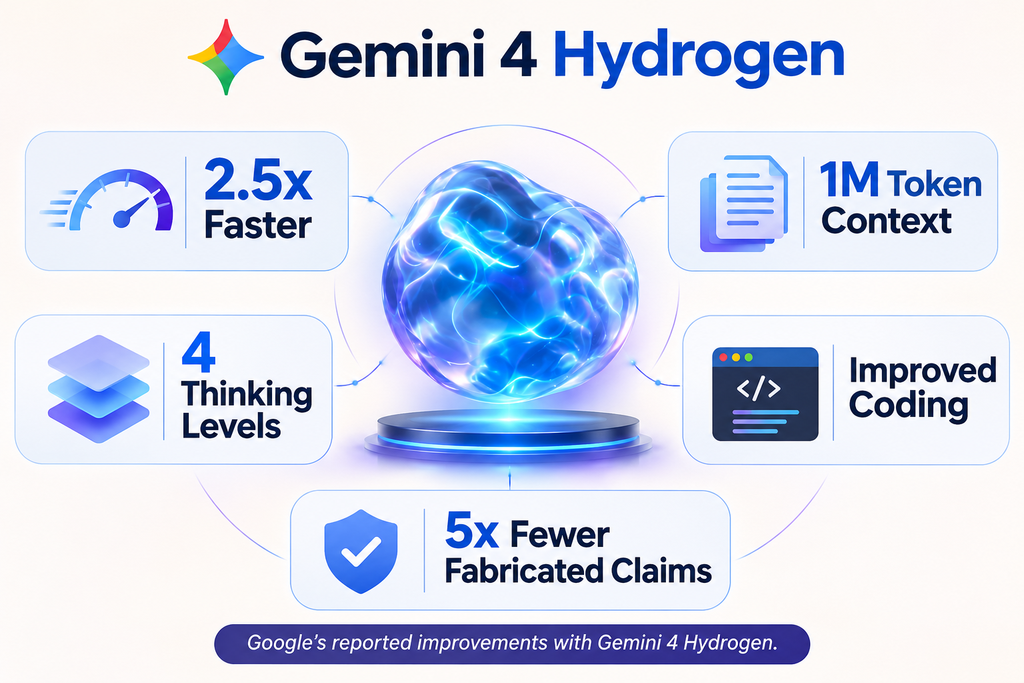
According to the company, Gemini 4 Hydrogen completes tasks 2.5 times faster than Gemini 3.8 Flash at the default high thinking setting. Google says the model also performs better on several coding and agentic workflow evaluations.
One of the key comparisons is Terminal-Bench 4.1, a benchmark designed to evaluate how well AI models complete tasks in a terminal environment.
| Benchmark or improvement | Google’s reported result |
|---|---|
| Task completion speed | Up to 2.5x faster than Gemini 3.8 Flash |
| Terminal-Bench 4.1 | 57% |
| Gemini 3.8 Flash Terminal-Bench 4.1 | 18.2% |
| Reduction in fabricated claims | More than 5x fewer |
| Artificial Analysis Intelligence Index | 51 at high, 54 at xhigh |
These results suggest that Hydrogen is not simply a smaller or faster model with reduced capabilities. Google is presenting it as an upgrade for practical tasks where speed, instruction-following and reliable tool use matter.
However, benchmark scores depend on the evaluation method, task selection and testing conditions. Actual performance can vary depending on the complexity of the request, the tools being used and the amount of information provided.
Four Thinking Levels Give Users More Control
Another important addition is the ability to choose between four thinking levels.
Google says Gemini 4 Hydrogen supports low, medium, high and xhigh reasoning settings. These options allow users and developers to balance response speed, reasoning depth and cost.
Here’s how they are intended to work:
- Low: Suitable for straightforward questions and tasks where quick responses matter.
- Medium: Offers a balance between speed and reasoning for regular work.
- High: The default setting, intended for more involved everyday tasks and coding.
- Xhigh: Provides additional reasoning time for difficult problems and more demanding workflows.
This flexibility is useful because not every request needs extensive reasoning. For example, summarising a short document may require less processing than debugging a large software project.
Developers can use these settings to adjust how much reasoning a model applies to different stages of an application. This could help reduce unnecessary processing for routine operations while preserving additional reasoning capacity for difficult tasks.
Better Coding, Debugging and AI Agent Workflows
Google is placing considerable emphasis on Hydrogen’s coding capabilities.
The model is designed to work with software repositories, identify problems, make code changes, run tests and help developers refine applications. It can also handle questions about large codebases and perform multiple file operations more efficiently.
One useful capability is parallel file reading and searching. Instead of examining files one by one, Hydrogen can batch certain operations to explore large repositories more quickly.
Google says early partner testing showed improvements of around 2x to 2.8x in some complex graph, SQL and data-heavy enterprise workflows, with token usage reduced by 12% to 23% compared with Gemini 3.8 Flash. These figures come from early partner evaluations rather than a universal performance guarantee.
The model is also designed to handle situations where a tool call fails or a search produces no useful results. This is important for AI agents because real-world workflows rarely proceed perfectly from beginning to end.
For example, an AI coding assistant may need to inspect a repository, identify a bug, modify several files, execute tests and correct an error if the first attempt fails. A model that can manage these steps consistently can reduce the amount of manual intervention required.
Hydrogen is also designed for interactive web development, including prototyping interfaces and turning design ideas into functional layouts.
Google Antigravity Introduces Orchestrator for Multi-Model Coding

Google is also introducing a new Orchestrator feature in Google Antigravity.
The feature allows different Gemini models to work together within the same development session. Instead of relying on one model for every stage, Orchestrator can switch between models based on the type of work required.
For example, Gemini 4 Carbon can handle a difficult architectural decision, while Hydrogen can take care of implementation, testing and verification tasks.
Google says this approach achieved near-Carbon task success rates on Terminal-Bench 4.0 while using an average of 24% less quota and completing tasks 19% faster.
For projects involving parallel agents, Carbon can act as the coordinator while Hydrogen handles worker and verifier roles. These agents can build and test changes simultaneously in separate workspaces.
This approach could become important as AI development tools move beyond simple code generation. Instead of asking a chatbot to produce a single block of code, developers increasingly want systems that can plan, execute, test and improve an entire project.
1 Million-Token Context Window for Large Files
Gemini 4 Hydrogen also supports a large context window designed for multimodal knowledge work.
Google lists support for up to 1 million input tokens and up to 1 million output tokens. This gives the model room to process large amounts of information and generate lengthy structured responses.
In practical terms, this can help with tasks such as:
- Analysing lengthy PDF documents and reports.
- Working with large spreadsheets and financial data.
- Understanding charts and other visual information.
- Summarising audio recordings and recorded videos.
- Combining information from multiple files into a structured report.
- Producing detailed research and business documents.
For example, a business user could provide several reports, spreadsheets and presentation files and ask Hydrogen to identify important trends, compare figures and prepare a structured summary.
Google says the model achieved a 53.4% score on its Multimodal Knowledge Agent benchmark and 71.6% on Agents’ Last Exam v1.1, both focused on complex knowledge-work tasks. These results are Google’s reported evaluations.
A large context window does not automatically guarantee that every detail in a long file will be interpreted correctly. Users should still verify important calculations, citations and conclusions, particularly when working with financial, legal or technical information.
Google Search Gets a Major Upgrade With Gemini 4 Hydrogen
One of the biggest parts of this launch is its integration with Google Search.
Google says Gemini 4 Hydrogen is now rolling out globally in Search, bringing improvements to how the service understands complicated questions and presents information.
The update focuses on three main areas.
Better understanding of search intent: Users can ask questions in a natural way, even when they contain multiple requirements, unclear wording or typos. Search is designed to understand the different parts of the request and provide a more relevant response.
More relevant website links: Google’s improved query fan-out technology can conduct simultaneous searches across related subtopics. This is intended to identify a wider range of useful websites rather than relying on a narrow interpretation of the original query.
More visual answers: Search can present information through images, comparison tables, structured responses and custom tools. This could make product comparisons, travel planning and research questions easier to understand.
For example, someone comparing two smartphones could ask about camera quality, battery life, software support and pricing in a single question. Search may organise the information into a more structured response instead of requiring several separate searches.
Google says these improvements are available globally across supported AI Mode languages. The company describes this as its biggest model upgrade to Search so far.
This change is particularly relevant for websites and publishers. More detailed AI-generated answers could make it easier for users to understand a topic directly in Search. At the same time, Google’s promise of a broader range of links is important because websites remain a key source of detailed information and original reporting.
Where Can You Use Gemini 4 Hydrogen?
Google is making Hydrogen available across its consumer, developer and enterprise products. The rollout began on November 12, 2026.
1. Gemini App
Users can access Hydrogen through the Gemini app. Paid Google AI Pro and Ultra subscribers can select the model directly from the model menu.
Free users can also receive access through automatic model selection when Google determines that Hydrogen is appropriate for their request. This means free users may not always be able to manually select it.
2. Google Search
Hydrogen is rolling out globally in Google Search for all users. It powers the improved Search experience, including better understanding of complex questions, broader link discovery and more visual responses.
3. Google AI Studio and Gemini API
Developers can build applications using Hydrogen through Google AI Studio and the Gemini API. The model is also available through the paid tier in Android Studio.
4. Google Antigravity
Paid Google AI Pro and Ultra subscribers can use Hydrogen in Google Antigravity. Its Orchestrator feature can combine Hydrogen with other Gemini models for more complex coding workflows.
5. Google Workspace and Business Products
Google is bringing Hydrogen to Gemini for business and selected enterprise workflows. It is also available in Gemini in Google Sheets for eligible Google AI Pro and Ultra subscribers, with business access depending on the relevant subscription. blog.google+1
| Platform | Availability |
|---|---|
| Gemini app | Paid users can select it; free users receive automatic access when appropriate |
| Google Search | Rolling out globally for all users |
| Google AI Studio | Available across all tiers |
| Gemini API | Available for developers |
| Android Studio | Available through the paid tier |
| Google Antigravity | Available to Google AI Pro and Ultra subscribers |
| Gemini in Google Sheets | Available to eligible paid subscribers and business users |
The availability of individual features may differ by subscription, product, region and rollout schedule.
Gemini 4 Hydrogen API Pricing
Google has announced API pricing of $1.50 per million input tokens and $7.50 per million output tokens.
Input tokens represent the information sent to the model, including prompts and supported content. Output tokens represent the response generated by the model.
| API usage | Price |
|---|---|
| Input | $1.50 per 1 million tokens |
| Output | $7.50 per 1 million tokens |
| Context window | Up to 1 million input tokens |
| Maximum output | Up to 1 million tokens |
Google says the pricing remains flat across the model’s 1-million-token context window. This means the announced rate does not change simply because a request uses a longer context within that limit.
For Indian developers, the actual cost in rupees will depend on the applicable currency exchange rate, taxes and any relevant billing charges. The published API prices are in US dollars.
It is also important to distinguish API pricing from Gemini app subscriptions. Users accessing Hydrogen through the Gemini app do not pay the API token rates separately; their access depends on the Google AI subscription and usage limits.
Is Gemini 4 Hydrogen Better Than Gemini 3.8 Flash?
Based on Google’s published results, Hydrogen represents a substantial upgrade over Gemini 3.8 Flash for the workloads highlighted in the announcement.
The company reports faster task completion, improved coding benchmark results and fewer fabricated claims. It also highlights better performance when the model needs to use tools or recover from unsuccessful operations.
However, the difference depends on the task.
| Area | Gemini 4 Hydrogen |
|---|---|
| Everyday assistance | Designed for faster execution |
| Coding | Improved repository editing and debugging |
| Agentic workflows | Better multi-step execution and tool handling |
| Reasoning control | Four thinking levels |
| Large files | Up to 1 million input tokens |
| Search | Improved intent understanding and query fan-out |
| API cost | $1.50 input and $7.50 output per million tokens |
The most meaningful upgrade may be the combination of speed and practical execution. A model that can follow instructions, use tools, inspect files and recover from errors can be more useful in daily work than one that only produces a convincing answer.
Still, independent testing across a broader range of real-world tasks will be important before drawing conclusions about how Hydrogen compares with competing AI models.
What Gemini 4 Hydrogen Means for the AI Industry
The launch reflects a broader shift in AI development. Companies are no longer competing only to build the most powerful model. They are also trying to make AI systems faster, more affordable and capable of completing practical tasks with less human supervision.
Gemini 4 Hydrogen is Google’s attempt to address this requirement. Its role is to handle everyday execution while more powerful models take responsibility for difficult reasoning and planning.
This could be particularly useful for businesses that run multiple AI agents. Instead of sending every request to an expensive, high-capability model, they can use a faster model for routine work and reserve deeper reasoning for situations that genuinely need it.
Google’s Orchestrator demonstrates this approach. If the company’s reported improvements translate into real-world performance, multi-model workflows could help developers reduce processing time and usage costs.
However, benchmark results alone cannot establish whether Hydrogen is the best option for every business. Reliability, API availability, integration costs, privacy requirements and performance on specific workloads will all influence adoption.
Conclusion
Google’s Gemini 4 Hydrogen brings a speed-focused model to the Gemini 4 family, targeting everyday assistance, software development and multi-step AI workflows. The company claims it can complete tasks up to 2.5 times faster than Gemini 3.8 Flash at its default high thinking setting, while delivering significant improvements in coding benchmarks and reducing fabricated claims.
Its availability across Google Search, the Gemini app, AI Studio, the Gemini API and selected business products makes this a wider platform update rather than just another model announcement.
For everyday users, the improved Search experience and Gemini assistance are the most immediately relevant changes. Developers, meanwhile, get a model designed for faster coding and automated workflows, with API pricing starting at $1.50 per million input tokens.
The bigger question is how well Hydrogen performs outside Google’s own evaluations. If its speed and reliability claims hold up in independent testing, it could become an important model for everyday AI applications.
Frequently Asked Questions
1. When did Google launch Gemini 4 Hydrogen?
Google officially announced Gemini 4 Hydrogen on November 12, 2026. The announcement was published by Koray Kavukcuoglu, SVP of Google DeepMind and Google’s Chief AI Architect.
2. What is Gemini 4 Hydrogen?
Gemini 4 Hydrogen is Google’s speed-focused AI model designed for everyday assistance, coding, research, multimodal tasks and agentic workflows.
3. Is Gemini 4 Hydrogen faster than Gemini 3.8 Flash?
Google claims Hydrogen completes tasks up to 2.5 times faster than Gemini 3.8 Flash at its default high thinking setting. Actual speed improvements depend on the task and testing conditions.
4. What are the four Gemini 4 Hydrogen thinking levels?
The four settings are Low, Medium, High and Xhigh. They allow users and developers to balance response speed and reasoning depth.
5. What is the context window of Gemini 4 Hydrogen?
Gemini 4 Hydrogen supports up to 1 million input tokens and up to 1 million output tokens, according to Google’s announcement.
6. Is Gemini 4 Hydrogen available for free?
Free users can access Hydrogen through automatic model selection in the Gemini app when Google determines it is suitable. It is also rolling out in Google Search for all users. Manual model selection and other features depend on the subscription.
7. How much does Gemini 4 Hydrogen API cost?
Google lists the API price at $1.50 per million input tokens and $7.50 per million output tokens.
8. What is Google Antigravity’s Orchestrator?
Orchestrator is a multi-model workflow feature in Google Antigravity. It can switch between models such as Gemini 4 Carbon and Hydrogen to coordinate complex coding and development tasks.
9. Is Gemini 4 Hydrogen better than Gemini 4 Argon?
Hydrogen scored 51 on the Artificial Analysis Intelligence Index at its default high thinking level, compared with Argon’s 50, according to Google. Hydrogen reached 54 at xhigh. These benchmark results do not mean Hydrogen is better for every type of task.
Suggestions
- OpenAI Engineer Arrested: 5 Key Facts About Hidden Recorder
- China AI Stock Crash: Massive $480 Billion Market Loss
- Sam Altman Changes X Name to ‘Ram Altman’ After RAM Backlash
- Meta’s Muse AI Models Arrive on Google Cloud; Pichai Welcomes Zuckerberg
Source
- Google Official Announcement – Introducing Gemini 4 Hydrogen
- Google Search – Gemini 4 Hydrogen Upgrade
- Google Developers – Gemini 4 Hydrogen Coding Workflows
- Google DeepMind – Gemini Model Cards