
Meta’s Muse AI Models Arrive on Google Cloud; Pichai Welcomes Zuckerberg
Sundar Pichai Welcomes Mark Zuckerberg as Meta’s Muse AI Models Arrive on Google Cloud
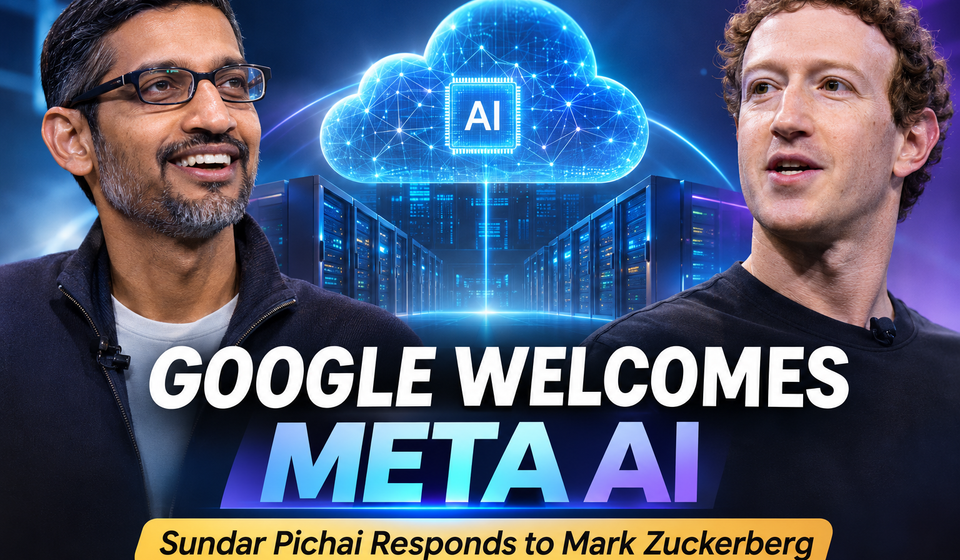
Google CEO Sundar Pichai has publicly welcomed Meta CEO Mark Zuckerberg after Meta’s latest Muse AI models became available through Google Cloud. The announcement highlights growing cooperation between two major technology companies, with Google’s cloud infrastructure now hosting Meta’s AI models for enterprise customers.
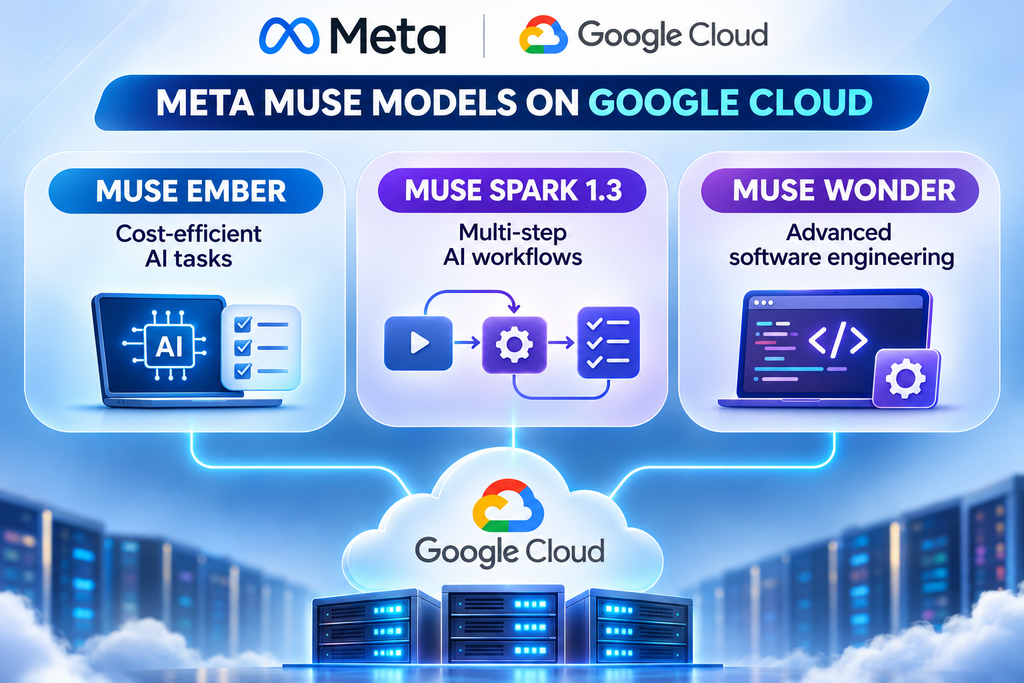
Zuckerberg announced that Muse Ember, Muse Spark 1.3 and Muse Wonder are now available on Google Cloud’s Model Garden through managed APIs. Pichai responded on X, congratulating Meta and welcoming its models to the platform.
The development is notable because Google and Meta compete in the AI industry, but their cloud businesses can also work together to make AI models available to enterprise developers.
What Did Sundar Pichai Say to Mark Zuckerberg?
Mark Zuckerberg shared the availability announcement on X, writing:
“Muse Ember, Muse Spark 1.3, and Muse Wonder are now available on Google Cloud.”
Sundar Pichai responded:
“Congrats and welcome to the model garden, excited to serve our Google Cloud customers!”
Pichai’s message welcomed Meta’s models to Google’s cloud platform. It also highlighted the business relationship behind the announcement: Google Cloud can provide infrastructure and managed access to AI models developed by another company.
The exchange does not indicate a merger, joint AI-model development agreement or change in ownership. Meta continues to develop its own Muse models, while Google provides a platform through which customers can access them.
Meta’s Three Muse AI Models Arrive on Google Cloud
The announcement includes three models from Meta’s Muse family. Each is designed for a different type of workload, allowing developers and businesses to select a model based on the complexity, speed and cost requirements of their applications.
The models are available through Google Cloud’s Model Garden managed APIs. This gives enterprise customers a way to access Meta’s models through Google’s cloud environment rather than building and maintaining their own model-serving infrastructure.
1. Muse Ember: Designed for Cost-Efficient AI Tasks
Muse Ember is positioned as the smaller and more cost-efficient model in the group. It is designed for repetitive, high-volume tasks where businesses need to process many requests without using a larger model for every operation.
Its reported use cases include:
- Everyday coding tasks
- Document understanding and information extraction
- Automated tool execution
- Request routing
- Repetitive AI-agent workloads
- Processing text, images, audio and video
Muse Ember is particularly relevant to companies building AI agents that perform routine tasks at scale. For example, an enterprise application could use a smaller model for document classification, information extraction or basic coding assistance, while reserving a more capable model for difficult decisions.
The Times of India reported that Meta positions Muse Ember as its smallest and least expensive model, with performance comparable to models such as Claude Haiku at roughly one-third of the per-task cost. This is a reported comparison, not an independent benchmark result.
2. Muse Spark 1.3: Built for Multi-Step Workflows
Muse Spark 1.3 is designed for more involved tasks that require reasoning, tool use and multiple steps.
The model supports native tool calling and Model Context Protocol (MCP) server integration, according to the launch coverage. These capabilities allow developers to connect AI applications with external tools and services.
Potential applications include:
- Multi-step workflow automation
- AI-powered assistants
- Software development support
- API and MCP-based task orchestration
- Enterprise process automation
- Tasks that require repeated interaction with connected tools
For businesses, the ability to connect a model to tools is important because many workplace tasks involve more than generating a text response. An AI agent may need to retrieve information, interact with an application, process the result and then complete another action.
Muse Spark 1.3 is intended to support these longer workflows, with a balance between capability, speed and scalable execution.
3. Muse Wonder: Meta’s Model for Complex Engineering Work
Muse Wonder is described as the most capable model in this group. Meta positions it for demanding software engineering and professional workflows that require deeper reasoning and extended execution.
Its reported capabilities include native computer use, long-context understanding and multi-step task execution across browsers, desktop environments and mobile applications.
The model is designed to support work such as:
- Complex software engineering
- Multi-file codebase updates
- End-to-end workflow automation
- Analysis of large software repositories
- Sub-agent delegation and task orchestration
- Professional knowledge-work tasks
One of the notable features is its ability to work across applications rather than remaining limited to a single chat interface. Native computer-use capabilities could allow an agent to interact with software interfaces as part of a larger task.
Muse Wonder is therefore aimed at workloads where a developer or organisation needs an AI system to manage several connected steps, rather than simply answer a question or generate a short code snippet.
What Is Google Cloud Model Garden?
Google Cloud Model Garden is a platform that helps developers and businesses discover, access and deploy AI models.
It includes models from Google and other providers, giving enterprise customers more flexibility when selecting AI technology for their applications.
The addition of Meta’s Muse models means Google Cloud customers can access Meta-developed models through managed APIs. This can simplify the process of integrating those models into applications and business workflows.
Instead of choosing a single AI provider for every task, businesses can select different models based on their requirements. A company might use one model for low-cost document processing, another for complex reasoning and a third for specialised coding tasks.
This approach is becoming increasingly important as businesses experiment with AI agents and multi-model systems. Different models can be assigned different responsibilities according to their strengths, operating costs and performance requirements.
The availability of Meta’s models on Google Cloud also gives enterprise customers another option within Google’s existing cloud ecosystem.
Why Is This Partnership Important for Google and Meta?
Google and Meta are major competitors in the artificial intelligence industry. Google develops its Gemini models and operates one of the world’s major cloud platforms. Meta develops its own AI models and offers AI technology across its products and services.
However, competition in AI does not prevent companies from working together in other parts of the technology ecosystem.
Meta benefits by making its models accessible to businesses that already use Google Cloud. This can expand the potential reach of its AI technology and give enterprise developers another way to integrate Muse models into their applications.
Google Cloud benefits by adding more third-party AI models to its platform. Customers can access additional choices without being limited to Google’s own models.
The arrangement also reflects a wider change in enterprise AI adoption. Businesses increasingly want the freedom to select models from different providers rather than depending entirely on one company’s technology.
For Google, offering a wider model selection can make its cloud platform more attractive to organisations building AI-powered products. For Meta, distribution through a major cloud provider can help bring its models to a larger enterprise audience.
The announcement is therefore significant beyond the friendly exchange between the two CEOs. It demonstrates how companies that compete in AI development can still cooperate in infrastructure and distribution.
What Does This Mean for Enterprise AI Developers?
The arrival of Muse Ember, Muse Spark 1.3 and Muse Wonder on Google Cloud could give developers more flexibility when building AI applications.
One important consideration is model selection. Not every task requires the most advanced model available. A business processing thousands of routine documents may prioritise cost and speed, while a software company working on a complex engineering project may need a model with stronger reasoning and longer task execution.
The three Muse models are positioned around these different requirements:
| Model | Main focus | Example use cases |
|---|---|---|
| Muse Ember | Cost-efficient execution | Document processing, routine coding, task routing |
| Muse Spark 1.3 | Multi-step workflows | AI agents, tool use, workflow automation |
| Muse Wonder | Complex reasoning and engineering | Advanced coding, multi-file updates, computer use |
The reported multimodal capabilities and context windows of up to one million tokens could also be relevant for applications that process large amounts of information. However, developers should check the actual model documentation, supported inputs, API limits and pricing before selecting a model for production use.
Another important factor is operational cost. Businesses need to consider more than the headline model price. They should evaluate token usage, response speed, API availability, reliability, security requirements and the cost of connecting models to external tools.
The availability of more models can create more choice, but it also makes testing and evaluation more important. Developers will need to compare models against their own workloads before deciding which one is suitable.
The announcement reflects a broader movement towards multi-model AI platforms.
In the early stages of generative AI adoption, many businesses experimented with one chatbot or one model provider. As AI applications become more specialised, companies are increasingly looking for ways to combine models with different strengths.
Cloud platforms are positioned to benefit from this shift because they can provide the infrastructure, APIs, security controls and deployment tools required to run models from multiple providers.
The Google Cloud announcement also illustrates that the relationship between AI companies is not always defined by direct competition. A model developer can compete with another company in consumer AI products while distributing its technology through that company’s cloud platform.
For enterprise customers, this could mean more options and greater flexibility. For AI developers, it could increase competition around model performance, cost, availability and integration.
However, the announcement alone does not establish how widely customers will adopt Meta’s Muse models or how they will perform against competing systems in independent testing.
Expert Analysis
Sundar Pichai’s welcome message highlights a growing relationship between AI model developers and cloud infrastructure providers.
Meta gains another enterprise distribution channel, while Google Cloud expands its selection of third-party AI models.
The three Muse models target different workloads, from cost-efficient execution to advanced software engineering.
The real test will be their performance, pricing and reliability in independent enterprise deployments.

Conclusion
Sundar Pichai’s welcome note to Mark Zuckerberg marks an interesting development in the AI industry. Meta’s Muse Ember, Muse Spark 1.3 and Muse Wonder are now available through Google Cloud’s Model Garden managed APIs, giving enterprise customers another set of AI models to explore.
The three models target different requirements, including repetitive tasks, multi-step automation and complex software engineering. For Meta, Google Cloud offers another route to enterprise customers. For Google, the addition strengthens its multi-model AI platform.
Although Google and Meta remain competitors in AI development, this announcement shows how they can cooperate in cloud infrastructure and model distribution. It also reflects a wider industry shift towards giving businesses access to multiple AI models instead of relying on a single provider.
Frequently Asked Questions
1. Why did Sundar Pichai welcome Mark Zuckerberg?
Pichai welcomed Meta’s Muse AI models after Zuckerberg announced their availability on Google Cloud. He congratulated Meta and said Google was excited to serve its cloud customers with the models.
2. Which Meta AI models are available on Google Cloud?
The three models are Muse Ember, Muse Spark 1.3 and Muse Wonder. They are available through Google Cloud’s Model Garden managed APIs.
3. What is Meta Muse Ember?
Muse Ember is designed for cost-efficient, repetitive and high-volume AI tasks, including document processing, information extraction and routine coding.
4. What is Muse Spark 1.3 used for?
Muse Spark 1.3 is designed for multi-step workflows, AI agents, tool calling and workflow automation.
5. What is Muse Wonder?
Muse Wonder is Meta’s more advanced model in this group. It is designed for complex software engineering, multi-file code updates, computer use and long-running workflows.
6. Are Google and Meta partnering on AI development?
The announcement confirms that Meta’s models are available through Google Cloud. It does not establish a joint model-development partnership or a merger between the companies.
7. What is Google Cloud Model Garden?
Model Garden is Google Cloud’s platform for discovering and accessing AI models from Google and other providers. It gives developers options for integrating models into their applications.
Suggestions:
Elon Musk Praises Larry Page’s Prediction that 99.999% of Computing in Space
Anthropic Claude Fable 5.2 and Mythos 5.2: What’s New
GPT-6 Sol and Luna Launch With 50% Lower API Prices
Source:
Times of India – Pichai’s welcome message
Economic Times – Meta Muse models on Google Cloud
X post reference