

Microsoft 365 Outage Disrupts Outlook, Teams & Copilot Worldwide
Microsoft 365 Outage Disrupts Outlook, Teams and Copilot Worldwide as Recovery Efforts Continue
Microsoft is working to restore several Microsoft 365 services after a major global outage disrupted Outlook, Teams, Copilot and other business applications. The Microsoft 365 Outage disruption began on Thursday, November 12, and continued into Friday, November 13, affecting users across multiple countries, including the United States, the United Kingdom, Japan, Singapore and Australia.
The outage left many users unable to access their Outlook inboxes, send or receive emails, and use certain Microsoft 365 features. Businesses, educational institutions and government organisations also reported disruptions to services that depend on Microsoft’s cloud infrastructure.
Microsoft has identified server availability and infrastructure problems as major factors behind the incident. The company has been restarting affected servers, adjusting traffic routes and testing configuration changes to bring services back online. However, recovery has been gradual because some servers became unresponsive again after receiving traffic.
Microsoft 365 Outage Affects Outlook, Teams and Other Services
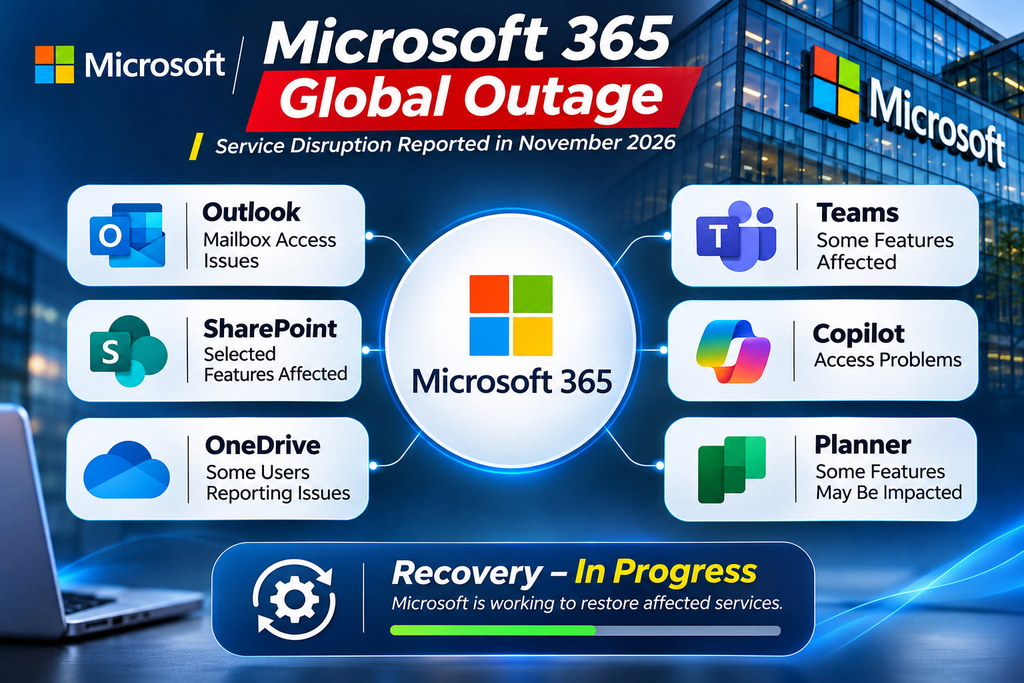
The disruption affected Microsoft’s cloud-based productivity ecosystem rather than a single application. Outlook was among the most visibly affected services, with users reporting problems accessing mailboxes, loading inboxes and sending or receiving messages.
Other services also experienced problems, including:
- Outlook and Exchange Online: Mailbox access failures and delayed email delivery.
- Microsoft Teams: Problems with some features that depend on Exchange Online, including calendar functions and meeting scheduling.
- Microsoft 365 Copilot: Users experienced difficulties loading Copilot Chat and accessing work-related information.
- SharePoint Online: Certain features that rely on Exchange Online were affected, although direct access to stored SharePoint files remained functional.
- Microsoft Planner and To Do: Some users experienced reliability problems and operation failures.
- Microsoft Defender: Certain portal features and security-related functions were affected.
Importantly, not every feature within these applications stopped working. Microsoft said core Teams messaging and online meetings remained largely functional, while features connected to Exchange Online were more significantly affected.
The impact also extended to Microsoft Graph and other services that depend on Exchange Online data, including email, calendar and contacts.
Nearly 130,000 Outlook Problems Reported on Downdetector
The scale of the Microsoft 365 Outage became clear through reports submitted to Downdetector, an online platform that tracks service disruptions based on user reports.
The Associated Press reported that Outlook-related complaints in the United States reached nearly 130,000 shortly after 1 p.m. Eastern Time on Thursday. Other reporting placed the global peak at approximately 130,000 to 140,000 reports, depending on the measurement and time of the snapshot.
Users reported being unable to open their inboxes, experiencing connection errors and facing delays in email delivery. Thousands of additional reports involved Teams, Copilot and other Microsoft services.
The disruption was not limited to North America. Reports came from 74 countries and territories, while users across parts of Asia also experienced problems on Friday morning.
These figures represent user-submitted outage reports, not a confirmed count of affected Microsoft customers. Nevertheless, they illustrate the scale of the disruption and how heavily organisations rely on Microsoft’s cloud services.
What Caused the Microsoft 365 Outage?
Microsoft’s investigation has pointed to problems involving affected infrastructure and servers becoming unavailable.
According to updates reproduced from Microsoft’s service-health notices, a large number of servers unexpectedly failed automated health checks. This reduced the available capacity across the affected infrastructure and shifted additional workloads onto the remaining operational servers.
Microsoft also found that a core process responsible for establishing secure connections on affected servers could become overwhelmed, causing those servers to stop processing requests.
The company began investigating whether a recent network configuration change was contributing to the disruption. It also explored reverting configuration changes and applying a revised configuration to affected infrastructure.
The problem became more complicated when some servers that had been restarted initially appeared healthy but became unresponsive again after traffic returned.
This created a difficult recovery process: Microsoft needed to restore server capacity without overwhelming systems that had only just returned to service.
Microsoft’s Recovery Efforts: Why Is It Taking So Long?
Microsoft has been following several recovery approaches to bring the affected services back online.
The company’s reported actions include:
- Restarting affected servers: Microsoft has been restarting infrastructure that failed automated health checks.
- Testing alternative health checks: It validated an alternative method on a subset of servers to help return them to service.
- Redirecting network traffic: The company has shifted connections towards alternative infrastructure where possible.
- Applying traffic restrictions: Microsoft temporarily limited certain types of traffic reaching affected infrastructure in specific locations.
- Testing configuration changes: It prepared and validated changes intended to prevent the affected server processes from becoming overwhelmed.
- Reviewing network configuration: The company began reverting a recent network configuration change that correlated with the start of the disruption.
However, the first recovery attempts did not deliver the expected results. Microsoft reported that some restored servers became unresponsive again when traffic returned.
In its November 13 updates, the company said it was seeing positive results from restarting affected infrastructure and was monitoring the stability of restored servers. It was also working to improve available capacity and gradually reintroduce traffic in affected locations.
This explains why some users may regain access while others continue experiencing problems. Recovery can vary depending on the affected service, region and connection method.
Was the Microsoft 365 Outage Caused by a Cyberattack?
The Microsoft 365 Outage disruption naturally raised questions about whether Microsoft had suffered a cyberattack. However, available reports do not indicate that the incident was caused by malicious activity.
Microsoft’s service-health updates said there was no indication that the outage resulted from malicious activity. The company has instead focused its investigation on infrastructure availability, server failures, connection handling and network configuration.
The distinction is important because a major service outage does not automatically mean that customer accounts or company data have been compromised.
At the time of reporting, Microsoft had not announced that the incident(Microsoft 365 Outage) involved a data breach or unauthorised access to customer information. The investigation was continuing, and a detailed final root-cause report had not yet been published.
Businesses and Government Organisations Also Affected
The Microsoft 365 Outage demonstrated how much businesses and public organisations depend on Microsoft 365 for daily operations.
Companies using Exchange Online for corporate email faced communication disruptions. Organisations relying on Teams for scheduling and collaboration also encountered problems with certain connected features.
In Japan, the Associated Press reported that government IT infrastructure had been affected, with officials monitoring the situation. Australian reporting also described disruptions affecting government departments, schools and public-sector organisations.
The impact was not limited to employees checking their email. When cloud-based services become unavailable, connected workflows can also be interrupted. These may include calendar scheduling, document collaboration, task management, administrative operations and automated business processes.
The incident is a reminder that even widely deployed cloud platforms can experience outages affecting multiple services at once.
Are Outlook and Teams Working Again?
Recovery is gradual, and the status can differ between Microsoft services and individual regions.
Microsoft’s updates indicated that Teams messaging and online meetings were largely functional, although features dependent on Exchange Online could still experience problems. Outlook mailbox access remained one of the most significant areas of disruption.
Microsoft’s service-health information also showed continued degradation affecting Microsoft 365 business services during the recovery period. Its public consumer status information and business-service status should not be treated as interchangeable.
Users experiencing problems should check Microsoft’s official service health status page or, for business and enterprise accounts, the Microsoft 365 admin centre when accessible.
Microsoft has not provided a guaranteed time for complete restoration in the updates available at the time of writing.
Users who continue experiencing problems can take a few practical steps while Microsoft works on recovery.
- Check Microsoft’s service-health page before repeatedly troubleshooting individual devices.
- Avoid repeatedly changing account passwords when there is no evidence of an account-specific security issue.
- Keep important work communications moving through an approved alternative channel where possible.
- Save copies of critical documents locally when permitted by organisational policy.
- Avoid repeatedly retrying failed operations, especially when they could create duplicate messages or tasks.
- Contact the organisation’s IT administrator if business email or other essential services remain unavailable.
Businesses that rely heavily on Microsoft 365 should also review their continuity plans. Alternative communication channels, backup procedures and clear internal escalation processes can help reduce disruption during future cloud-service incidents.
Expert Analysis
The outage highlights the risks of relying on a connected cloud ecosystem for essential business operations.
Although Microsoft has begun restoring affected infrastructure, the repeated server failures have made recovery more complicated.
The available evidence points towards an infrastructure and configuration problem, not a confirmed cyberattack.
Microsoft’s final incident report will be important for understanding the root cause and preventing similar disruptions.
Conclusion
Microsoft’s global outage has disrupted Outlook, Teams, Copilot and several other Microsoft 365 services, affecting individuals, businesses and government organisations across multiple countries.
The investigation has identified server availability problems and an overwhelmed connection-handling process as important factors behind the disruption. Microsoft has been restarting affected servers, adjusting traffic routes and testing configuration changes, but recovery has taken longer than initially expected.
The incident also highlights the importance of cloud-service reliability for modern businesses. Microsoft’s next challenge is not only to restore normal operations but also to explain what caused the disruption and how similar incidents can be prevented.
At the time of writing on November 13, 2026, recovery efforts were continuing, and users could still experience intermittent service problems.

Frequently Asked Questions
1. What happened to Microsoft 365 on November 12, 2026?
Microsoft experienced a widespread service outage that disrupted Outlook, Teams, Copilot and several other Microsoft 365 services across multiple countries.
2. Is Outlook down worldwide?
Outlook experienced widespread access and connectivity problems. Recovery was gradual, and the impact could vary depending on the user’s region and connection method.
3. Which Microsoft services were affected?
Affected services included Outlook, Exchange Online, Teams features connected to Exchange, Microsoft 365 Copilot, SharePoint Online features, Planner, To Do and certain Microsoft Defender functions.
4. What caused the Microsoft outage?
Microsoft identified server availability problems and an overwhelmed process responsible for establishing secure connections. Its investigation also examined a recent network configuration change.
5. Was Microsoft hacked?
There was no indication in Microsoft’s reported updates that the outage resulted from malicious activity. The company had not announced a cyberattack or customer data breach.
6. Is Microsoft Teams working again?
Microsoft said core Teams messaging and online meetings remained largely functional, although some features relying on Exchange Online were affected.
7. When will Microsoft fully restore its services?
Microsoft had not provided a guaranteed full-restoration timeline in the updates available on November 13, 2026.
8. How can users check Microsoft 365 outage updates?
Users can visit Microsoft’s official service health status page or check the Microsoft 365 admin centre if they have access.
Suggestions:
Oracle Stock Nears $100 After Microsoft AI Cloud Deal Exit
John Langford Leaves Microsoft After AI Frontiers Group Restructuring
Microsoft Surface Laptop Ultra: RTX Spark, 128GB Unified Memory and 15-Inch Mini-LED Display
Source:
Associated Press – Microsoft outage disrupts Outlook and other apps
The Guardian – Microsoft struggles to fix global outage
Microsoft incident updates reproduced by University of Pennsylvania
Moneycontrol – Microsoft outage and recovery updates
Microsoft official service health status