
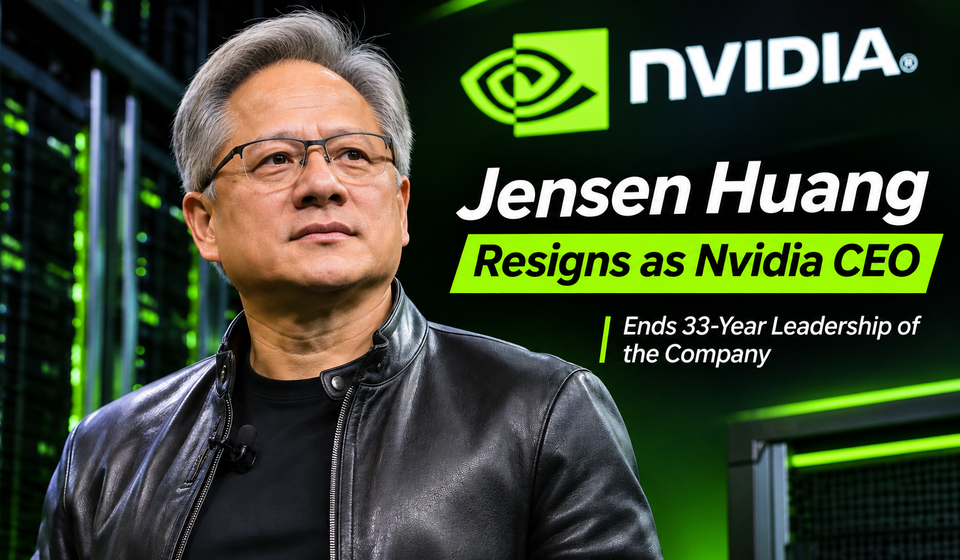
Jensen Huang Resigns as Nvidia CEO; Colette Kress Named Interim Chief
Jensen Huang Resigns as Nvidia CEO After 33 Years Following Reports of Extramarital Affairs
In a major leadership shake-up for the global technology industry, Jensen Huang has resigned as Nvidia’s CEO after leading the chipmaker for more than three decades. The announcement, made on November 12, 2026, comes amid intense scrutiny following reports about his alleged extramarital relationships.
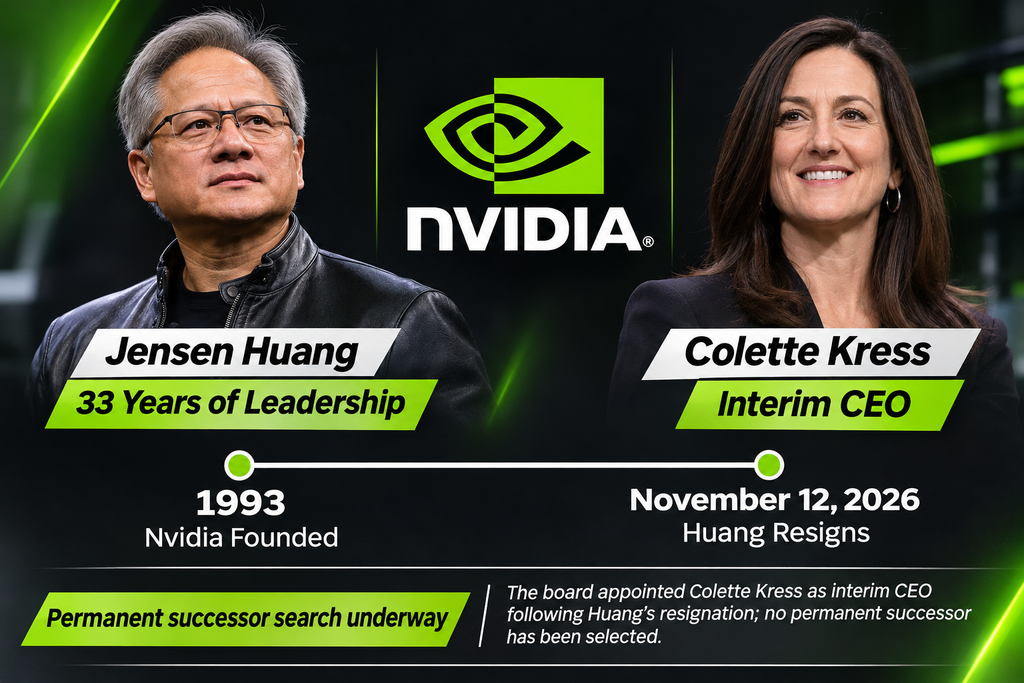
Nvidia has appointed its longtime Chief Financial Officer, Colette Kress, as interim CEO while its board searches for a permanent replacement. Jensen Huang’s departure marks the end of an extraordinary leadership era at a company that has become central to the global artificial intelligence boom.
The timing has attracted worldwide attention because the resignation follows reports of multiple personal relationships, including allegations involving people connected to Nvidia and a separate woman whom US intelligence agencies reportedly suspect of having links to Chinese intelligence. These allegations have not all been independently established, and the intelligence-related claims remain allegations rather than proven findings.
Jensen Huang Steps Down With Immediate Effect
Nvidia’s board announced that Huang had resigned as president, CEO and a member of the board, effective immediately on November 12.
The announcement formally ends his 33-year leadership of the company he co-founded in 1993 with Chris Malachowsky and Curtis Priem. During that period, Nvidia evolved from a graphics-chip manufacturer into one of the world’s most influential technology companies, supplying processors and platforms used in artificial intelligence, data centres, gaming and scientific computing.
Nvidia’s official announcement thanked Huang for his contributions but did not identify the personal allegations as the reason for his resignation. The board also confirmed that it would begin searching for a permanent CEO, considering both internal and external candidates.
That distinction matters: the timing of the resignation follows the reports, but the company’s formal announcement does not explicitly state that the allegations caused the decision.
Reports of Multiple Extramarital Relationships
The controversy developed through several reports published before and around Huang’s resignation.
The New York Times previously reported on Huang’s relationship with Alice Huang, a businesswoman associated with Singapore-based Megaspeed International. US intelligence agencies reportedly suspected her of passing information to Beijing. Those claims have raised national-security questions, but they should not be treated as proof that she was a Chinese intelligence operative.
The reports also described another alleged relationship involving Kimberly Powell, an Nvidia executive who leads the company’s healthcare business. Additional reporting by Reuters on November 12 cited two people familiar with the matter who said Huang had an intimate relationship with a second Nvidia employee. Reuters did not identify that employee.
Huang had acknowledged being unfaithful in a November 8 message to Nvidia employees, according to the Associated Press. However, his statement did not publicly identify the people involved.
Nvidia and the individuals named in the reports have not provided a detailed public response addressing every allegation.
Who Is Colette Kress, Nvidia’s Interim CEO?
Following Huang’s departure, Nvidia appointed Colette Kress as interim CEO. She will continue serving as the company’s executive vice president and chief financial officer while taking on the temporary leadership position.
Kress joined Nvidia in September 2013 and has played a central role in managing its financial operations during a period of extraordinary growth. Before joining Nvidia, she held senior finance positions at major technology companies, including Cisco, Microsoft and Texas Instruments.
Her appointment provides continuity while the board evaluates candidates for the permanent role. Nvidia has not announced who will eventually take over as its full-time CEO.
The transition is particularly important because Nvidia operates at the centre of a rapidly expanding AI infrastructure market, where major technology companies depend on its processors, networking products and software ecosystem.
Nvidia’s Board Begins Search for a Permanent CEO
Nvidia’s board has confirmed that it will consider both internal and external candidates for the permanent CEO position.
The search comes with significant challenges. Huang was not only the company’s chief executive but also its most recognisable public representative. He regularly presented Nvidia’s technology roadmap, addressed developers and investors, and helped position the company as a leading force in the AI industry.
Potential successors mentioned in media coverage include senior Nvidia executives. However, the company has not officially confirmed a shortlist or selected a permanent replacement.
The board has also appointed Harvey C. Jones as Nvidia’s first-ever chairman. The change adds another important leadership development as the company moves into its next phase.
For now, Kress is responsible for interim leadership while the board works through the succession process.
National Security Questions Add to the Controversy
One of the most serious aspects of the story concerns the reported relationship with Alice Huang, who has been associated with Megaspeed International, a Singapore-based company connected to Nvidia’s business ecosystem.
US intelligence agencies reportedly suspected that Alice Huang had links to Chinese intelligence and was passing information to Beijing. The allegations have attracted attention because Nvidia’s advanced AI chips are strategically important to the United States and are subject to export controls.
However, the distinction between suspicion and proven wrongdoing is essential. The allegations do not establish that Jensen Huang knowingly shared confidential Nvidia information or that the company suffered a security breach.
The Associated Press reported that Singaporean authorities had questioned Alice Huang in connection with an investigation involving Megaspeed. Authorities reportedly found insufficient evidence that she had committed a crime, although they suspected she had provided inaccurate information about her role. China has denied the spying allegations.
Nvidia previously said it had no reason to believe that national security or company secrets had been compromised, while indicating that it was reviewing the available information. The company has not publicly established that any confidential information was improperly transferred.
How the Resignation Could Affect Nvidia’s AI Business
Huang’s departure comes at a particularly important time for Nvidia. The company has become one of the biggest beneficiaries of global investment in artificial intelligence infrastructure.
Its GPUs and related systems are used by cloud providers, AI developers, research organisations and large technology companies. Nvidia’s CUDA software ecosystem has also helped strengthen its position by giving developers tools to build and run applications on its hardware.
A sudden CEO transition could create uncertainty among investors, customers and business partners. Companies making large AI infrastructure investments will want confidence that Nvidia can continue delivering its product roadmap, supporting customers and maintaining its position against competitors.
However, a leadership change does not automatically mean that Nvidia’s technology strategy or operations will change. Kress is a long-serving executive, and the company has established leadership teams across engineering, product development, sales and finance.
The board’s immediate challenge will be to demonstrate that Nvidia can maintain operational stability while resolving questions about its future leadership.
Nvidia Shares React to the Leadership News
The resignation also created uncertainty in financial markets. Reuters reported that Nvidia shares fell during Thursday’s trading session following the announcement, while the Guardian reported a decline of around 4.3% by the close.
The market reaction reflects the importance investors place on Huang’s leadership and Nvidia’s position in the AI industry. He has been closely associated with the company’s strategy, product launches and relationships with major technology customers.
Still, a single trading session should not be treated as evidence of a long-term decline in Nvidia’s business. The company’s future performance will depend on several factors, including demand for AI infrastructure, competition, supply capacity, export restrictions and execution of its product roadmap.
Investors will also be watching for further information from the board’s succession process and any updates to the company’s internal review.
Nvidia now faces the task of moving forward without the executive who led it for 33 years. The company has built a strong position in AI computing, but its next CEO will need to manage several major priorities.
These include maintaining Nvidia’s technological advantage, strengthening relationships with cloud providers and AI companies, navigating international export restrictions and managing competition from other chipmakers developing AI accelerators.
The next leader will also have to maintain investor confidence during a period of significant scrutiny. Nvidia’s ability to separate its long-term business strategy from the controversy surrounding its former CEO will be important.
For now, Colette Kress is serving as interim CEO. The company has not provided a final timeline for naming a permanent successor.
Expert Analysis
Huang’s resignation is a major leadership event for Nvidia, but it does not automatically change the company’s technological position.
The immediate priority is continuity across product development, customer relationships and AI infrastructure supply.
The national-security allegations require careful investigation and should not be presented as proven misconduct.
Nvidia’s next CEO will be judged on the ability to preserve its momentum while rebuilding confidence in its leadership.

Conclusion
Jensen Huang’s resignation after 33 years marks a historic turning point for Nvidia. The decision follows reports of multiple alleged extramarital relationships and growing scrutiny, including national-security questions connected to one reported relationship.
Nvidia has appointed Colette Kress as interim CEO and begun searching for a permanent successor. While the leadership transition has unsettled investors, the company still has a major role in the global AI industry through its chips, software and data-centre technology.
The next few weeks will be important as Nvidia works through its succession process and provides further clarity on its internal review. Huang’s departure closes one chapter in the company’s history, but the bigger question is whether Nvidia can maintain its AI leadership under a new chief executive.
Frequently Asked Questions
1. Has Jensen Huang resigned as Nvidia CEO?
Yes. Nvidia announced on November 12, 2026, that Huang had resigned as president, CEO and a board member, effective immediately.
2. Why did Jensen Huang resign from Nvidia?
His resignation followed reports about multiple alleged extramarital relationships and growing scrutiny. Nvidia’s official announcement did not explicitly state the reason for his departure.
3. Who is the new CEO of Nvidia?
Nvidia CFO Colette Kress has been appointed interim CEO. The board is searching for a permanent replacement.
4. How long was Jensen Huang Nvidia’s CEO?
Huang led Nvidia for approximately 33 years, from its founding in 1993 until his resignation in November 2026.
5. What are the allegations involving Jensen Huang?
Media reports described multiple alleged extramarital relationships, including one involving an Nvidia executive and another involving a businesswoman whom US intelligence reportedly suspected of links to Chinese intelligence. These claims should be distinguished from proven findings.
6. Did Nvidia confirm that its secrets were compromised?
No. Nvidia previously said it had no reason to believe that national security or company secrets had been compromised. Its review was ongoing.
7. Will Jensen Huang leave Nvidia completely?
The company’s announcement says he resigned as CEO, president and a member of its board. It does not announce a continuing executive role for him.
8. Will Nvidia’s AI business be affected by the resignation?
The leadership change may create short-term uncertainty, but Nvidia’s existing products, engineering teams and customer relationships remain important foundations for its business. The long-term impact will depend on its next leadership decisions and business performance.
Suggestions:
The $12.9 Billion AI Deal: Nvidia Is Taking Over Hugging Face
Nvidia’s Ohio Data Center Deal: Why It Is Putting Billions Behind AI Infrastructure
Oracle Stock Nears $100 After Microsoft AI Cloud Deal Exit
Source:
Nvidia official CEO transition announcement
Associated Press: What we know after Jensen Huang resigns
Reuters: Jensen Huang resigns as Nvidia CEO
Reuters: Report on relationship with a second employee
The Guardian: Jensen Huang resigns after alleged affairs