Gemini 3.7 Flash: Google’s New AI Workhorse for Coding and Agents
Google has released Gemini 3.7 Flash, and the biggest story is not simply that it is a newer AI model. Google is building it to do more work on its own, especially coding, website creation and multi-step tasks handled by AI agents.
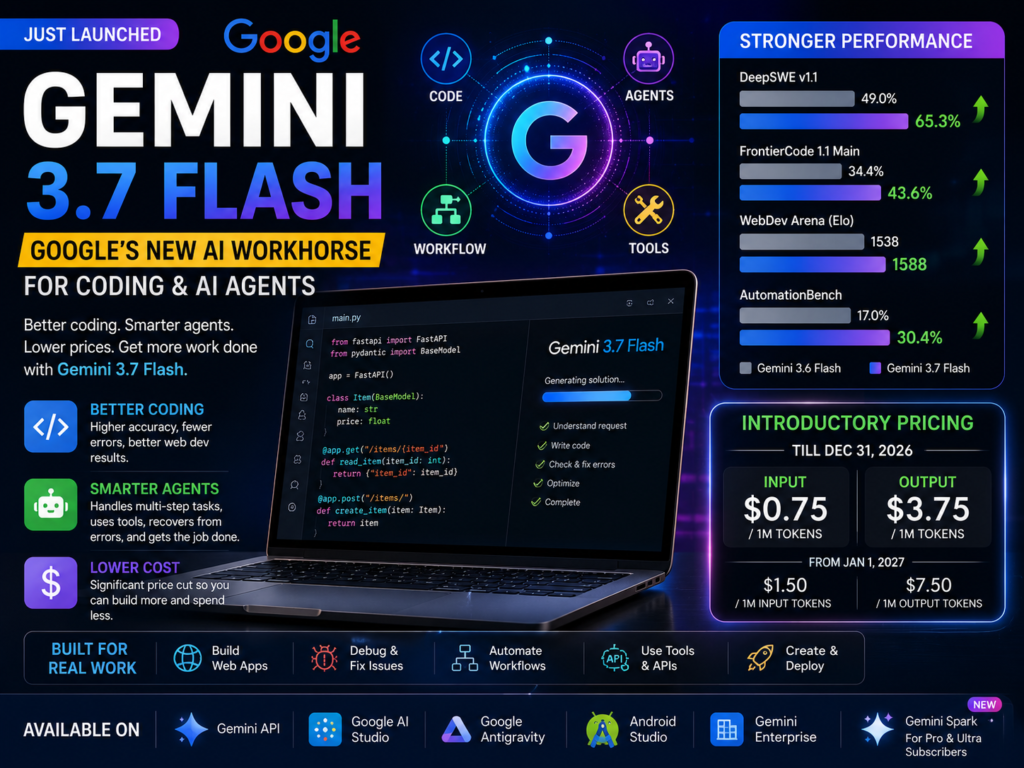
There is another reason developers are paying attention: Google is offering the model at an introductory price of $0.75 per million input tokens and $3.75 per million output tokens through December 31, 2026. That is a major cut from the previous Flash pricing.
At the same time, early results show clear improvements over Gemini 3.6 Flash in several coding and agent tests. So the real question is simple: can Google’s cheaper Flash model become a serious tool for developers building AI that actually gets things done?
What Is Gemini 3.7 Flash?
The easiest way to understand Gemini 3.7 Flash is to think beyond a normal chatbot.
A chatbot mainly answers a question. An AI agent is expected to take several steps to finish a task. It may understand an instruction, use a tool, check the result, find a mistake and continue working.
That is the kind of work Google is targeting. The company describes the model as a workhorse for coding and agents, with improvements in software engineering, web development, following instructions and handling longer tasks.
The Coding Improvement Is Hard to Ignore
Coding is one of the biggest reasons this release is getting attention.
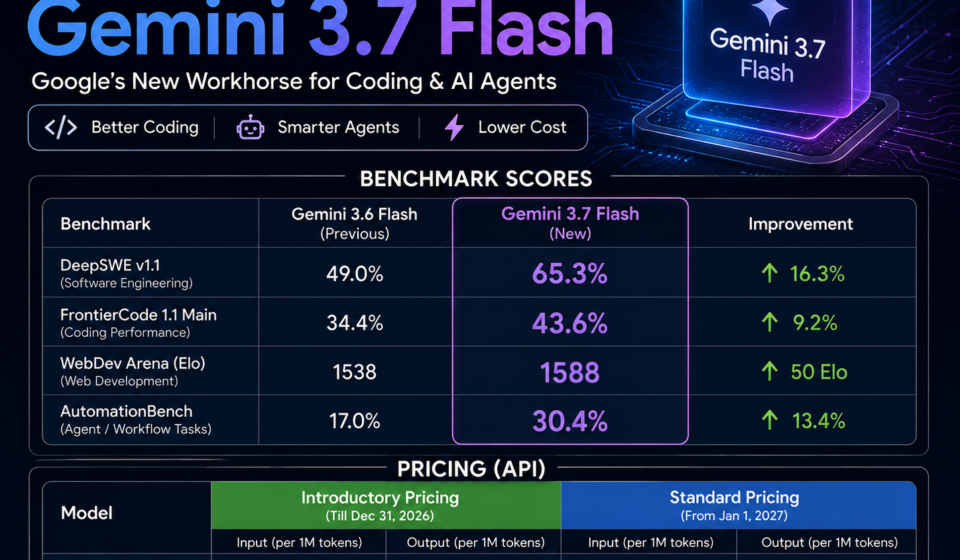
Reported results show DeepSWE v1.1 rising from 49.0% with Gemini 3.6 Flash to 65.3%, while FrontierCode 1.1 Main increased from 34.4% to 43.6%. WebDev Arena also moved from 1538 to 1588 Elo.
But what do these numbers actually mean for a developer?
The important part is not simply getting a higher benchmark score. If an AI can write better code on its first attempt, understand a problem more accurately and fix errors with fewer corrections, developers can spend less time going back and forth with the model.
Google is also highlighting better accuracy when generating websites and following design instructions.
The Bigger Story May Be AI Agents
Coding is only one part of the upgrade.
Gemini 3.7 Flash is also aimed at AI agents that have to complete several actions instead of stopping after one answer. One reported AutomationBench comparison shows the score increasing from 17.0% with Gemini 3.6 Flash to 30.4% with the new model.
Google is already putting the model to work in Gemini Spark, its personal AI agent for Google AI Pro and Ultra subscribers. Spark can handle multi-step tasks using tools such as Gmail, Google Calendar and Google Docs.
This explains Google’s “workhorse” idea: the goal is not just to make AI answer faster, but to help it complete a job from beginning to end.
Why Is the Price So Important?
This may be the part developers care about most.
Until December 31, 2026, API pricing is $0.75 per million input tokens and $3.75 per million output tokens. From January 1, 2027, Google says the price will become $1.50 and $7.50 respectively.
Lower pricing matters even more for AI agents because one task can require multiple model calls. If each step costs less, developers have more room to run larger workflows without the bill increasing as quickly.
Where Can Developers Use It?
The model is rolling out through the Gemini API, Google AI Studio, Google Antigravity and Android Studio. Enterprises can access it through Google’s Gemini Enterprise offerings, while Gemini Spark is using it for eligible Pro and Ultra subscribers.
That gives developers several ways to test it, from writing code directly to building larger AI-agent systems.
Is Gemini 3.7 Flash a Big Upgrade?
It looks promising, but the real test will happen outside benchmarks.
The combination of better coding, stronger agent performance and lower introductory pricing makes this a meaningful release. If developers find that it can complete real tasks with fewer corrections while keeping costs under control, Google’s Flash line could become an important part of everyday AI development. Gemini 3.7 Flash
And that may be the real point of Gemini 3.7 Flash: not simply making AI smarter, but making AI useful enough to keep working until the job is finished.
Related Articles
- Best AI Tools Every Student Should Know in 2026
- YouTube Monetization Changes 2027…
- Flipkart Freedom Sale 2026
- Vivo S2 Price in India Revealed
For more info visit Gemini