
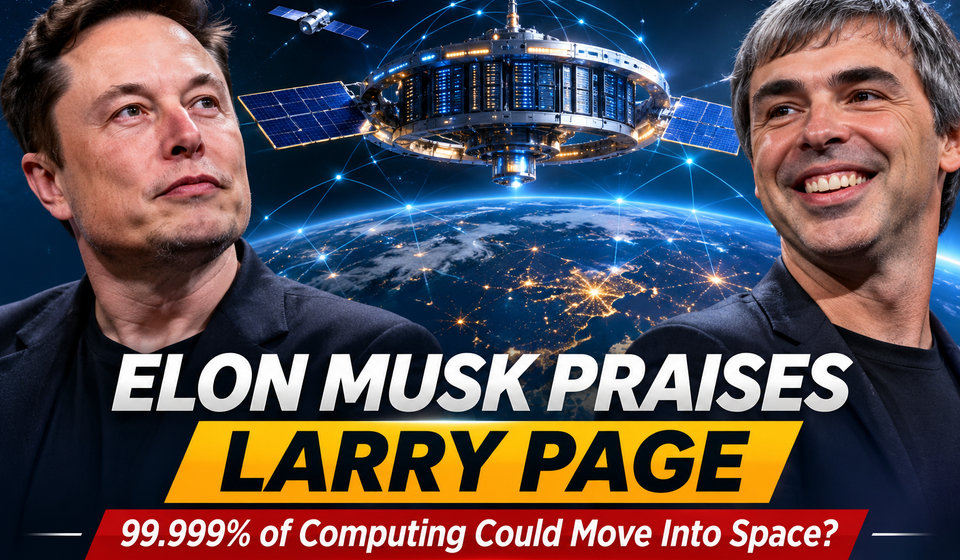
Elon Musk Praises Larry Page’s Prediction that 99.999% of Computing in Space
Elon Musk Praises Larry Page Over Prediction That 99.999% of Computing Could Move Into Space
Elon Musk has praised Google co-founder Larry Page for making “many accurate predictions” after a podcast discussion revived Page’s reported vision of moving almost all computing infrastructure into orbit. The comment has attracted attention because Musk is also developing plans for space-based AI infrastructure, while Google is exploring orbital data centres through Project Suncatcher.
Musk made the remark in a post on X on November 8, 2026, responding to a video clip discussing Page’s Larry Page reported prediction that 99.999% of future computing could eventually take place in space. The claim was shared through a podcast conversation, rather than a direct public statement from Page.
What Did Elon Musk Say About Larry Page?
Musk responded to the circulating clip with a short message:
“Larry Page has made many accurate predictions and this is one of them.”
The comment was a public endorsement of the prediction being discussed in the video. It did not include a detailed explanation, a proposed timeline or a specific plan for moving computing infrastructure into orbit.
The clip featured Patrick O’Shaughnessy, host of the Invest Like the Best podcast, speaking with Martin Casado, a partner at venture capital firm Andreessen Horowitz. O’Shaughnessy recounted a story he had heard about someone asking Page how much computing would eventually be located in orbit.
According to O’Shaughnessy’s account, Page’s reported answer was “five nines”, a way of expressing 99.999%. He described the reasoning as ultimately being about physics. However, Page was not directly speaking in the clip, and the prediction has not been independently confirmed as a direct quotation from him.
That distinction matters. Musk endorsed the idea, but his post does not establish that Page made a formal announcement or that the technology is close to supporting almost all global computing needs.
Why Larry Page Believes Computing Could Move Into Space
The underlying idea is that orbital infrastructure could eventually offer advantages over building and operating increasingly large data centres on Earth.
AI development is driving demand for computing power, electricity, cooling systems and suitable land. Large data centres need substantial grid connections and physical infrastructure. In some locations, securing electricity supply, permits and construction approvals has become a major challenge.
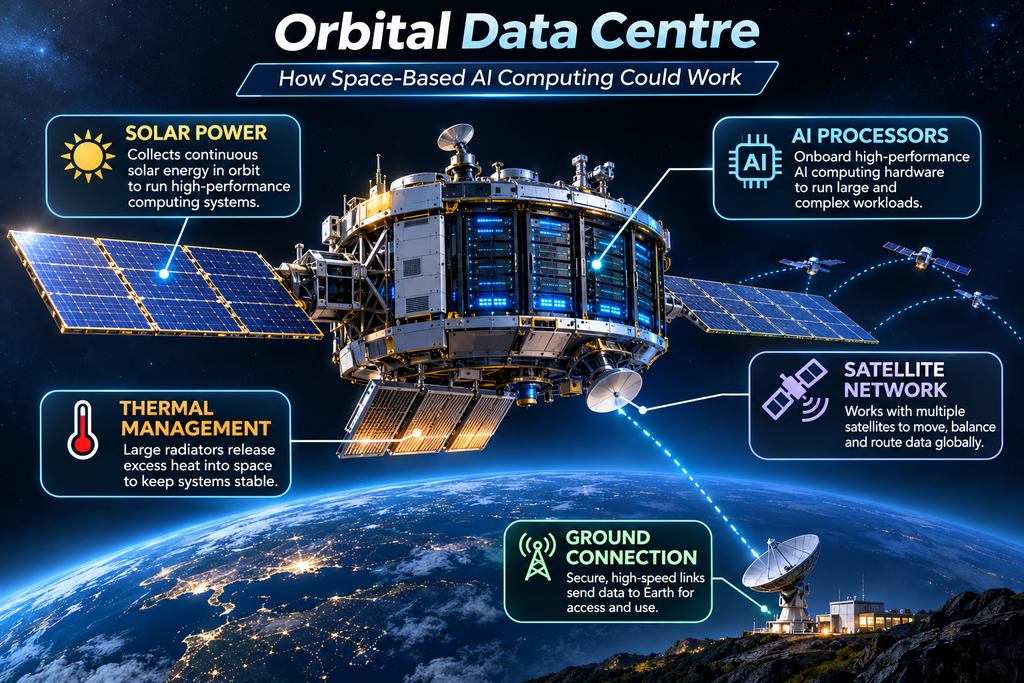
Space-based computing could offer a different way to approach some of these constraints. Satellites equipped with processors and solar power systems could theoretically perform computing tasks in orbit and communicate with ground-based networks.
Solar energy is one of the main attractions. Satellites can collect sunlight without the same day-night cycle experienced by ground-based solar installations, depending on their orbit and design. This could make orbital solar power useful for certain applications.
However, collecting energy is only one part of the problem. Space-based data centres would also need reliable cooling, radiation protection, hardware maintenance, high-capacity communication links and affordable launch systems.
The 99.999% figure should therefore be understood as a reported long-term vision, not an established forecast supported by a publicly available deployment plan.
Data Centre Construction Challenges Could Make Space More Attractive
The podcast discussion also connected the idea of orbital computing with regulatory pressure on data centre construction.
Martin Casado suggested that restrictions on new data centre projects could make it harder for companies to expand infrastructure on Earth. He referred to hundreds of proposed US bills that could affect data centre construction, including in Texas.
His argument was that if companies face increasing difficulty obtaining approval for new facilities, they may look for alternatives, including building infrastructure in other countries or eventually moving some computing capacity into space.
This is an argument about potential infrastructure constraints, not proof that regulation alone will make orbital data centres economically viable.
The economics will depend on several factors, including the cost of launching equipment, the lifespan of satellites, energy availability, cooling technology, network latency and the ability to repair or replace failed hardware.
For now, terrestrial data centres remain the established option for large-scale computing. Space-based infrastructure would need to demonstrate clear advantages in cost, reliability and performance before it could replace a significant share of that capacity.
Elon Musk Is Also Exploring Space-Based AI Infrastructure
Musk’s response is particularly notable because his companies are pursuing projects that connect space technology with artificial intelligence.
SpaceX has experience launching and operating large satellite networks, while Musk has increasingly discussed the possibility of using orbital infrastructure to support AI computing.
He has argued that cooling could be an advantage in space, where radiators can release heat into the surrounding environment. But managing heat in orbit is not as simple as placing a computer in a cold location. Spacecraft must transfer heat from electronic components to radiators, and the design must account for sunlight, Earth-facing radiation and the thermal conditions of the orbit.
Musk has also discussed ambitious plans for AI computing capacity connected to SpaceX. These plans indicate interest in combining launch infrastructure, satellite technology and AI services, although public targets and proposals should not be confused with operating orbital data centres at commercial scale.
The broader opportunity is clear: if launch costs fall and satellite hardware becomes more capable, companies could investigate placing selected computing workloads closer to space-based applications or using orbit as an additional infrastructure layer.
But large-scale orbital AI computing remains an engineering and economic challenge.
Google Is Testing AI Computing Hardware in Orbit
Google is also investigating the possibility of running AI workloads in space through Project Suncatcher.
The project explores how Google’s Tensor Processing Units (TPUs) could operate on satellites. The longer-term concept involves using solar-powered satellite systems to support machine learning workloads in orbit.
Google’s work is relevant to the discussion because it shows that orbital computing is not limited to speculative conversations between technology leaders. Companies are beginning to investigate the hardware and operational requirements.
According to reports, Google has been working with satellite company Planet Labs on prototype systems intended to test AI chips in space. The project is designed to examine whether specialised computing hardware can function reliably under orbital conditions.
However, Project Suncatcher should not be interpreted as evidence that Google is ready to move its existing data centre operations into orbit. Testing processors on satellites is an early step towards understanding the technology, not a commercial replacement for conventional cloud infrastructure.
Google’s research also highlights the practical questions that companies must answer before orbital computing can expand: how to power the systems, protect sensitive electronics, manage heat and transmit large amounts of data between satellites and Earth.
Why Elon Musk and Larry Page’s Relationship Makes the Comment Interesting
Elon Musk’s praise has another dimension because he and Larry Page were once close friends and shared an interest in ambitious technology projects.
Page has previously spoken positively about Musk’s goal of making humanity a multiplanetary species. During a 2014 interview with Charlie Rose, Larry Page reportedly agreed with the idea that he might leave his fortune to Musk rather than give it to a traditional charity. Larry Page viewed Musk’s Mars ambitions as a way of helping secure humanity’s future.
Their relationship later became strained over disagreements about artificial intelligence.
Musk has repeatedly warned about the potential risks of advanced AI and argued for safeguards. He has described a disagreement with Larry Page over whether digital intelligence should be treated as a potential successor to humanity. Musk has said that the disagreement contributed to his decision to help establish OpenAI.
The latest public praise does not necessarily indicate that the two have repaired their relationship. Musk’s post focused on Page’s reported prediction about computing in space, rather than their personal history.
Still, it is a notable moment because both technology leaders have long been associated with ambitious ideas about the future of computing, artificial intelligence and humanity’s presence beyond Earth.
Can 99.999% of Computing Really Move Into Space?
Moving nearly all computing infrastructure into orbit would be an enormous undertaking. The concept faces several technical and financial barriers.
Launch costs: Data centres require large quantities of hardware. Sending processors, power systems, cooling equipment and supporting infrastructure into orbit would require significant launch capacity. Even with lower launch prices, replacing terrestrial data centres would be difficult.
Cooling: Space is cold, but vacuum does not provide conventional air cooling. Orbital data centres would need carefully designed thermal systems and radiators to remove heat generated by processors.
Maintenance: Earth-based facilities can be repaired and upgraded by technicians. Repairing hardware in orbit is more complicated and expensive. Satellite servicing could become important, but it is not yet a routine solution for large computing systems.
Radiation: Electronics in space face exposure to radiation that can damage components or cause errors. Hardware would need protection and systems capable of handling failures.
Connectivity and latency: Orbital computing would need reliable, high-bandwidth links to users and other infrastructure. The usefulness of space-based processing would depend partly on where the data originates and where results need to be delivered.
Economics: The total cost of building, launching, operating and replacing orbital systems must compete with increasingly efficient terrestrial data centres.
These barriers do not make space-based computing impossible. They do mean that the transition would likely require major advances in hardware, launch systems, satellite servicing and networking.
The discussion comes at a time when AI companies and cloud providers are investing heavily in computing infrastructure. Demand for advanced processors and electricity is pushing data centre operators to explore new locations, energy sources and hardware designs.
Orbital computing could eventually serve specialised workloads, particularly those connected to satellites, space exploration or applications that benefit from processing data closer to its source.
It could also become part of a wider infrastructure strategy rather than a direct replacement for facilities on Earth. Companies may operate a combination of terrestrial data centres, edge computing systems and specialised orbital platforms.
Elon Musk’s public support for Larry Page’s reported prediction highlights the growing interest in this possibility. Google’s Project Suncatcher provides an example of early technical exploration, while SpaceX’s launch capabilities could become relevant if the economics improve.
However, the prediction that 99.999% of computing will move into orbit remains a long-term vision. There is no confirmed timetable or evidence that the industry is approaching that level of adoption.
Expert Analysis
Musk’s praise brings renewed attention to the possibility of moving some AI computing infrastructure beyond Earth.
Google’s Project Suncatcher and SpaceX’s launch capabilities show why the concept is attracting industry interest.
But launch economics, thermal management, radiation protection and maintenance remain significant obstacles.
For now, orbital computing is an emerging research direction, not a replacement for terrestrial data centres.
Conclusion
Elon Musk has publicly praised Larry Page after a podcast discussion circulated a reported prediction that 99.999% of future computing could eventually move into space.
The idea fits into a wider technology trend, as companies explore new ways to meet the growing demand for AI computing power. Google is investigating orbital AI hardware through Project Suncatcher, while Musk has also discussed the potential of space-based data centres.
Despite the excitement, the prediction remains a long-term vision rather than a confirmed industry roadmap. The next major developments will depend on whether companies can make orbital computing reliable, maintainable and economically competitive with data centres on Earth.
Frequently Asked Questions
1. Why did Elon Musk praise Larry Page?
Musk praised Page after a video circulated discussing Page’s reported prediction that almost all future computing could eventually take place in space.
2. What percentage of computing could move into space?
The reported prediction is 99.999%, expressed as “five nines”. It was recounted secondhand during a podcast conversation and has not been established as a direct public statement from Page.
3. Who is Larry Page?
Larry Page is the co-founder of Google, which he established with Sergey Brin. He is known for his role in building Google’s search technology and its early development.
4. What is Google’s Project Suncatcher?
Project Suncatcher is Google’s research initiative exploring the use of solar-powered satellites and AI computing hardware, including its Tensor Processing Units, in space.
5. Why are companies interested in space-based data centres?
Potential advantages include access to solar energy and an alternative to some land, electricity and permitting constraints affecting terrestrial data centre construction.
6. Can data centres operate in space today?
Companies are testing relevant technologies, but large-scale commercial orbital data centres are not yet an established replacement for ground-based facilities.
7. Are Elon Musk and Larry Page friends again?
Musk’s public praise does not confirm that their relationship has been repaired. Their friendship reportedly deteriorated after disagreements about artificial intelligence.
Suggestions:
NASA’s Voyager 1 Survives 48-Hour Blackout Ahead of Historic Milestone
Anthropic’s Claude Discovers a CRISPR-Like Enzyme System
Anthropic Claude Fable 5.2 and Mythos 5.2: What’s New
Source:
Times of India – Musk’s comment and Page’s history
Benzinga – Orbital computing report
FourWeekMBA – Podcast context and sourcing limitations
Elon Musk X Account