
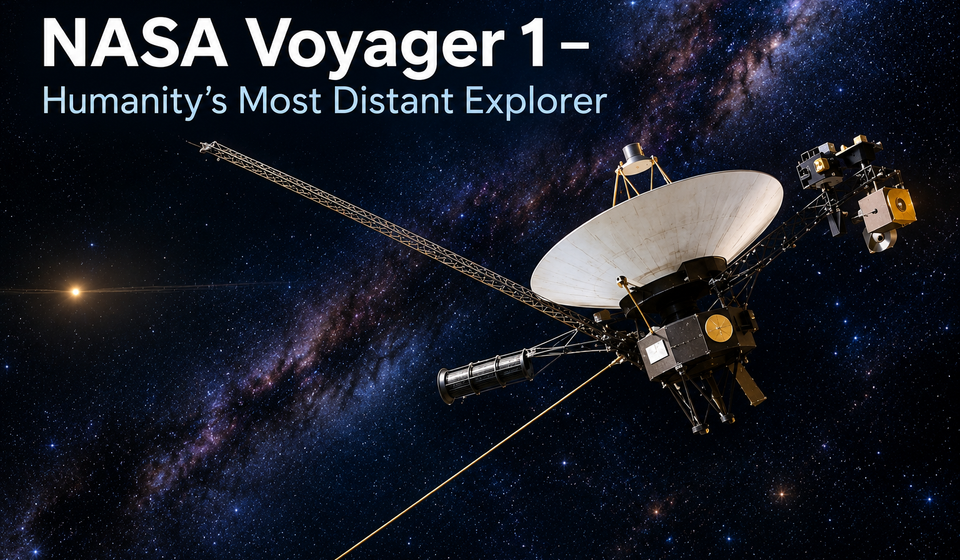
NASA’s Voyager 1 Survives 48-Hour Blackout Ahead of Historic Milestone
NASA’s Voyager 1 Survives 48-Hour Communication Blackout as It Approaches Historic Space Milestone
Nearly 50 years after leaving Earth, NASA’s Voyager 1 continues to explore a region of space no other operating spacecraft has directly studied. But keeping the historic probe alive is becoming increasingly difficult. In October 2026, NASA temporarily lost contact with Voyager 1 for approximately 48 hours before its signal unexpectedly returned. The incident came just weeks after engineers completed a major power-saving operation designed to extend the spacecraft’s scientific mission.
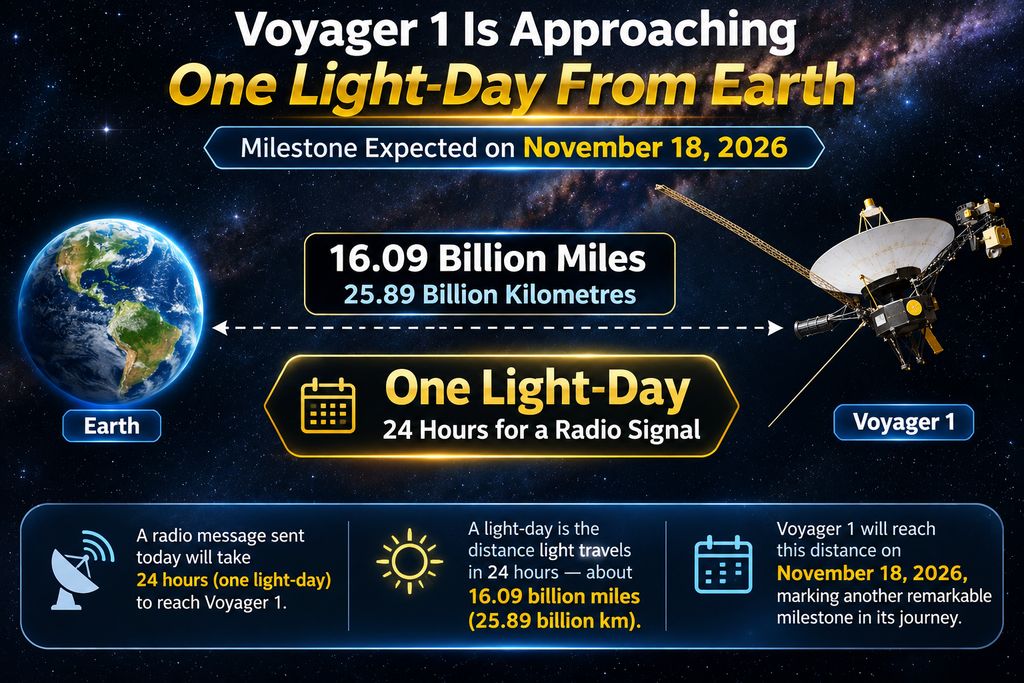
Now, NASA’s Voyager 1 is approaching another extraordinary milestone. On November 18, 2026, it is expected to reach a distance of one light-day from Earth. That means a radio message will take approximately 24 hours to reach the spacecraft, with another 24 hours needed for its reply to return.
NASA’s Voyager 1 The spacecraft is still communicating with NASA, but its ageing systems, declining power supply and recent technical problems show just how challenging it is to operate a machine launched in 1977.
What Happened to NASA’s Voyager 1?
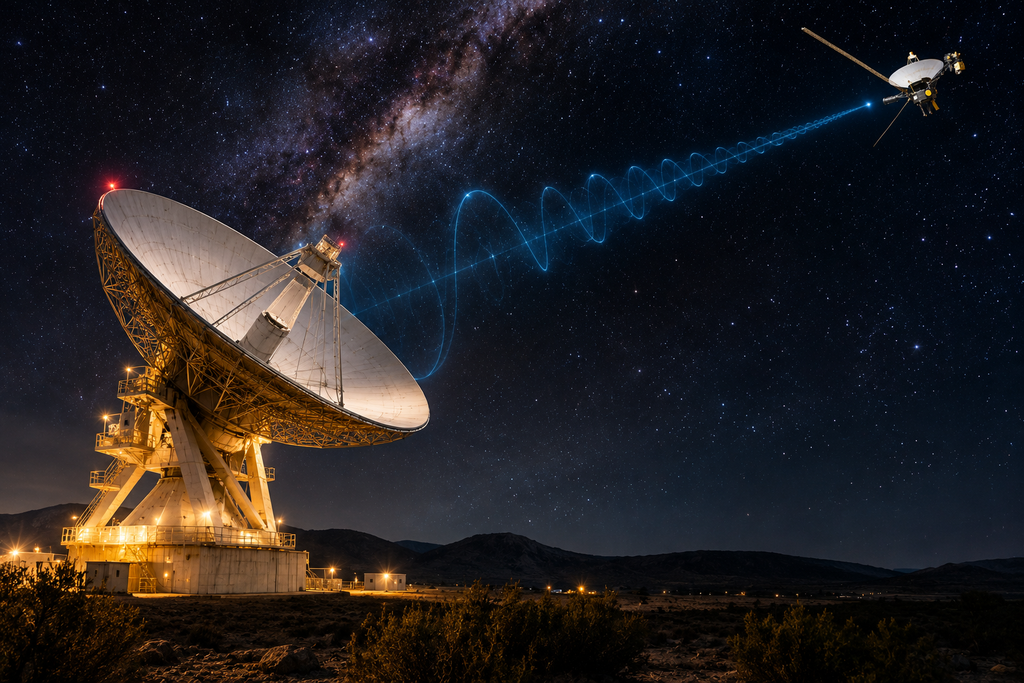
NASA’s Deep Space Network failed to detect Voyager 1’s radio signal during two scheduled communication sessions on October 18 and 19. The attempts were separated by approximately 24 hours, leaving engineers temporarily without contact with the spacecraft.
The signal returned on October 20, around 48 hours after the interruption began. Importantly, Voyager 1 restored communication before engineers had sent commands to troubleshoot the issue. NASA has since maintained contact with the spacecraft and continued investigating what happened.
Engineers found that one group of thrusters had gone offline and the spacecraft’s backup thrusters had activated. This appears to have involved Voyager 1’s automatic fault-protection system, which responds when onboard computers detect a potential problem. The system can move the spacecraft into a safer operating configuration and pause normal activities while engineers investigate.
NASA has not confirmed the precise cause of the incident. The switch to backup thrusters is an important clue, but it does not mean the underlying problem has been fully resolved.
Why Is NASA’s Voyager 1 Approaching a One-Light-Day Distance?
The next major milestone is about distance and communication time.
NASA expects Voyager 1 to reach approximately 16.09 billion miles (25.89 billion kilometres) from Earth on November 18, 2026. At that distance, light itself takes roughly 24 hours to travel between the spacecraft and our planet.
This is known as a one-light-day distance. It does not mean Voyager 1 is travelling for a day or reaching a new boundary in space. It describes how far light can travel in 24 hours.
The practical effect is remarkable: if NASA sends a command to Voyager 1, it will take about a day to arrive. If the spacecraft immediately sends a response, that message will take another day to reach Earth.
In other words, even a simple exchange with the spacecraft can require approximately 48 hours. NASA says Voyager 1 will be the first human-made object to reach this distance from Earth.
NASA’s “Big Bang” Operation: How Engineers Are Saving Power
The communication interruption was not the only recent challenge. NASA’s Voyager 1 is also running on a steadily declining power supply.
Both Voyager spacecraft use radioisotope thermoelectric generators (RTGs), which convert heat from the natural radioactive decay of plutonium-238 into electricity. These power systems have supported the probes since their launch in 1977, but their electrical output gradually decreases over time.
To keep Voyager 1 operating, NASA engineers completed a major power-conservation operation in early September 2026. Nicknamed “Big Bang,” the operation involved switching off three devices and replacing them with three lower-power alternatives.
The team completed the complex procedure approximately six weeks after carrying out a similar operation on Voyager 2. The objective was to reduce energy consumption while preserving the spacecraft’s ability to conduct scientific measurements.
NASA says that without this operation, the team might have needed to turn off another Voyager 1 science instrument as early as summer 2027. The power-saving changes are expected to help the spacecraft continue its scientific work longer than previously anticipated.
Why NASA Is Turning Off Voyager 1’s Scientific Instruments
Voyager 1 launched with 10 dedicated science instruments. Several were switched off after the spacecraft completed its planetary encounters, while others continued collecting measurements from the outer heliosphere and interstellar space.
As electrical power becomes more limited, NASA has had to decide which instruments should remain active. In April 2026, engineers switched off the Low-Energy Charged Particles experiment (LECP) to conserve electricity. The instrument had operated almost continuously since the spacecraft’s launch in 1977.
It measured low-energy charged particles, including ions, electrons and cosmic rays. Its observations helped scientists understand the environment beyond the heliosphere.
NASA’s current instrument-status information shows that Voyager 1’s magnetometer and plasma-wave subsystem remain active. Other instruments have been shut down either to conserve power or because of degraded performance. Its cameras were switched off decades ago, so it is no longer sending new photographs of distant planets or stars.
Voyager 1 Is Exploring Interstellar Space
NASA’s Voyager 1 is not simply travelling through the outer solar system. It crossed the heliopause in 2012, entering interstellar space—the region beyond the Sun’s protective bubble of solar particles and magnetic fields, known as the heliosphere.
This makes the mission scientifically important. NASA’s Voyager 1 and its twin, Voyager 2, are the only spacecraft to have directly studied this environment.
Their instruments have provided measurements of particles, magnetic fields and plasma waves in a region that cannot be explored through ordinary observations from Earth. The information helps scientists understand how the Sun interacts with the space between stars.
Although Voyager 1’s cameras have been inactive since 1990, its remaining scientific instruments continue to provide data that cannot currently be collected by another operating spacecraft at the same distance.
NASA has not announced a definitive end date for Voyager 1. Its remaining operating life depends on available electrical power, the condition of its ageing systems and the ability of engineers to manage future technical problems.
The spacecraft loses approximately four watts of electrical power each year. As its energy supply declines, NASA must make difficult decisions about which heaters, instruments and other systems can be switched off without compromising the mission.
The recent Big Bang operation offers some additional breathing room, but it cannot stop the gradual loss of power. Engineers will continue balancing the need to keep the spacecraft warm and operational against the value of collecting scientific data.
Even after Voyager 1 can no longer communicate with Earth, it will continue travelling through interstellar space. Its journey will not suddenly end when its instruments or power systems stop working.
Expert Analysis
Voyager 1’s recent communication interruption highlights the risks of operating a spacecraft that has spent nearly five decades in space.
The Big Bang power-saving operation demonstrates how careful engineering can extend a mission beyond its original expectations.
Its upcoming one-light-day milestone will also make the communication delay more significant for NASA engineers.
Even as individual instruments are switched off, Voyager 1 continues to provide unique scientific information from interstellar space.
Conclusion
NASA’s Voyager 1 is approaching one of the most remarkable milestones in space exploration while facing the challenges of ageing technology and declining power. Its recovery from the October communication interruption is encouraging, and the Big Bang operation could help extend its scientific life. On November 18, the spacecraft is expected to become the first human-made object to reach a distance of one light-day from Earth. The milestone will not change Voyager 1’s journey, but it will demonstrate just how far humanity’s most distant explorer has travelled. Nearly 50 years after launch, its mission remains an extraordinary achievement in engineering and scientific discovery.
Frequently Asked Questions
1. What happened to NASA’s Voyager 1?
Voyager 1 briefly stopped communicating with Earth between October 18 and October 20, 2026. Its signal returned, and NASA has maintained contact since then.
2. Why did Voyager 1 lose communication?
NASA found that one group of thrusters had gone offline and backup thrusters had activated. Engineers are still investigating the exact cause of the incident.
3. When will Voyager 1 reach one light-day from Earth?
NASA expects Voyager 1 to reach this milestone on November 18, 2026, at a distance of approximately 16.09 billion miles.
4. What does one light-day mean?
One light-day is the distance light travels in 24 hours. At this distance, a radio signal takes approximately one day to travel between Earth and Voyager 1.
5. Is Voyager 1 still working?
Yes. Voyager 1 is still communicating with NASA and collecting scientific measurements using its remaining active instruments.
6. Why is NASA turning off Voyager 1’s instruments?
Its nuclear power supply gradually produces less electricity. NASA switches off selected instruments and devices to conserve power and extend the mission.
7. When was NASA’s Voyager 1 launched?
NASA launched Voyager 1 on September 5, 1977, to study the outer planets and eventually explore interstellar space.
Suggestions:
Sam Altman Changes X Name to ‘Ram Altman’ After RAM Backlash
China AI Stock Crash: Massive $480 Billion Market Loss
OpenAI Engineer Arrested: 5 Key Facts About Hidden Recorder
Source:
NASA JPL – Voyager 1 Conserves Power and Resolves Communication Pause
NASA – Where Are Voyager 1 and Voyager 2 Now?
NASA – Voyager 1 Shuts Down an Instrument to Save Power
Space.com – Voyager 1 Recovers From Communication Glitch