
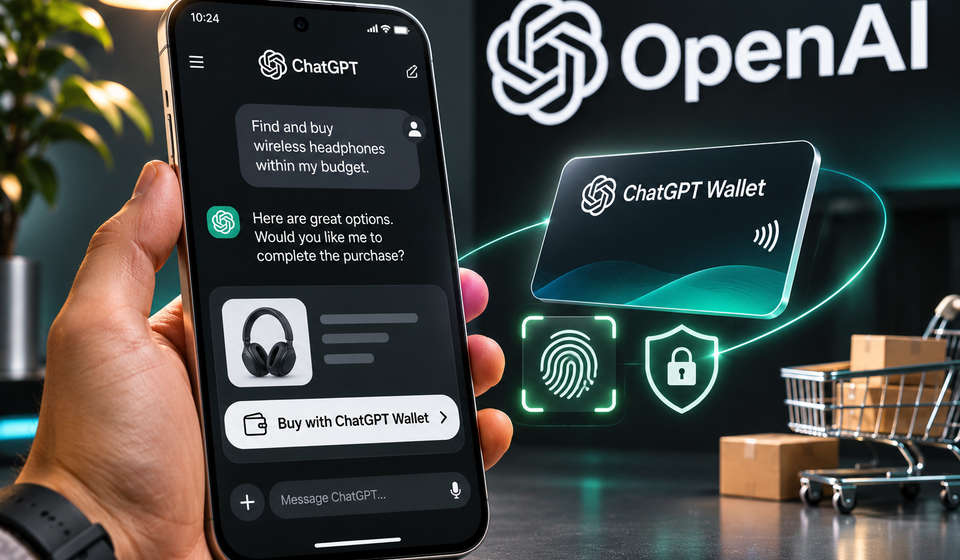
OpenAI ChatGPT Wallet: AI Agent Payments and Features
OpenAI Introduces ChatGPT Wallet: AI Agents Can Now Make Purchases With User Approval
OpenAI has introduced ChatGPT Wallet, a new payment feature designed to let AI agents complete online purchases on behalf of users. Announced on November 13, 2026, the feature brings payment capabilities into ChatGPT’s agent-based shopping experience, allowing users to find products, compare options and proceed to checkout without manually entering their card details every time.
ChatGPT Wallet is being introduced through OpenAI’s dots experience, where an AI agent can help users with tasks such as shopping for clothes or booking hotels. Users can add an eligible payment card, ask their agent to complete a purchase and review the merchant, items, total amount and selected card before authorising the payment.
The feature uses payment tokens instead of exposing the user’s actual card details to the AI agent or merchant. Each purchase also requires a security check, such as Face ID or fingerprint verification.
However, the initial rollout is limited. ChatGPT Wallet is gradually becoming available to eligible ChatGPT Pro subscribers aged 18 or older in the United States. It is not currently a worldwide payment service, and users in India cannot assume that they can access the new Wallet feature.
What Is ChatGPT Wallet?
ChatGPT Wallet is a payment feature that allows an eligible AI agent to make purchases using a payment card saved by the user.
Traditionally, people use ChatGPT to research products, compare prices, understand specifications and decide what to buy. They then visit a retailer’s website, add the selected product to their cart and complete the payment separately.
ChatGPT Wallet aims to connect more of these steps.
With the feature, users can ask their dot to find a product or service and help complete the purchase. When checkout is ready, the agent presents the payment details for the user to review and approve.
For example, a user could ask an agent to find a suitable sweater within a particular budget. The agent can help identify options and proceed towards checkout. Before payment is made, the user reviews the purchase and authorises the transaction.
The important distinction is that ChatGPT Wallet is not a conventional digital wallet with a stored cash balance. It does not create a bank account, provide credit or independently hold money for users. Instead, it securely connects an eligible payment card to an agent-assisted checkout process.
How Does ChatGPT Wallet Work?
OpenAI has designed ChatGPT Wallet around a process in which the AI agent handles parts of the shopping journey while the user retains control over payment approval.
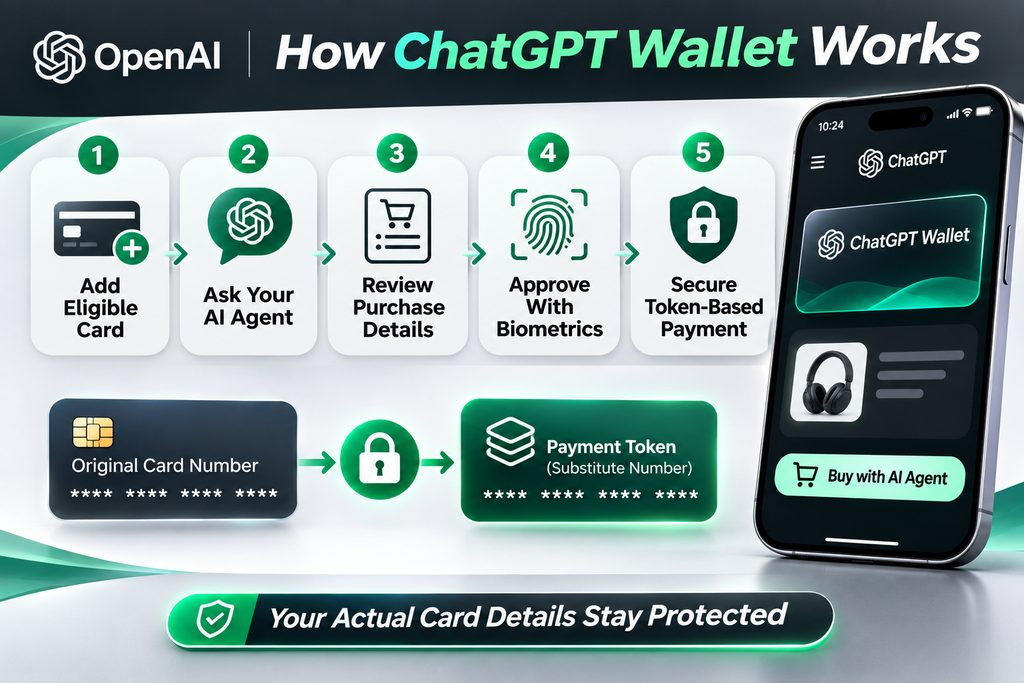
The process generally works in five stages:
- Add a payment card: The user adds an eligible card through ChatGPT Wallet’s secure setup process.
- Ask the agent to shop: The user tells their dot what they want to purchase.
- Review the purchase: The agent presents the merchant, selected items, total amount and payment card.
- Approve securely: The user authorises the purchase using a security check such as Face ID or fingerprint verification.
- Complete checkout: After approval, the agent continues the merchant checkout process using a payment token linked to the selected card.
This arrangement is intended to reduce the need for users to repeatedly enter payment information while maintaining a clear approval step before a purchase.
There is also an important distinction between approving a payment request and completing an order. Approval allows the agent to continue checkout, but it does not guarantee that the merchant has accepted the order. Users should check the merchant’s confirmation after the transaction.
Actual Card Details Are Hidden From AI Agents
One of the most important features of ChatGPT Wallet is its payment security design.
When a user approves a purchase, the payment network generates a payment token that acts as a substitute for the actual card details.
The token can include a payment card number, security code and expiration date that are used during checkout. The merchant and AI agent do not receive the user’s actual card number through this process.
This approach is designed to reduce the exposure of sensitive payment information while allowing purchases to work with existing merchant checkout systems.
The user also retains the rewards associated with the selected card and its protections for qualifying disputes, according to OpenAI.
For example, eligible card protections may apply when a purchased item is defective, subject to the card issuer’s terms and applicable dispute rules.
The payment networks and financial institutions involved also contribute their existing payment and risk-management infrastructure.
However, tokenisation does not eliminate every payment risk. Users still need to verify the seller, review the total amount and check the purchase terms before approving a transaction.
Face ID and Fingerprint Verification Required for Purchases
ChatGPT Wallet includes an additional security step before an agent can proceed with an approved purchase.
Users must review the payment request and complete a biometric security check, such as Face ID or Touch ID, on a supported device.
The approval screen displays important purchase information, including:
- Merchant name
- Products or services being purchased
- Total payment amount
- Selected payment card
- Applicable shipping or recurring-payment terms shown in the request
This gives users an opportunity to check whether the agent has selected the correct product, merchant and payment amount.
If the details are incorrect or the user changes their mind, they can decline the request instead of authorising it.
OpenAI says each approval creates a clear record of the purchase authorised by the user. The feature is designed to ensure that an AI agent cannot simply use a saved card to make an unreviewed purchase under the initial rollout.
Users should also remember that approving a recurring payment may allow the merchant to charge the payment credential again under the terms they accepted. Managing or cancelling those recurring charges may require contacting the merchant.
American Express, Mastercard and Visa Partner With OpenAI
OpenAI is working with major payment networks and financial institutions to support ChatGPT Wallet.
The initial announcement identifies three major payment partners:
- American Express: Bringing its payment infrastructure, security and card protections into agent-assisted shopping.
- Mastercard: Supporting the connection between user-approved agent purchases and existing payment systems.
- Visa: Providing payment infrastructure to help businesses and banks process purchases initiated by AI agents.
These partnerships are important because agent-led payments require more than an AI assistant that can select products. The payment must also work with the systems already used by merchants, banks and payment processors.
OpenAI is also working with fraud-prevention companies, including Forter, Riskified, Sardine and Signifyd, as well as payment service providers such as Adyen, Checkout.com and Stripe.
The goal is to help these systems recognise legitimate purchases made by authorised AI agents instead of incorrectly flagging them as suspicious transactions.
OpenAI says it wants agentic commerce to work through existing merchant systems rather than requiring businesses to replace their entire payment infrastructure.
ChatGPT Wallet Is Designed for AI-Powered Shopping
The introduction of ChatGPT Wallet represents a shift in how people may use AI assistants for online shopping.
Until now, AI shopping assistance has mainly focused on helping users discover products, compare specifications, understand reviews and identify suitable options.
Agentic commerce takes this further by allowing an AI agent to perform actions on the user’s behalf, including interacting with websites and progressing through checkout.
Consider a hotel-booking example. A user could ask their agent to find a hotel in Chicago for a particular weekend. The agent could help compare suitable properties and proceed towards a booking.
Before payment, the user reviews the selected hotel, dates, total cost and payment method before approving the transaction.
The same concept could eventually support purchases involving clothing, electronics, household products and other online services.
However, not every retailer currently supports AI-agent purchases. Some websites may block automated browser activity, while payment and fraud-detection systems may reject transactions they cannot properly identify.
This is one of the reasons OpenAI is working with businesses and payment providers alongside the Wallet launch.
OpenAI Plans to Expand Automated Purchases in the Future
The initial version of ChatGPT Wallet requires users to review and approve each purchase.
However, OpenAI has also outlined a longer-term direction in which users could delegate certain purchases to their agents under predefined rules.
For example, users might eventually be able to establish:
- Maximum spending limits
- Approved product categories
- Specific purchasing time periods
- Conditions under which an agent can complete a transaction
This could allow an AI agent to handle routine purchases without requiring a separate approval for every individual transaction.
Imagine asking an agent to purchase a household item whenever the price falls below a specified amount, or to reorder an approved product when supplies run low.
Such experiences could make AI assistants more useful for everyday shopping and repetitive tasks.
However, these capabilities are part of OpenAI’s longer-term plans. They should not be confused with the current rollout, which requires users to review and authorise each purchase through the security process.
ChatGPT Wallet Availability: Who Can Use It?
OpenAI began gradually rolling out ChatGPT Wallet on November 13, 2026, through its dots experience.
The initial eligibility requirements are limited to users who meet the following conditions:
| Requirement | Details |
|---|---|
| ChatGPT plan | Pro |
| Age | 18 or older |
| Country | United States |
| Billing address | US billing address |
| Card | Eligible US-issued payment card |
| Experience | Dots |
| Purchase approval | Biometric verification |
The OpenAI Help Center identifies eligible American Express, Chase, Mastercard and Visa cards for the initial rollout. Card eligibility can still depend on the issuer and individual account.
There are also some limitations:
- Wallet is available through conversations with a dot, not regular ChatGPT conversations.
- It is not currently available in ChatGPT Work or standalone Codex threads.
- Some merchant websites may not support AI-agent purchases.
- A successful approval does not guarantee that the merchant has accepted the order.
The rollout is gradual, so even eligible users may not immediately see the feature.
Is ChatGPT Wallet Available in India?
Not available in India at launch
ChatGPT Wallet is initially restricted to eligible US-based ChatGPT Pro subscribers with qualifying US-issued cards and a US billing address.
This means Indian users cannot currently use the newly announced Wallet feature through the standard eligibility process.
However, India already has a separate development involving OpenAI, NPCI and Razorpay.
In October 2025, the three organisations announced work on agentic payments using India’s UPI infrastructure. The initiative was designed to let users discover products and complete purchases through AI-powered experiences.
The pilot involved Razorpay’s payment infrastructure, NPCI’s UPI network and OpenAI’s AI technology. BigBasket was identified as one of the early participating merchants.
This earlier India initiative and the newly announced ChatGPT Wallet are related through the broader idea of agentic commerce, but they are not the same product or rollout. The November 2026 Wallet announcement does not confirm that its US card-based payment system is available in India or that it supports UPI.
The introduction of ChatGPT Wallet could create a new way for businesses to reach customers.
Traditionally, online retailers optimise their websites for people browsing through search engines, shopping applications and social media platforms.
With agentic commerce, businesses may also need to make their products and checkout systems accessible to AI agents.
OpenAI has published a Commerce Partner Playbook to help businesses prepare for this change. Its guidance covers several areas:
- Product information: Businesses can claim their profiles in ChatGPT and provide accurate product information, pricing and availability through product feeds.
- Website access: Companies can configure their websites and security systems to recognise legitimate ChatGPT agent requests.
- Payment compatibility: Merchants and payment providers can work together to reduce unnecessary declines of authorised agent purchases.
- Agent integrations: Businesses can build plugins or use WebMCP tools to let agents check availability, manage carts and interact with existing systems.
This could eventually change how customers discover products. Instead of visiting multiple websites and comparing everything manually, people may increasingly ask AI agents to research products and complete selected purchases.
However, retailers will still control their pricing, fulfilment, returns and customer service.
Expert Analysis
ChatGPT Wallet moves AI assistants beyond product discovery into payment execution, making agentic commerce more practical.
Its token-based payment design and biometric approval provide important safeguards, although users must still verify merchants and purchase details.
The biggest limitation is availability: the initial rollout is restricted to eligible US Pro subscribers and does not support India-based users.
Its long-term impact will depend on merchant compatibility, payment reliability and how safely OpenAI expands automated purchasing.

Conclusion
OpenAI’s ChatGPT Wallet introduces a new way to complete online purchases through AI agents. Users can save an eligible payment card, ask their dot to find products or services, review the checkout details and authorise payments using biometric verification.
The use of payment tokens helps protect actual card information, while partnerships with American Express, Mastercard and Visa connect the experience with established payment infrastructure.
However, the initial rollout is limited to eligible ChatGPT Pro subscribers in the United States. Indian users will have to wait for further availability announcements, even though OpenAI has previously explored UPI-based agentic payments with NPCI and Razorpay.
ChatGPT Wallet is an early step towards a future where AI assistants can handle more of the shopping process. Whether it becomes a mainstream payment method will depend on security, merchant adoption and the trust users place in AI-powered transactions.
Frequently Asked Questions
1. What is ChatGPT Wallet?
ChatGPT Wallet is an OpenAI payment feature that allows eligible AI agents to make purchases on behalf of users through saved payment cards and user-approved transactions.
2. When did OpenAI launch ChatGPT Wallet?
OpenAI announced ChatGPT Wallet on November 13, 2026, with a gradual rollout through its dots experience.
3. How does ChatGPT Wallet work?
Users add an eligible payment card, ask their dot to complete a purchase, review the merchant and payment details, and approve the transaction using biometric verification.
4. Is ChatGPT Wallet safe?
OpenAI uses payment tokens to avoid exposing users’ actual card details to agents and merchants. Purchases require user approval and a security check. However, users should still verify the seller and transaction details.
5. Which payment networks support ChatGPT Wallet?
OpenAI announced partnerships with American Express, Mastercard and Visa. The Help Center also lists eligible Chase cards for the initial US rollout.
6. Is ChatGPT Wallet available in India?
No. The initial rollout is limited to eligible US-based ChatGPT Pro subscribers with qualifying US-issued cards and a US billing address.
7. Does ChatGPT Wallet support UPI?
The newly announced US Wallet rollout is based on eligible payment cards. OpenAI has not confirmed UPI support for this Wallet. Its earlier work with NPCI and Razorpay on UPI-based agentic payments was a separate initiative.
8. Does ChatGPT Wallet require ChatGPT Pro?
Yes. The initial rollout is for eligible ChatGPT Pro subscribers aged 18 or older in the United States.
9. Can ChatGPT make purchases without asking for approval?
The initial Wallet experience requires users to review and approve each purchase. OpenAI has discussed future options for delegated purchases with predefined spending limits and other safeguards, but these are not part of the current initial rollout.
10. Is ChatGPT Wallet a bank account or digital cash balance?
No. It does not create a bank account, store a cash balance or provide credit. It uses an eligible payment card to facilitate purchases through an AI agent.
Suggestions:
ChatGPT Parental Controls: What Parents Can Control and How They Work
ChatGPT + Higgsfield: A Better AI Workflow for Image and Video Creation
OpenAI GPT-6 Cyber: New AI Model for Advanced Cybersecurity
OpenAI Engineer Arrested: 5 Key Facts About Hidden Recorder
Source:
OpenAI – Introducing ChatGPT Wallet
OpenAI – ChatGPT Release Notes
OpenAI – ChatGPT Wallet Terms
OpenAI Help Center – Making Purchases With ChatGPT Wallet
NPCI, Razorpay and OpenAI – Agentic Payments Initiative
Reuters – OpenAI launches ChatGPT Wallet