
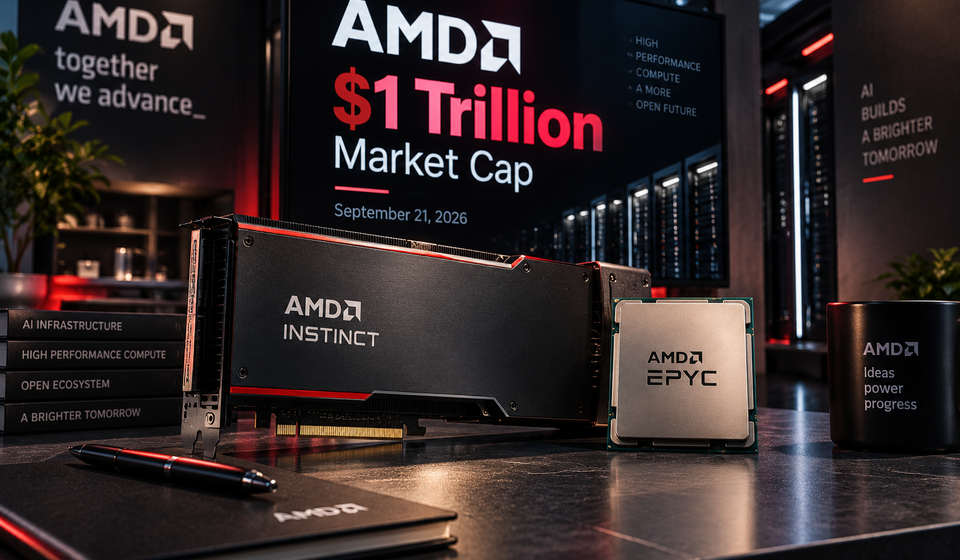
AMD Hits $1 Trillion Market Cap for the First Time
AMD Hits $1 Trillion
Advanced Micro Devices has officially crossed a major financial milestone. AMD passed a $1 trillion market capitalization for the first time on Monday, September 21, 2026, as its shares surged during a broader rally in semiconductor and artificial intelligence stocks.
The milestone puts AMD among a small group of semiconductor companies valued at more than $1 trillion. The move also reflects how strongly investors are focusing on AI infrastructure, data-center computing and the growing demand for chips needed to run AI workloads.
AMD Crosses the $1 Trillion Mark
AMD shares jumped roughly 10% on September 21, pushing the company’s total market value above the trillion-dollar threshold during trading. Reuters reported that AMD shares were up 9.6% at $613.31 when the company crossed the milestone.
AMD later finished the session up about 9.95% at $615.52, according to MarketWatch, giving the company a market capitalization of around $1 trillion.
The milestone is particularly notable because AMD’s valuation has increased dramatically during 2026 as demand for AI computing has reshaped the semiconductor industry.
Why AMD’s Valuation Has Risen
AI infrastructure is one of the major factors behind the renewed interest in AMD.
Modern AI systems require enormous amounts of computing power for both training and inference. That demand extends beyond GPUs to server CPUs, networking, memory and complete rack-scale systems.
AMD has been expanding across all of these areas.
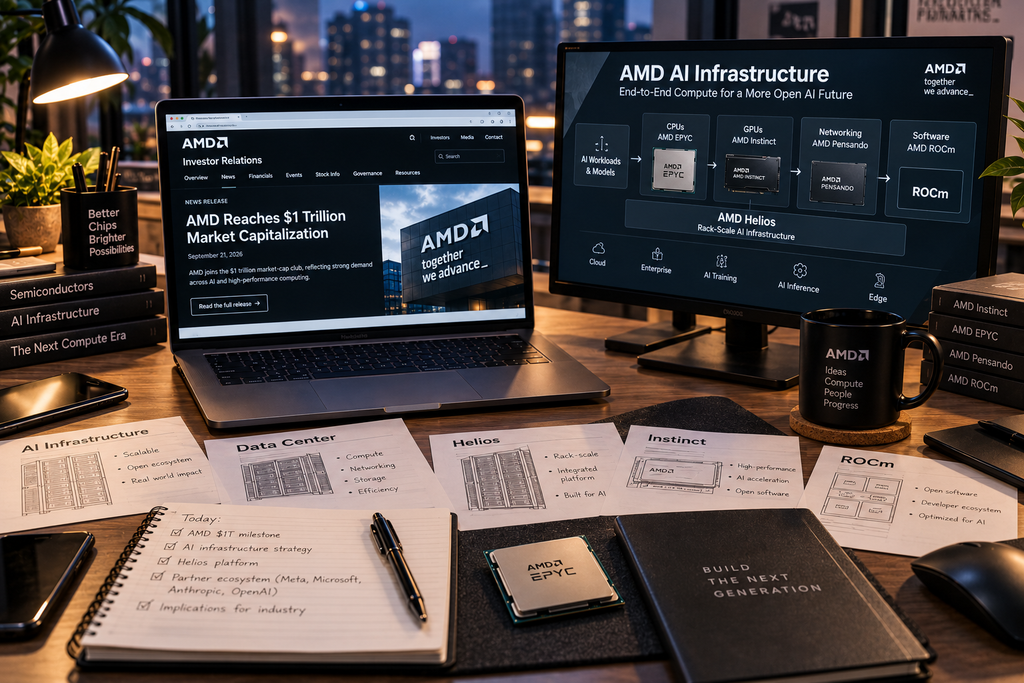
At its Advancing AI 2026 event, AMD introduced its Helios rack-scale AI platform, combining Instinct GPUs, EPYC CPUs, Pensando networking and ROCm software into a single infrastructure platform. AMD says Helios is designed for large-scale AI training and inference.
The company is therefore increasingly presenting itself not simply as a chip supplier, but as a provider of broader AI computing infrastructure.
AMD’s Data Center Business Is Growing
AMD’s latest financial results also show why investors are paying attention to its data-center operations.
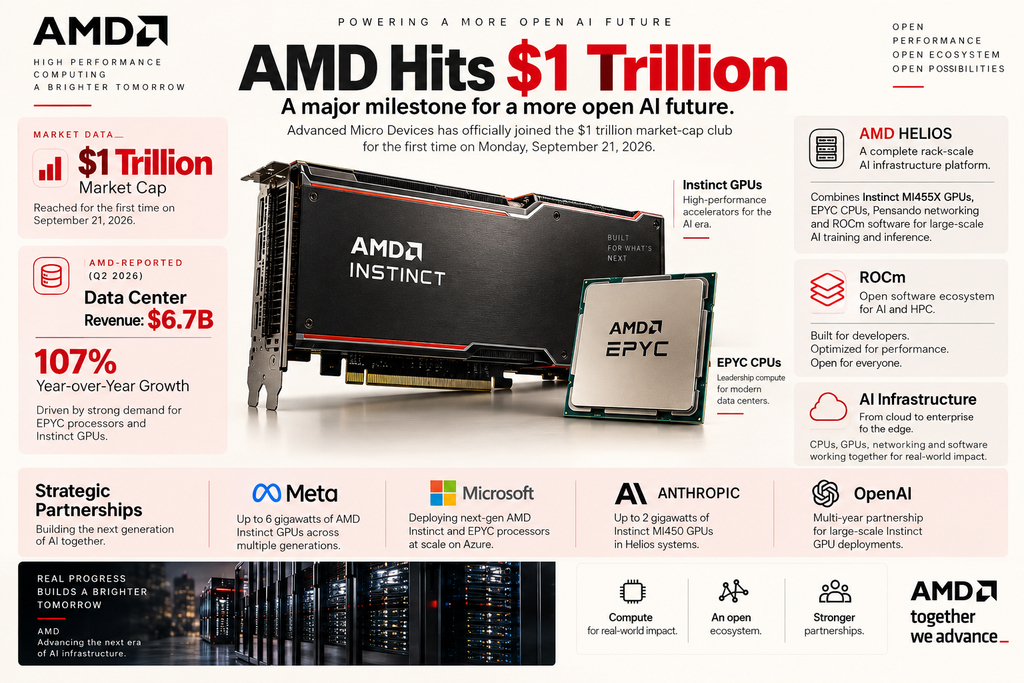
For the second quarter of 2026, AMD reported $6.7 billion in Data Center revenue, up 107% year over year. The company attributed the growth to strong demand for EPYC processors and Instinct GPUs.
AMD’s broader Q2 revenue was $11.5 billion, while its Client and Gaming segment generated $3.8 billion.
The data-center business has become increasingly important as cloud providers and AI companies expand infrastructure to support larger models and AI agents.
AMD Is Building Complete AI Systems
One of the biggest changes in AMD’s strategy is its move toward complete AI systems.
The company’s Helios platform combines:
- AMD Instinct GPUs
- AMD EPYC server CPUs
- AMD Pensando networking
- AMD ROCm software
AMD says Helios is designed to provide an integrated infrastructure platform for frontier AI and large-scale inference. Its announced architecture includes 72 Instinct MI455X GPUs and 18 sixth-generation EPYC CPUs.
This approach allows AMD to compete for larger portions of AI infrastructure spending rather than relying only on individual processor sales.
Major AI Companies Are Working With AMD
AMD has also announced several large AI infrastructure partnerships.
In July, AMD and Meta announced an agreement covering up to 6 gigawatts of AMD Instinct GPUs across multiple generations. The first gigawatt deployment is scheduled to begin shipping in the second half of 2026.
AMD also announced a partnership with Anthropic involving up to 2 gigawatts of Instinct MI450 GPUs in Helios systems. The first gigawatt deployment is expected to begin in the first half of 2027.
Microsoft has separately announced plans to deploy AMD Helios at scale on Azure for frontier-model inference and other AI workloads.
AMD has also announced a multi-year partnership with OpenAI involving large-scale Instinct GPU deployments.
These partnerships are important because they represent potential demand for AMD’s hardware beyond traditional PC and server markets.
ROCm Is Becoming More Important
Hardware is only one part of the AI infrastructure equation.
AMD has continued developing ROCm, its open software stack for GPU computing and AI workloads. The company says ROCm supports major AI frameworks and is being expanded to make it easier for developers to build and optimize applications on AMD hardware.
AMD recently introduced ROCm.ai, designed to provide an AI-native developer experience across its platforms. AMD says coding agents such as Claude, Codex and Cursor can understand AMD platforms and ROCm natively.
Software compatibility remains an important part of AMD’s attempt to expand its position in AI computing.
AMD Is Also Targeting AI PCs
AMD’s AI strategy isn’t limited to data centers.
The company is also developing processors and platforms designed for AI workloads on PCs and edge devices.
At Advancing AI 2026, AMD highlighted Ryzen AI Halo systems, which are designed for developers to build, test and run agentic AI workflows locally.
This creates another part of AMD’s strategy: supporting AI workloads across data centers, cloud infrastructure, PCs and edge devices.
AMD Becomes One of the Trillion-Dollar Chipmakers
Crossing $1 trillion puts AMD in a relatively small group of semiconductor companies that have reached that valuation.
Reuters reported that AMD became the fourth U.S. chipmaker to cross the $1 trillion threshold, following Nvidia, Broadcom and Micron.
The comparison also shows the scale of the AI semiconductor market. Nvidia remains significantly larger, but AMD’s milestone demonstrates how investor expectations around AI infrastructure have expanded beyond a single GPU supplier.
The AI Infrastructure Race Is Expanding
AMD’s $1 trillion milestone comes during a broader period of strong interest in AI infrastructure.
On September 21, the Nasdaq reached a record closing level, while several semiconductor stocks posted large gains. Intel and Arm also recorded significant increases during the session.
However, a rising market value does not by itself guarantee future business performance.
AMD still faces competition across GPUs, CPUs, networking and AI software. The company’s ability to convert its announced partnerships and infrastructure deployments into sustained revenue and profitability will remain important.
What AMD’s $1 Trillion Milestone Means
AMD reaching $1 trillion is more than a stock-market milestone. It reflects the increasing importance of AI infrastructure and the market’s attention toward companies supplying the hardware needed to operate increasingly large AI systems.
AMD’s strategy now extends from EPYC CPUs and Instinct GPUs to Helios racks, Pensando networking and ROCm software.
With partnerships involving Meta, Microsoft, Anthropic and OpenAI, AMD is positioning its technology across several layers of the AI infrastructure ecosystem.
Whether the company can maintain this momentum will depend on future deployments, customer demand, product execution and the economics of the rapidly expanding AI market.
Conclusion
AMD’s first move above a $1 trillion market capitalization marks a significant moment for the company and the semiconductor industry. The milestone comes as AMD expands beyond traditional CPU and GPU sales into complete AI infrastructure, software and large-scale partnerships.
With data-center revenue growing rapidly and new Helios systems being adopted by major technology companies, AMD is becoming an increasingly important participant in the AI infrastructure market.
The next stage will be watching how AMD converts this growing AI demand and its announced partnerships into actual deployments, revenue and long-term business growth.
FAQs
When did AMD reach a $1 trillion market cap?
AMD crossed the $1 trillion market-capitalization level for the first time on September 21, 2026.
Why did AMD’s market cap reach $1 trillion?
The rise came during a broader semiconductor rally, with investors focusing on AMD’s expanding role in AI computing and data-center infrastructure.
What is AMD Helios?
AMD Helios is a rack-scale AI infrastructure platform combining Instinct GPUs, EPYC CPUs, Pensando networking and ROCm software.
Which AI companies are working with AMD?
AMD has announced major AI infrastructure partnerships involving Meta, Microsoft, Anthropic and OpenAI.
Is AMD now the largest semiconductor company?
No. Crossing $1 trillion does not make AMD the largest semiconductor company by market capitalization. Nvidia remains substantially larger.
Related Articles: