
Xiaomi HyperOS 4: New Features, Eligible Devices & Release Schedule
Xiaomi HyperOS 4: New Features, Performance Improvements and Eligible Devices
Xiaomi has published its global Xiaomi HyperOS 4 feature page and rollout schedule, outlining a major software update for Xiaomi, Redmi and POCO devices. The update focuses on a redesigned interface, smoother performance, expanded AI tools and additional privacy protections.
According to Xiaomi’s official global page, the rollout is scheduled to begin in early November 2026, with supported devices receiving the update in stages. The company has also listed separate rollout windows for November and December.`
What’s New in Xiaomi HyperOS 4?
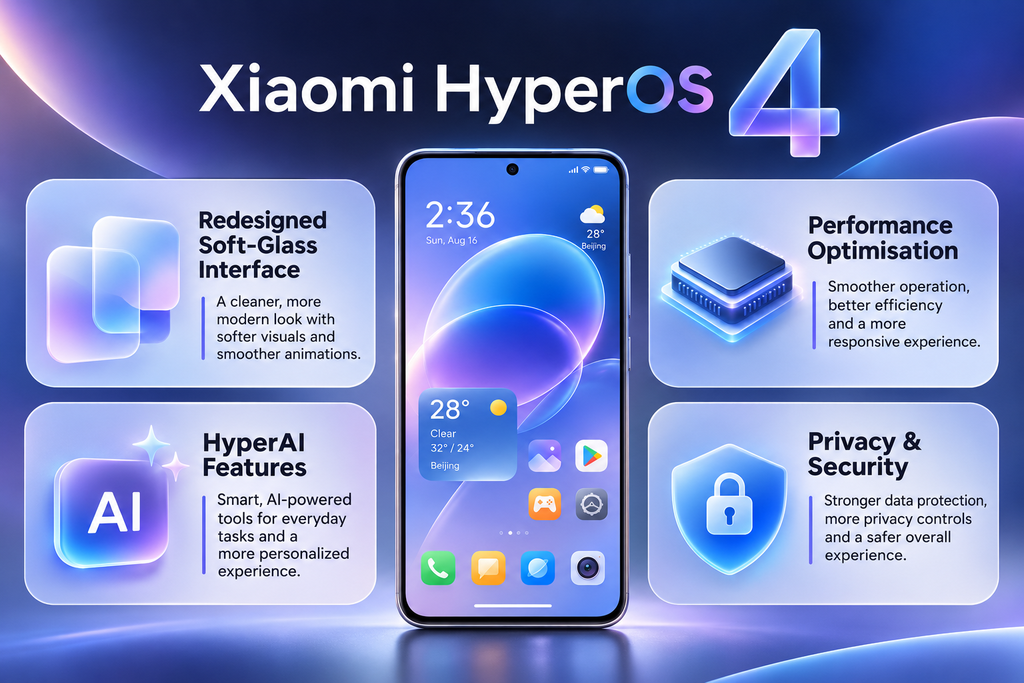
Xiaomi is presenting HyperOS 4 around three main priorities: effortless aesthetics, effortless performance and effortless interaction. Rather than focusing on one headline feature, the update combines interface changes, system-level optimisation and AI-powered tools.
The features below are based on Xiaomi’s published global information. Availability is not universal: the company says some options depend on the device, region, language and software version.
1. A Redesigned Interface With a Soft-Glass Look
One of the most visible changes in HyperOS 4 is its refreshed visual design. Xiaomi describes the new approach as a soft-light glass interface, with improved use of transparency, lighting, shadows and visual depth.
The interface is designed to feel more responsive to user interactions. Xiaomi highlights dynamic lighting effects that react when users tap or drag elements on the screen. Transparency can also adapt to the displayed content to make different interface layers easier to recognise.
The update introduces several home-screen and lock-screen improvements:
- Flexible lock-screen clocks: Users can adjust clock sizing and typography.
- Stacked notifications: Notifications are organised into a cleaner stack that can be browsed by swiping.
- Resizable home-screen folders: Supported phones can use different folder sizes to organise apps.
- Stacked widgets: Users can organise multiple widgets in a shared space and switch between them.
- Improved layouts: Xiaomi says its phone and tablet applications are being optimised for their respective screen sizes.
These changes are intended to make HyperOS feel more organised without completely changing how users navigate their devices. However, Xiaomi notes that some interface features will only work on selected models.
2. Performance Improvements and Faster App Launches
Performance is another major focus of Xiaomi HyperOS 4. Xiaomi says it has improved workload scheduling, memory management and the application runtime environment to deliver a smoother experience.
The company highlights three technologies:
Precision Workload Scheduling: Xiaomi says HyperOS 4 monitors workloads across the system and optimises how resources are allocated. The goal is to keep applications and system controls responsive during everyday use.
Memory Preloading: The system uses AI-driven proactive memory management to prepare resources when they are needed. Xiaomi describes this as an approach that helps applications access memory more efficiently.
Application Runtime Environment: Xiaomi says it has reworked its first-party application environment to improve efficiency and overall system performance.
The company has also published internal laboratory comparisons between HyperOS 4 and HyperOS 3 on the Xiaomi 17 Ultra.
| Performance test | HyperOS 3 | HyperOS 4 |
|---|---|---|
| Total hot-launch time for 30 apps after 9 hours of use | 40.3 seconds | 36.8 seconds |
| Rear-camera HDR photo capture | 313.38 ms | 240.16 ms |
| Camera cold launch | 1,043.6 ms | 808.8 ms |
| Average frame-drop rate | 2.92% | 1.10% |
| Frame-drop rate after 9 hours of use | 0.15% | 0.08% |
These figures suggest improvements in app launching, camera responsiveness and frame stability. However, they are Xiaomi’s own laboratory results, not independent benchmark tests. Xiaomi also says actual results may vary depending on the device and testing environment.
3. Xiaomi HyperAI Brings More AI Features
AI is an important part of Xiaomi’s HyperOS 4 experience. The company is expanding its HyperAI features to help users organise information, understand conversations and create content.
Some of the key features include:
AI Voice Notes
Users can record voice notes with a single tap. HyperAI can organise recordings into structured entries and provide additional tools, including:
- Questions and answers based on saved notes.
- Automatic extraction of to-do items.
- Conversion of complex notes into visual mind maps.
- More organised voice-recording management.
This could be useful for people who regularly record meetings, reminders or personal notes.
AI Speech Recognition
Xiaomi is also introducing improved speech-recognition tools for recorded content. The listed capabilities include identifying meeting contexts, extracting important points, generating outlines and inserting image markers.
The system can also skip silent sections in recordings, making it easier to review longer audio files.
AI Answers
AI Answers combines multimodal intelligence with web search to provide information in response to user questions. The feature is designed to make it easier to find answers without manually searching through multiple sources.
AI Translate Conversation
This feature is designed to translate face-to-face conversations. It could help users communicate when speaking different languages.
AI Gallery Search
Instead of manually scrolling through hundreds of photos, users can search for specific memories using the gallery’s AI-powered search capabilities.
AI Creativity Assistant
Xiaomi also lists AI-powered editing tools that help users modify and enhance visual content.
One important limitation is that HyperAI features will not be available on every device. Xiaomi says availability depends on the model, region and supported languages. Some tools also require an internet connection.
4. Improved Privacy and Security
Xiaomi has also highlighted privacy and security as part of the Xiaomi HyperOS 4 update.
The official page mentions two areas of development.
Quantum-level Data Protection: Xiaomi says it is strengthening data protection through future-ready post-quantum encryption. However, the company clarifies that quantum encryption currently protects main key delivery in certain end-to-end encryption scenarios. It should not be interpreted as complete quantum-resistant protection across the entire operating system.
Edge-to-Cloud AI Data Security: Xiaomi describes an approach that combines on-device privacy storage with confidential cloud computing. The objective is to protect user data while enabling AI features that may involve cloud processing.
The company says availability of these protections can vary depending on the supported device and service.
Xiaomi HyperOS 4 Eligible Devices and Rollout Schedule
Xiaomi has published a global rollout schedule covering Xiaomi, Redmi and POCO phones and tablets. The schedule is divided into three phases: early November, mid-November and December 2026.
The following are examples from Xiaomi’s published device list. They are not a complete list of every eligible model.
Early November 2026
| Device category | Listed models |
|---|---|
| Xiaomi | Xiaomi 17 Ultra, Xiaomi 17, Xiaomi 17T Pro, Xiaomi 17T |
| Redmi | Redmi Note 15 Pro+ 5G, Redmi Note 15 Pro 5G, Redmi Note 15 Pro, Redmi Note 15 5G, Redmi Note 15, Redmi 17 series |
| POCO | POCO F8 Ultra, POCO F8 Pro, POCO X8 Pro Max, POCO X8 Pro, POCO M8 series |
| Tablets | Xiaomi Pad 8 Pro, Xiaomi Pad 8 |
Mid-November 2026
| Device category | Listed models |
|---|---|
| Xiaomi | Xiaomi 15 Ultra, Xiaomi 15, Xiaomi 15T Pro, Xiaomi 15T |
| Redmi | Redmi Note 17 Pro Max 5G, Redmi Note 17 Pro 5G, Redmi Note 17 5G, Redmi Note 17 |
| POCO | POCO F9 Ultra, POCO F9 Pro, POCO F7 Ultra, POCO F7 Pro, POCO F7, POCO X8, POCO X7 Pro |
| Tablets | Xiaomi Pad 7 Pro, Xiaomi Pad 7, Redmi Pad 2 Pro 5G, POCO Pad X1, POCO Pad M1 |
December 2026
| Device category | Listed models |
|---|---|
| Xiaomi | Xiaomi MIX Flip, Xiaomi 14 Ultra, Xiaomi 14, Xiaomi 13 Ultra, Xiaomi 13 Pro, Xiaomi 13, Xiaomi 14T series, Xiaomi 13T series |
| Redmi | Redmi Note 14 series, Redmi 15 series, Redmi A7 Pro |
| POCO | POCO F6 series, POCO X8s, POCO X7, POCO X6 Pro, POCO M8s 5G, POCO M7, POCO C81 Pro |
| Tablets | Xiaomi Pad 6S Pro 12.4, Redmi Pad 2 series, POCO Pad C1 |
Important: This is Xiaomi’s estimated global schedule, not a guarantee that every listed device will receive the update on the first day of its phase. The company says timing can change based on region, carrier, device model and development progress. The order of devices does not represent their exact update sequence.
Will Xiaomi HyperOS 4 Be Available in India?
Xiaomi’s published page provides a global rollout schedule for supported global devices, including Xiaomi, Redmi and POCO models. However, it does not provide a separate, confirmed India-specific rollout calendar.
That means Indian users should not assume that every device listed for an early-November global rollout will receive the update in India on the same date.
The rollout may also depend on the exact regional variant of a phone. Users should check the official Xiaomi channels and their device’s system update settings for confirmation.
Xiaomi also warns that some features may be restricted by region, language or hardware. This is particularly relevant for HyperAI features, which may not be available across the entire supported-device list.
Once Xiaomi begins distributing HyperOS 4 to a supported device, users can check for the update through their phone’s settings.
- Open Settings on your Xiaomi, Redmi or POCO phone.
- Select About phone.
- Tap the HyperOS version or system update section.
- Select Check for updates.
- If the update is available for your device and region, follow the on-screen instructions.
The update may not appear immediately, even if your phone is included in Xiaomi’s schedule. Software updates are often distributed in stages, so users may need to wait for their region or device batch.
Before installing a major system update, it is sensible to back up important data, use a stable Wi-Fi connection and ensure the phone has sufficient battery charge.
Expert Analysis
Xiaomi HyperOS 4 looks like a broad refinement of Xiaomi’s software experience rather than a simple visual redesign.
Its combination of interface improvements, system optimisation and HyperAI tools could make everyday tasks more convenient.
However, the most interesting features are subject to device and regional restrictions, so the experience may differ significantly between models.
The real test will be how consistently Xiaomi delivers these improvements across its large range of phones and tablets.
Conclusion
Xiaomi HyperOS 4 brings together a redesigned interface, performance optimisation, expanded AI features and additional privacy protections. The new soft-glass visual style is one of its most noticeable changes, while AI Voice Notes, AI Speech Recognition and AI Gallery Search add more practical functionality.
The published global rollout schedule starts in early November 2026 and extends through mid-November and December. Several Xiaomi, Redmi and POCO phones and tablets are included, although the timing remains subject to regional and device-specific changes.
For existing Xiaomi users, the update could bring useful improvements to everyday phone use. However, it is worth checking the exact device and regional availability rather than assuming that every HyperOS 4 feature will arrive on every supported phone.
Frequently Asked Questions
1. What is Xiaomi HyperOS 4?
Xiaomi HyperOS 4 is Xiaomi’s latest operating system update for supported Xiaomi, Redmi and POCO devices. It introduces a refreshed interface, performance improvements, AI tools and additional privacy features.
2. When will Xiaomi HyperOS 4 be released?
Xiaomi’s global rollout schedule starts in early November 2026. Additional devices are listed for mid-November and December 2026.
3. Which phones will receive Xiaomi HyperOS 4?
The official list includes selected Xiaomi 17 and Xiaomi 15 series devices, Redmi Note series phones, POCO F and X series phones, and several tablets. Eligibility depends on the specific model and region.
4. What are the major features of Xiaomi HyperOS 4?
The main features include a soft-glass interface, flexible lock-screen clocks, stacked notifications and widgets, improved performance scheduling, AI Voice Notes, AI Speech Recognition, AI Translate Conversation and AI Gallery Search.
5. Will Xiaomi HyperOS 4 improve gaming and performance?
Xiaomi reports improvements in workload scheduling, application launches and frame stability in its internal tests. However, it has not provided a universal gaming-performance improvement figure for every supported device.
6. Will all HyperOS 4 features be available on every device?
No. Xiaomi says some interface and AI features are restricted to selected models, regions and languages. Hardware and software differences can also affect availability.
7. Is HyperOS 4 coming to Redmi and POCO phones?
Yes. Xiaomi’s global schedule includes selected Redmi and POCO phones and tablets alongside Xiaomi-branded devices.
Suggestions:
Xiaomi 18 Fold Launched With XRing O3, 7.58-Inch Display and 6,000mAh Battery
Redmi M100 Pro: Expected Specifications, Features and India Launch Status
POCO X8s: 7 Powerful Features, Price and India Launch News
Source:
Xiaomi Global – Xiaomi HyperOS 4 official feature and rollout page
Xiaomi Hyper OS X Account