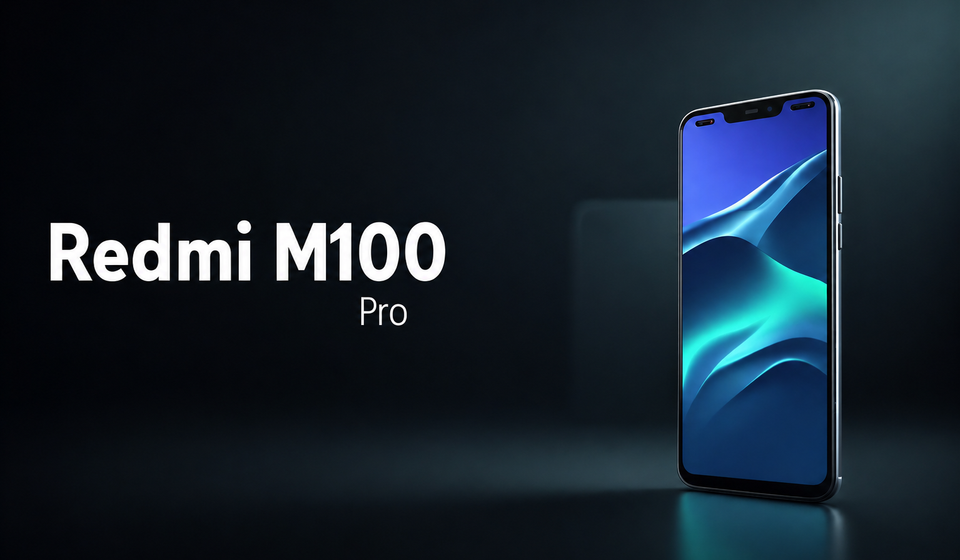
Redmi M100 Pro: Expected Specifications, Features and India Launch Status
The Redmi M100 Pro looks like a 2026 phone until you read the fine print. A 1.5K OLED, IP68 protection, and a 190g frame sit on top of a Dimensity 7300-Ultra chip that MediaTek announced in 2024, a 5,500mAh battery smaller than the cheaper M100’s, and a CNY 2,499 price that never got adjusted for the gap. This is what a rebrand looks like when it’s done competently — and why the spec sheet deserves a second read before the badge does.
key points and features
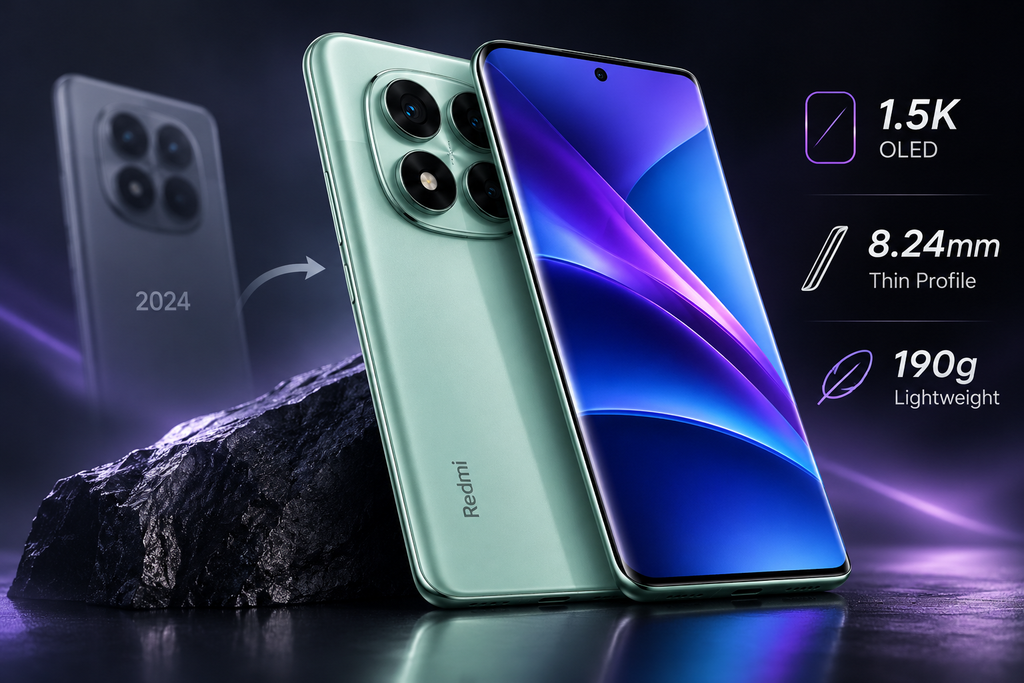
- 6.67-inch 1.5K OLED, 120Hz, 3,000 nits peak, Gorilla Glass Victus 2 — the strongest part of the phone
- MediaTek Dimensity 7300-Ultra, a 4nm chip from 2024, paired with 12GB LPDDR4X RAM and 256GB UFS 2.2 storage
- 50MP main camera with OIS, plus an 8MP ultrawide and a 2MP macro; 20MP selfie shooter
- 5,500mAh battery with 45W wired charging — modest for 2026, when rivals are crossing 8,000mAh
- IP68, stereo speakers, IR blaster, NFC, in-display fingerprint — the feature set is genuinely complete
- 190g and 8.24mm thick with a curved display — a very different physical proposition from the 232g standard M100
- China-only at CNY 2,499 (~₹33,000) for a single 12GB/256GB variant; no India launch announced
- It is functionally a rebrand of the Chinese Redmi Note 14 Pro — same chip, same cameras, same battery, different name.
Redmi M100 Pro price and availability
Xiaomi launched the Redmi M100 Pro in China on 2 November 2026. There is exactly one configuration: 12GB RAM and 256GB storage, priced at CNY 2,499, which converts to roughly ₹33,000 before local taxes and retail margins. It comes in Midnight Black, Mirror Porcelain White, Phantom Blue, and Twilight Purple.
For Indian readers, the availability answer is short: there is no India launch, and Xiaomi has not announced plans for one. Multiple outlets expect the M100 Pro to remain China-only, positioned for local carrier deals rather than a global rollout. That is consistent with how Redmi has handled the M-series: the standard M100 never officially reached India either, and the M100 Pro looks set to follow the same path.
The display is the one genuinely strong argument
If you are going to defend the Redmi M100 Pro on any single specification, it is the screen.
The phone carries a 6.67-inch OLED panel with a 1.5K resolution — 2712 × 1220 pixels, working out to roughly 456ppi. It refreshes at 120Hz, samples touch at 2560Hz, and Redmi claims 3,000 nits of local peak brightness. It covers the DCI-P3 gamut, supports Dolby Vision, and is protected by Corning Gorilla Glass Victus 2. The panel is curved, which is a preference rather than a virtue, but the hardware itself is a clear tier above what the standard M100 offers with its 720p LCD.
This is the spec that justifies the “Pro” label. It is also the spec that makes the rest of the phone frustrating, because a display this good deserves a chipset that can drive it for more than a couple of years.
The chipset is the problem nobody wants to say out loud
The Redmi M100 Pro runs on MediaTek’s Dimensity 7300-Ultra. It is a 4nm octa-core part with a Mali-G615 MC2 GPU and a 2.5GHz peak clock. It is not slow. It handles everyday tasks, messaging, video, maps, and casual gaming without complaint.
But here is the part that matters: the Dimensity 7300-Ultra is a 2024 mid-range chip. By the time the M100 Pro went on sale in late 2026, that silicon was two product cycles old, sitting inside a phone priced at CNY 2,499. Notebookcheck put it bluntly: at the same price in China, the Lenovo Y70 offers a Snapdragon 8 Gen 5, a dramatically more capable chip.
The memory configuration is also worth flagging. Twelve gigabytes of RAM sounds generous until you notice it is LPDDR4X, paired with UFS 2.2 storage. Neither is a bottleneck for basic use, but both are older standards being sold at a 2026 price. Beebom’s benchmark database lists Geekbench 6 scores of roughly 1,080 single-core and 3,100 multi-core — numbers that were respectable for a mid-ranger in 2024 and are unremarkable now.
Battery, charging, and the 5,500mAh question
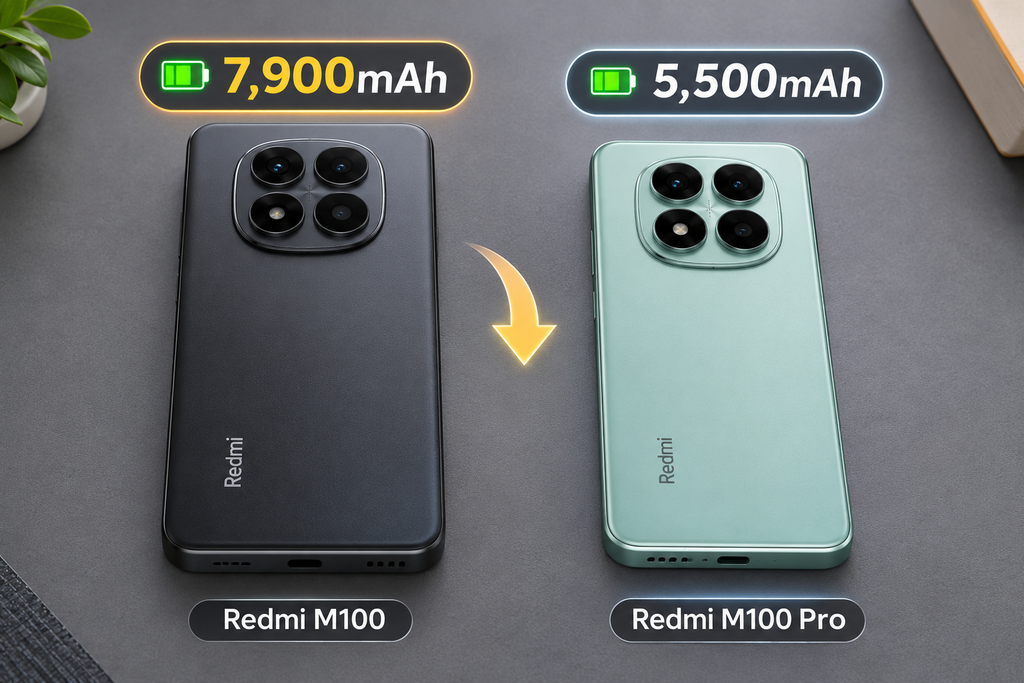
The Redmi M100 Pro has a 5,500mAh battery with 45W wired charging. On its own, that is a normal, perfectly usable combination. A 5,500mAh cell will get most people through a full day, and 45W is fast enough to be useful without being remarkable.
The problem is context. In 2026, the mid-range segment has moved aggressively toward 8,000mAh and beyond — including within Redmi’s own M-series, where the standard M100 carries a 7,900mAh cell. The M100 Pro, the more expensive and more premium-feeling phone, has 2,400mAh less capacity than its cheaper sibling. That is a strange hierarchy, and it is the clearest evidence that the M100 Pro was designed in a different era and relaunched without rethinking its power budget.
Xiaomi does claim four-year battery durability, which is a meaningful commitment if it holds up. But capacity is capacity, and the M100 Pro is not winning any endurance contest against its own family.
Camera, software and the rest of the hardware
The camera system is a 50MP main sensor with optical image stabilisation, flanked by an 8MP ultrawide and a 2MP macro, with a 20MP front-facing camera. The main sensor is a Sony LYT 600 with an f/1.5 aperture, which is a genuinely good piece of hardware for this price. The ultrawide and macro are functional rather than exciting, and the 2MP macro is the kind of lens that exists mostly to fill out a spec sheet.
Software is Android 16 with HyperOS 3, and Beebom lists two years of software updates. Two years is thin for a phone at this price. A ₹33,000 device in 2026 should be promising longer, and anyone planning to keep the M100 Pro for four years should factor that into the decision.
Around the edges, the phone is unusually well-equipped. There is IP68 dust and water resistance, a rarity at this price. There are stereo speakers with Dolby Atmos and Hi-Res Audio, an IR blaster, NFC, Wi-Fi 6, Bluetooth 5.4, and an in-display fingerprint scanner. The phone weighs 190g and measures 8.24mm thick, making it far more pocketable than the 232g standard M100.
Redmi M100 Pro vs Redmi M100: two phones, two philosophies
The most useful comparison for anyone trying to understand the M-series is between the two M100 models themselves.
The standard Redmi M100 is a battery phone. It has a 7,900mAh cell, a 6.9-inch 720p LCD, a Snapdragon 4 Gen 5, a 13MP camera, and it weighs 232g. It starts at CNY 1,799 and is built around endurance above all else.
The Redmi M100 Pro is a display phone. It has a 1.5K OLED, a Dimensity 7300-Ultra, a 50MP OIS camera, IP68, and it weighs 190g. It costs CNY 2,499 and is built around the experience of looking at and holding the device.
Neither is strictly better. They are answers to different questions. But the Pro’s smaller battery and older chipset mean it is not a straightforward “upgrade” — it is a sideways move into a different set of priorities. Buyers should choose the philosophy, not the badge.
Should you wait for the Redmi M100 Pro?
If you are in India: there is nothing to wait for. The phone is China-only, with no announced global plan. The standard M100 is also China-only, and the India-facing equivalent of that design is the Poco M8x 5G, which pairs the same 7,900mAh battery with a better 50MP camera and stereo speakers at a lower price. The M100 Pro has no equivalent India route at all.
If you are in China and shopping at CNY 2,499, the honest advice is to compare it against newer mid-rangers before buying. The M100 Pro’s screen, IP68 rating, and 190g build are real advantages. Its 2024 chipset, LPDDR4X memory, 5,500mAh battery, and two-year update commitment are real disadvantages. It is a phone that made sense in 2024 and is being sold in 2026 — and the price has not been adjusted to reflect that gap.
The Redmi M100 Pro is not a scandal. It is a rebrand, executed competently, aimed at a market where carrier deals and brand recognition matter more than benchmark scores. But a rebrand is still a rebrand, and the most useful thing a tech blog can do is say so plainly.
Conclusion
The Redmi M100 Pro is not a bad device. The 6.67-inch 1.5K OLED is excellent for the money, the IP68 rating is genuinely rare in this bracket, and the 190g build makes it a far more comfortable object than the standard M100. On a spec sheet, it looks like a phone that punches above its price.
The problem is that the spec sheet is not the whole story. The Dimensity 7300-Ultra is two product cycles old. The 5,500mAh battery sits below the capacity of the cheaper M100. The LPDDR4X memory and UFS 2.2 storage belong to an older price tier. And the two-year software update commitment is thin for a device that costs roughly ₹33,000. None of these are dealbreakers in isolation. Together, they describe a phone whose price has not been adjusted to match its age.
The most useful way to read the M100 Pro is as a carrier-deal device. Notebookcheck’s reporting suggests it is “geared for local carrier deals” rather than a global retail push, and that framing explains almost every odd decision in the product. On a subsidised contract in China, the calculus changes. At full retail against a Snapdragon 8 Gen 5 competitor, it does not.
For Indian readers, the answer is simple: the phone is not coming, so there is nothing to wait for. For Chinese buyers considering it at CNY 2,499, the honest advice is to compare it against newer mid-rangers before committing — and to buy it for the screen and the build, not for the chip or the battery. The M100 Pro is a competent rebrand, not a new benchmark. A tech blog’s job is to say that plainly, and this one does.
Frequently asked questions
1.Is the Redmi M100 Pro a new phone?
Not really. It carries the same Dimensity 7300-Ultra chipset, 1.5K OLED, 50MP camera and 5,500mAh battery as the 2024 Redmi Note 14 Pro. Xiaomi has effectively reissued that hardware under a new M-series name.
2.Will the Redmi M100 Pro launch in India?
No — there is no India launch announced, and reporting points the other way. Beebom lists it as “Not Released in India” and Notebookcheck calls a global debut unlikely. Treat it as China-only until Xiaomi says otherwise.
3.What is the Redmi M100 Pro price?
CNY 2,499 — roughly ₹33,000 — for a single 12GB + 256GB variant. No other configurations are offered. Colour options are Midnight Black, Mirror Porcelain White, Phantom Blue and Twilight Purple.
4.Why is the Redmi M100 Pro criticised despite good specifications?
Because the chipset lags the price. The Dimensity 7300-Ultra is a 2024 mid-range part, and Notebookcheck notes the Lenovo Y70 offers a Snapdragon 8 Gen 5 at the same price. Memory is LPDDR4X and storage is UFS 2.2 — older standards for the money.
5.Is the 5,500mAh battery a problem?
On its own, no — it will last most people a full day. But Redmi’s cheaper M100 has a 7,900mAh cell, so the premium model has 2,400mAh less capacity than its budget sibling. That hierarchy is hard to justify in 2026.
6.What is the difference between the Redmi M100 and the Redmi M100 Pro?
They are built around opposite priorities. The M100 is a battery phone: 7,900mAh, 720p LCD, 232g. The M100 Pro is a display phone: 1.5K OLED, IP68, 190g. It is a sideways move, not a straight upgrade.
7.Does the Redmi M100 Pro have a headphone jack?
No. It has stereo speakers with Dolby Atmos and Hi-Res Audio, but no 3.5mm jack and no analog audio output. Wired listening requires a USB-C dongle.
Suggestions
- Free Fire India Launched: Download Links, Features and Diwali Event
- Noise Buds R1 Gaana Edition Launched at ₹1,399 in India
- WhatsApp Group Chat Features: 4 Exciting New Updates
- Vivo V80 Lite 5G: Expected Specifications, Features and India Launch Status
Source
- Xiaomi China store — Redmi M100 Pro product page
- Xiaomi India — Redmi Note 14 Pro 5G specification page
- Xiaomi Global — Redmi 17 5G specification page