Meta VR Glasses vs Apple Vision Pro: Price, Weight and Features Compared
Meta has unveiled a new virtual-reality device designed to put a much lighter form factor at the center of the experience.
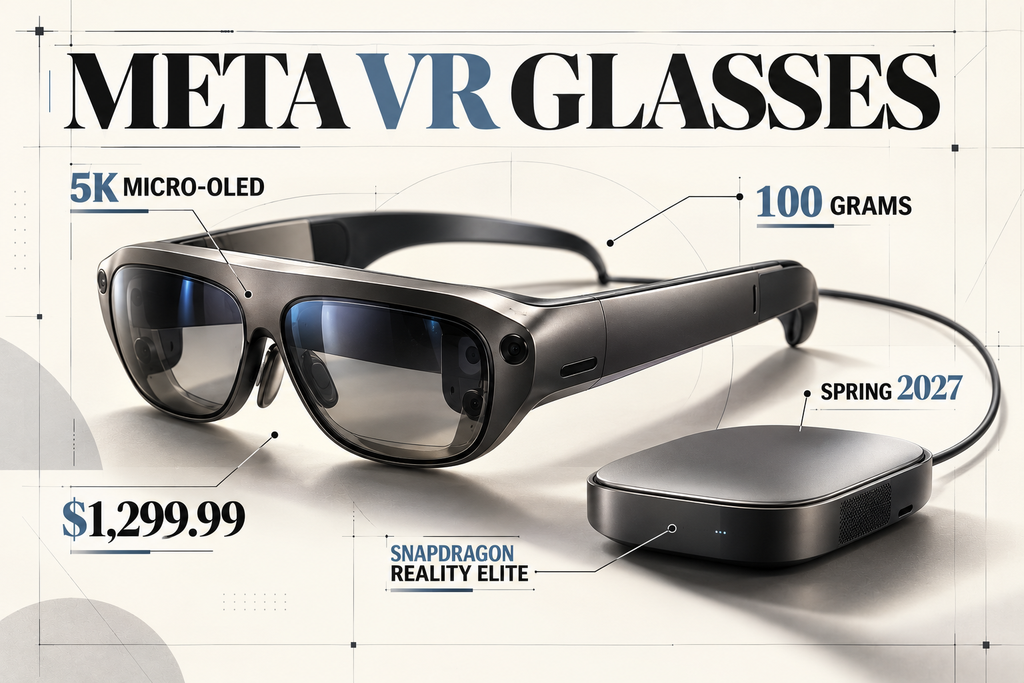
Called Meta VR Glasses, the device was introduced by Mark Zuckerberg at Meta Connect on September 23, 2026. It is priced at $1,299.99 and is scheduled to go on sale in spring 2027.
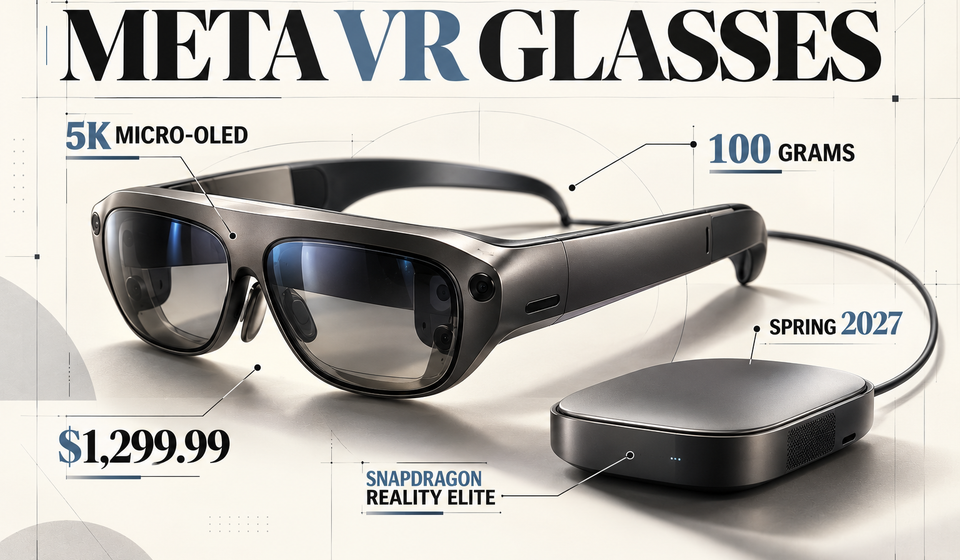
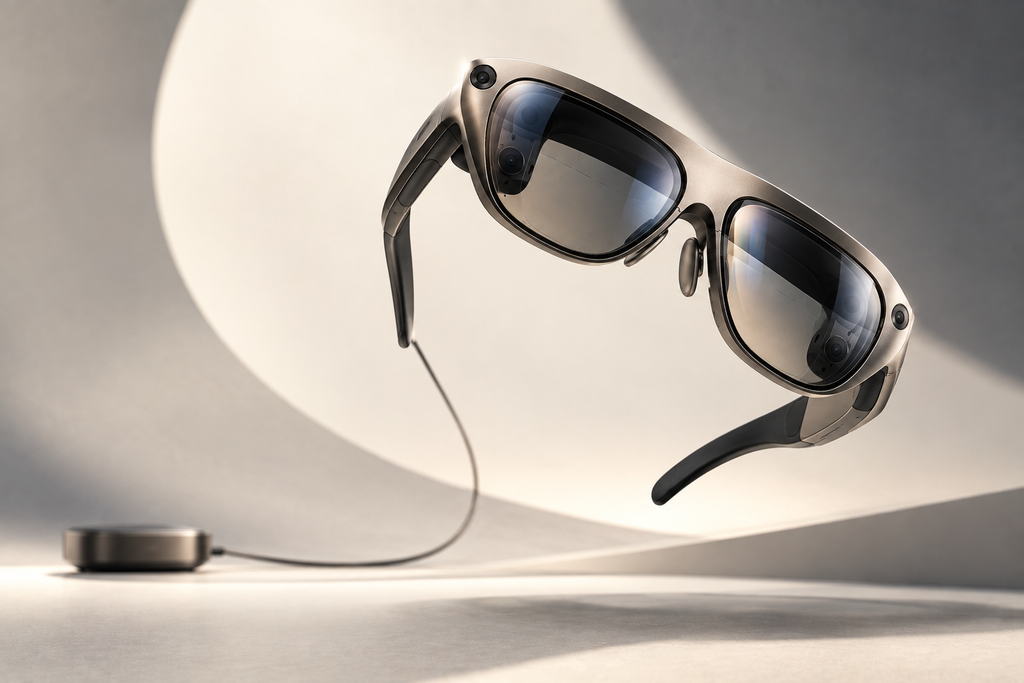
Unlike conventional VR headsets, Meta’s new device looks much closer to a pair of glasses. The glasses themselves weigh about 100 grams, while computing, battery and storage are moved into a separate puck connected to the glasses through an optical tether.
That approach puts Meta’s new hardware in a very different position from Apple’s Vision Pro, which currently starts at $3,499 in the U.S. and weighs 600–650 grams for the device, with a separate 353-gram battery.
Meta VR Glasses Cost $1,299.99
Meta has confirmed the U.S. price at $1,299.99.
The company says the glasses will become available in spring 2027, although it has not provided a specific release date.
The price puts the device substantially below Apple’s Vision Pro launch price of $3,499. Apple’s current Vision Pro technical specifications list 256GB, 512GB and 1TB storage configurations.
However, price alone does not tell the complete story because Meta’s system uses a two-piece design.
A 100-Gram VR Device
The biggest hardware difference is weight.
Meta says the glasses weigh approximately 100 grams, roughly the weight of a deck of cards. The company says this is possible because the glasses carry the displays and sensors while the external compute puck handles the processor, battery and storage.
The puck can be clipped to a pocket or bag and connects to the glasses using an optical tether.
This allows Meta to reduce the amount of hardware sitting directly on the user’s face while retaining a full VR experience.
For comparison, Apple’s Vision Pro currently weighs 600–650 grams depending on configuration, while its separate battery weighs another 353 grams.
The two products therefore use fundamentally different approaches to distributing hardware.
5K Micro-OLED Displays
Meta VR Glasses feature what Meta calls a 5K Infinite Display based on micro-OLED panels.
The company says the display delivers 37 pixels per degree, with compact pancake lenses designed specifically for the glasses form factor. Meta says the system is designed to provide enough clarity for activities such as watching movies and reading text in virtual workspaces.
Meta is also positioning the glasses as a cinematic device.
The company says they are the first VR device to receive IMAX Enhanced certification, with support planned for 3D movies and expanded cinematic experiences. Disney+ is also expected to offer selected 3D movies on the platform in supported markets.
Snapdragon Reality Elite Handles the Compute
Meta VR Glasses are powered by Qualcomm’s Snapdragon Reality Elite processor.
Instead of placing the main compute hardware inside the glasses, Meta moves it to the connected puck. The company says this arrangement enables high-performance VR while keeping the glasses substantially lighter.
The puck also contains the battery and storage.
Meta says its battery can provide up to three hours of continuous high-resolution media playback and supports 45W fast charging.
The company has not positioned the product as a completely standalone pair of glasses because the external puck is an essential part of the system.
Eye and Hand Tracking Without Controllers
Meta is also removing the need for conventional VR controllers for many interactions.
The glasses combine eye tracking, hand gestures and voice commands. Users can look at an object, use their hands to interact with virtual elements or speak to Meta’s AI assistant.
Meta says users can create multiple virtual displays for work and even turn a physical flat surface into a virtual keyboard and touchpad.
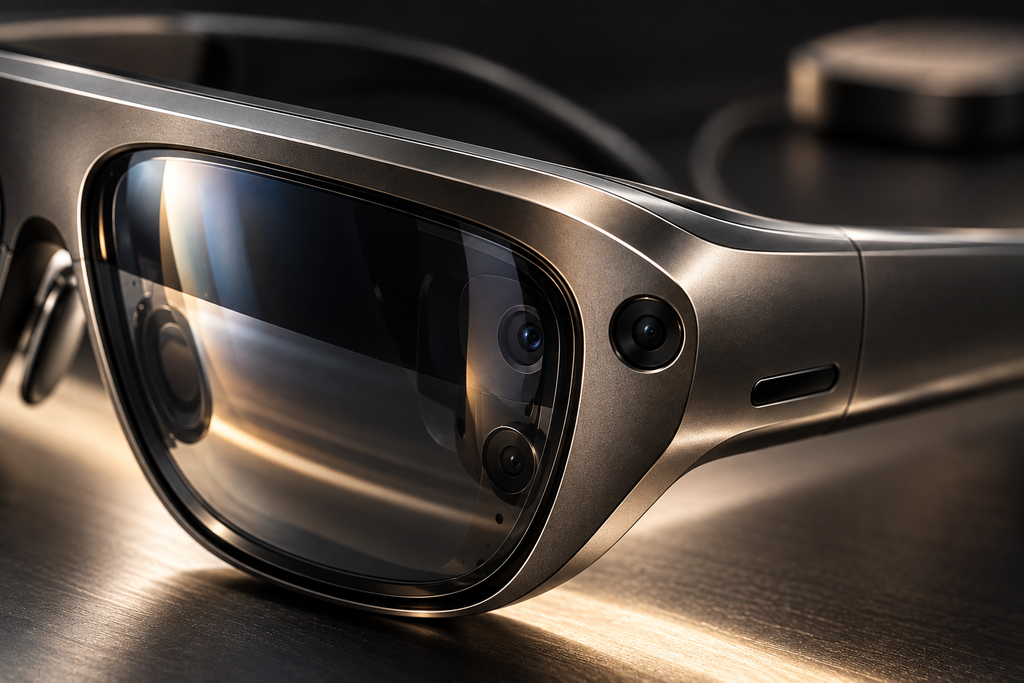
The system is also designed with passthrough cameras, allowing users to remain aware of their physical surroundings while wearing the glasses.
Meta AI and Muse Are Built Into the Experience
AI is another major part of Meta’s strategy.
Meta says its Muse AI agent is coming to its AI glasses in the coming months. Users will be able to interact with Muse through voice and ask it to understand or act on things they are looking at.
For Meta VR Glasses specifically, the company is integrating Meta AI into the operating system.
Users can use voice, eye movement and hand gestures to perform tasks such as launching applications, playing content and interacting with their workspace.
Meta is also introducing hologram calling, which can create a real-time digital representation of a person during video calls. The company says the feature will work across calling applications including WhatsApp and Zoom.
Gaming, Movies and Sports
Meta is pitching the VR Glasses as more than a productivity device.
The company says more than 75 games will support hand-gesture interaction at launch, while Xbox Cloud Gaming will provide access to additional games.
Sports are another major focus.
Meta says it is working with ESPN, MLB, NBC Sports, TNT Sports and UFC to provide immersive live sports, with more than 100 immersive live sporting events planned each year once the glasses launch.
The company is also working with entertainment partners including Prime Video, YouTube, DIRECTV, AMC+, Crunchyroll and Plex.
Meta VR Glasses vs Apple Vision Pro
The two products target overlapping use cases but differ significantly in hardware design.
| Feature | Meta VR Glasses | Apple Vision Pro |
| Price | $1,299.99 | From $3,499 |
| Release | Spring 2027 | Available |
| Device weight | About 100g | 600–650g |
| External battery | Yes, in compute puck | Yes, 353g battery |
| Display | 5K micro-OLED | Micro-OLED, 23 million pixels |
| Processor | Snapdragon Reality Elite | Apple M5 + R1 |
| Input | Eyes, hands, voice | Eyes, hands, voice |
| Controllers | Not required | Not required |
| Operating system | Meta VR platform | visionOS |
Apple’s current Vision Pro uses an M5 chip alongside Apple’s R1 chip, micro-OLED displays with 23 million pixels, and visionOS 26.
The comparison shows that Meta is approaching the category through a much lighter glasses design, while Apple’s current system remains a heavier spatial-computing device.
When Will Meta VR Glasses Launch?
Meta says spring 2027.
The company has not yet announced an exact day or month, nor has it provided regional pricing for every market.
More information about availability, storage configurations and regional pricing is expected closer to launch.
What Makes Meta VR Glasses Different?
Meta’s strategy is straightforward: move as much hardware as possible away from the user’s face while retaining the display, sensors and interaction systems needed for immersive computing.
The result is a roughly 100-gram pair of glasses connected to a separate computing and battery puck.
At $1,299.99, Meta is also placing the product at a significantly lower U.S. starting price than Apple’s $3,499 Vision Pro.
Whether consumers prefer this glasses-and-puck approach over a conventional spatial computer will become clearer when Meta VR Glasses reach stores in spring 2027.
FAQs
How much do Meta VR Glasses cost?
Meta VR Glasses cost $1,299.99 in the U.S. and are scheduled for spring 2027.
How much do Meta VR Glasses weigh?
The glasses themselves weigh about 100 grams. Their compute, battery and storage are housed in a separate connected puck.
Do Meta VR Glasses need a separate battery?
Yes. The external puck contains the battery and computing hardware and connects to the glasses through an optical tether.
Do Meta VR Glasses have OLED displays?
Yes. Meta says they use micro-OLED displays as part of its 5K Infinite Display system.
When will Meta VR Glasses launch?
Meta says the glasses will go on sale in spring 2027.
Related Articles:
- Meta Connect 2026: Muse AI Is Coming to Smart Glasses
- Make Payments and Handle Tasks for You Make Payments and Handle Tasks for You
- Amazon Blocks Meta’s Muse AI Shopping Assistant