
ASUS XG Core RX 9060 XT LP: 16GB USB4 External GPU
ASUS XG Core Radeon RX 9060 XT LP 16GB Launched as a Compact External GPU for Laptops and Handhelds
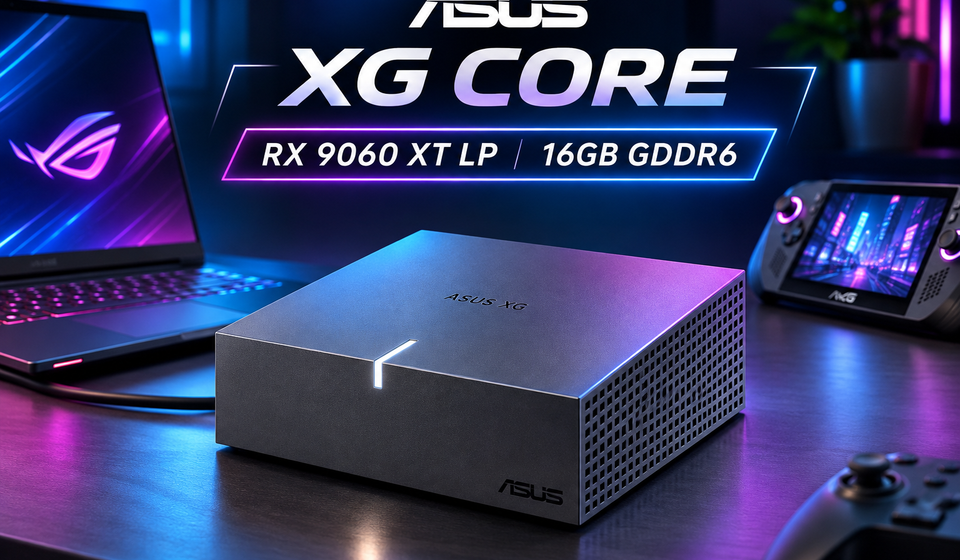
ASUS has announced the XG Core Radeon RX 9060 XT LP 16GB GDDR6, a compact external graphics card designed to bring dedicated GPU performance to compatible laptops, gaming handhelds and mini PCs. Powered by AMD’s RDNA 4 architecture, the device packs 16GB of GDDR6 memory into a small enclosure and connects through USB4 with up to 40Gbps bandwidth.
The main idea is simple: users can add a dedicated graphics processor to a compatible device without opening it or replacing its internal hardware. ASUS is targeting gamers, content creators and AI enthusiasts who want additional graphics capabilities from compact computers.
However, there is an important detail behind the product’s specifications. The XG Core limits GPU power consumption to 75W, considerably below the power rating of a conventional desktop Radeon RX 9060 XT. This makes it a specialised low-power external GPU rather than a direct replacement for a full-power desktop graphics card.
What Is the ASUS XG Core Radeon RX 9060 XT LP?
The ASUS XG Core is an external graphics card, commonly called an eGPU. Instead of installing a graphics card inside a desktop computer, users connect the external unit to a compatible laptop, mini PC or gaming handheld.
It contains the GPU, cooling system and enclosure in one compact package. This means users do not need to purchase a separate graphics card or build an external enclosure themselves.
The device is based on AMD’s Radeon RX 9060 XT LP GPU, featuring RDNA 4 architecture and 16GB of GDDR6 memory.
ASUS says the XG Core is designed to improve graphics performance for gaming, video editing, 3D rendering and compatible AI applications. It is particularly relevant to systems that rely on integrated graphics and do not have an internal slot for a dedicated desktop GPU.
The external design also makes it possible to use the same compact computer for everyday work and connect additional graphics power when needed.
AMD RDNA 4 Architecture and 16GB GDDR6 Memory
The XG Core uses AMD’s Radeon RX 9060 XT LP GPU, based on the RDNA 4 architecture.
Its key graphics specifications include:
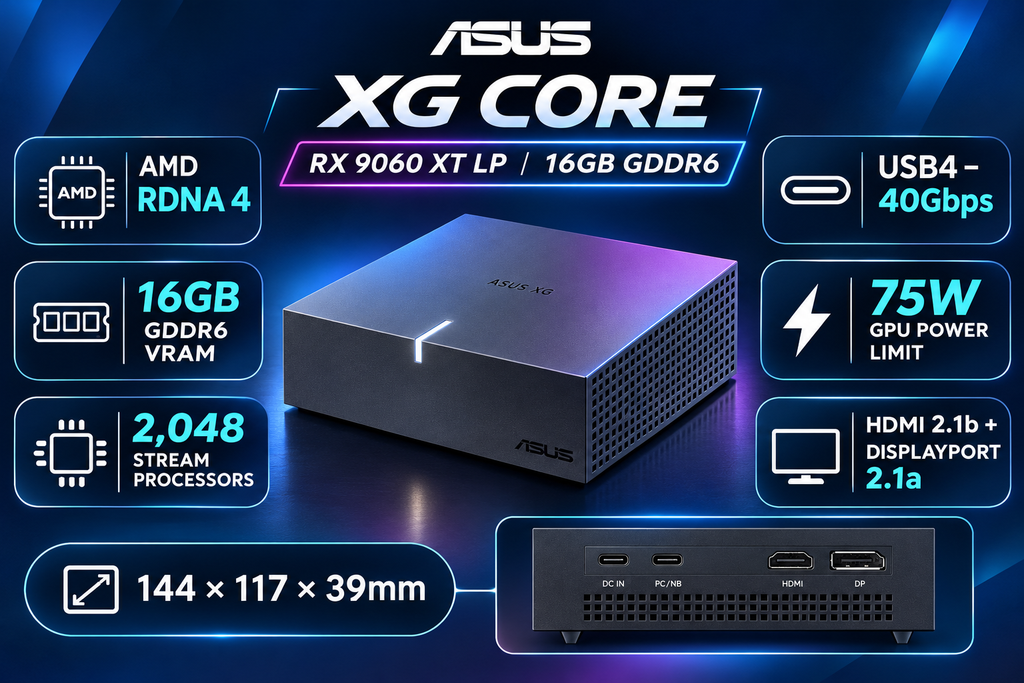
- 2,048 stream processors
- 16GB GDDR6 video memory
- 128-bit memory interface
- 20Gbps memory speed
- PCI Express 4.0 graphics engine
- Up to 406.3 AI TOPS with INT4 matrix sparsity
The 16GB memory capacity is particularly relevant for demanding games, creative applications and local AI workloads. Video editors and 3D creators can use compatible GPU-accelerated applications, while AI enthusiasts can experiment with local image-generation tools and large language models.
ASUS specifically mentions software such as ComfyUI, LM Studio and Ollama as examples of applications that can use the external GPU. Actual performance depends on the software, model, workload and connected computer.
The 75W Power Limit Is an Important Trade-Off
Although the XG Core uses a Radeon RX 9060 XT LP GPU with 16GB of memory, its power configuration is considerably different from a conventional desktop graphics card.
ASUS specifies a maximum GPU power limit of 75W. The default game clock is up to 1,010MHz, while the boost clock reaches up to 1,600MHz.
With OC mode enabled through GPU Tweak III, the figures increase slightly:
| GPU setting | Default mode | OC mode |
|---|---|---|
| Game clock | Up to 1,010MHz | Up to 1,030MHz |
| Boost clock | Up to 1,600MHz | Up to 1,620MHz |
| Power limit | 75W | 75W |
For context, the standard desktop Radeon RX 9060 XT 16GB has a substantially higher power rating. Even the separate low-power desktop RX 9060 XT LP variant is rated at 140W in comparisons reported by technology publications.
This means ASUS has significantly reduced the operating clocks to fit the GPU into its compact 75W external design.
The important point is that 16GB of VRAM does not automatically mean desktop-level RX 9060 XT performance. Clock speeds, power limits and the USB4 connection all influence the performance users will experience.
USB4 Connectivity Adds External Graphics to Compatible Devices
The ASUS XG Core connects to a compatible computer through USB4, offering bandwidth of up to 40Gbps.
This allows users to connect an external GPU without installing internal hardware. ASUS also lists support for compatible Thunderbolt 3 systems.
The company identifies compatible laptops, mini PCs and gaming handhelds as its target devices. Supported examples include:
- ROG Ally X
- ROG Xbox Ally X
- Compatible USB4 laptops
- Compatible mini PCs
- Compatible Thunderbolt 3 systems
However, USB-C is only the physical connector shape. A device having a USB-C port does not automatically mean it supports external graphics.
Users should confirm that their computer supports the required USB4 or compatible Thunderbolt connection and external GPU functionality before purchasing the XG Core.
The 40Gbps connection also represents a potential performance limitation compared with an internal PCIe graphics card. Actual results will depend on the host device, connection, workload and whether an external monitor is used.
HDMI 2.1b and DisplayPort 2.1a for External Monitors
ASUS has included dedicated display outputs, allowing users to connect external monitors directly to the XG Core.
The available connections include:
- One HDMI 2.1b port
- One DisplayPort 2.1a port
- One USB-C data connection supporting up to 40Gbps
- One separate USB-C power connection
The graphics dock supports up to two displays, with a maximum digital resolution of 3840 × 2160 listed in its specifications.
This can be useful for people who want to connect a compact laptop or handheld gaming device to a larger monitor. It also provides a more flexible setup for creative work, multitasking and desktop-style gaming.
The separate USB-C power connection is important because the external graphics unit needs its own power arrangement rather than relying solely on the host computer’s USB connection.
Compact Design Measures Just 144mm
Portability is one of the main design goals of the XG Core.
The enclosure measures:
- Length: 144mm
- Width: 117mm
- Height: 39mm
Its compact dimensions make it considerably smaller than a conventional desktop graphics card and external GPU enclosure combination.
Users can carry the unit between home, office and creative workspaces, then connect it to a compatible computer when additional graphics performance is required.
ASUS positions it as an option for people who prefer a portable computing device for everyday use but need more graphics capability for selected workloads.
The company has not provided a complete retail weight figure in the cited specifications, so buyers should check the final product documentation for the weight and included accessories.
GPU Tweak III Provides Performance Controls
The XG Core supports ASUS GPU Tweak III software for graphics tuning and monitoring.
The application gives users access to supported settings, including:
- GPU core clock adjustments
- Memory frequency controls
- Voltage settings
- Fan speed and fan control
- Real-time hardware monitoring
- Customisable on-screen display
Users can monitor GPU behaviour while gaming or running creative applications. The OC mode also offers slightly higher clock speeds than the default configuration.
These controls provide some flexibility, but they do not remove the product’s 75W power limit. Buyers should not expect the small OC increase to transform the XG Core into a full-power desktop RX 9060 XT.
Gaming, Content Creation and Local AI Workloads
ASUS is positioning the XG Core for more than gaming. Its 16GB of GDDR6 memory and RDNA 4 graphics architecture can also support compatible content-creation and AI applications.
For gaming, it provides dedicated graphics resources to devices that otherwise rely on integrated graphics. This could make a compatible handheld or compact laptop more useful when connected to an external monitor.
For creators, GPU acceleration can help with applications used for video editing, rendering and design.
Local AI processing is another area ASUS highlights. The company mentions ComfyUI for image-generation workflows and LM Studio and Ollama for local language-model inference.
However, the performance of AI models depends on more than VRAM capacity. GPU compute performance, software support, memory requirements and the 75W power limit all matter.
The XG Core could be useful for smaller local AI experiments and compatible workloads, but it should not be considered equivalent to a high-power workstation GPU.
ASUS XG Core Radeon RX 9060 XT LP Specifications
| Feature | Details |
|---|---|
| Product | ASUS XG Core Radeon RX 9060 XT LP 16GB GDDR6 |
| Product type | External GPU (eGPU) |
| GPU | AMD Radeon RX 9060 XT LP |
| Architecture | AMD RDNA 4 |
| AI performance | Up to 406.3 AI TOPS (INT4 matrix sparsity) |
| Stream processors | 2,048 |
| Video memory | 16GB GDDR6 |
| Memory speed | 20Gbps |
| Memory interface | 128-bit |
| Power limit | 75W |
| Default boost clock | Up to 1,600MHz |
| OC boost clock | Up to 1,620MHz |
| Connectivity | USB4, up to 40Gbps |
| Compatibility | Compatible USB4 and Thunderbolt 3 devices |
| Display outputs | HDMI 2.1b, DisplayPort 2.1a |
| Maximum displays | 2 |
| Maximum resolution | 3840 × 2160 |
| Dimensions | 144 × 117 × 39mm |
| Software | ASUS GPU Tweak III |
| Price | Not announced |
| Availability | Not announced |
ASUS XG Core Price and Availability
ASUS announced the XG Core Radeon RX 9060 XT LP 16GB GDDR6 on November 6, 2026.
However, the company has not announced an official retail price or confirmed general availability.
The product is listed on ASUS’s official website, where users can check its specifications and compatibility information. Regional availability may differ, and ASUS has not confirmed an Indian launch price or release date.
The ASUS XG Core is designed for a specific group of users: people who already own a compatible laptop, mini PC or gaming handheld but want additional graphics power without replacing the entire system.
Its compact enclosure, 16GB of GDDR6 memory and USB4 connectivity make the concept interesting. It also supports gaming, creative applications and compatible local AI workloads.
However, the 75W GPU power limit is a major consideration. Despite using the RX 9060 XT LP GPU, its reduced clock speeds mean buyers should not expect performance comparable to a conventional desktop RX 9060 XT.
USB4 bandwidth can also limit performance compared with an internal PCIe connection.
The final buying decision will depend heavily on pricing. If ASUS positions it competitively, it could become an interesting upgrade for compatible handhelds and compact computers. If it is priced too close to more powerful graphics solutions, its limitations could make the purchase harder to justify.
Expert Analysis
The XG Core addresses a genuine problem for laptop and handheld users who need more graphics performance without replacing their devices.
Its compact design and 16GB VRAM are attractive, particularly for creative applications and selected local AI workloads.
However, the 75W power limit and USB4 bandwidth make its performance positioning very different from a desktop RX 9060 XT.
Its eventual price and independent benchmarks will determine whether this external GPU makes practical sense.
Conclusion
ASUS’s XG Core Radeon RX 9060 XT LP 16GB GDDR6 introduces a compact external graphics solution for compatible laptops, gaming handhelds and mini PCs. It combines AMD RDNA 4 architecture, 16GB GDDR6 memory, USB4 connectivity and support for gaming, creative work and local AI applications.
Its biggest advantage is the ability to add dedicated graphics without modifying the host device. However, the 75W power limit and reduced GPU clock speeds are important compromises.
ASUS has not yet revealed its price or release date. Until independent performance reviews and regional pricing become available, the XG Core remains an interesting external GPU concept rather than a confirmed value-for-money upgrade.
Frequently Asked Questions
1. What is the ASUS XG Core Radeon RX 9060 XT LP?
It is a compact external graphics card featuring an AMD Radeon RX 9060 XT LP GPU and 16GB of GDDR6 memory. It connects to compatible laptops, gaming handhelds and mini PCs through USB4.
2. How much VRAM does the ASUS XG Core have?
It comes with 16GB of GDDR6 video memory and a 128-bit memory interface.
3. What is the power limit of the ASUS XG Core?
The external GPU has a specified power limit of 75W, which is significantly lower than conventional desktop RX 9060 XT graphics cards.
4. Does the ASUS XG Core support USB4?
Yes. It supports USB4 connectivity with up to 40Gbps bandwidth.
5. Can the ASUS XG Core work with gaming handhelds?
ASUS lists compatible devices such as the ROG Ally X and ROG Xbox Ally X. Compatibility should be checked for the exact device and connection.
6. Can the ASUS XG Core run local AI models?
It supports compatible local AI workloads, including applications such as ComfyUI, LM Studio and Ollama. Actual performance depends on the model, software and system configuration.
7. What is the price of the ASUS XG Core?
ASUS has not announced an official retail price.
8. When will the ASUS XG Core launch in India?
ASUS has not confirmed an India release date or local pricing.
Suggestions:
PS5 Black Friday Deals 2026: Best Offers & Big Discounts
Logitech MX Master 4 Developer Edition: Price, Features & Availability in India
New Amazon Echo Devices: 5 Exciting Launches & Home Map
Brick Night: 5 Powerful Ways It Helps Stop Bedtime Scrolling
Source:
ASUS Official Announcement
ASUS Official Product Page
ASUS Technical Specifications
Basic Tutorials – Power and performance details
Notebookcheck – Technical analysis