
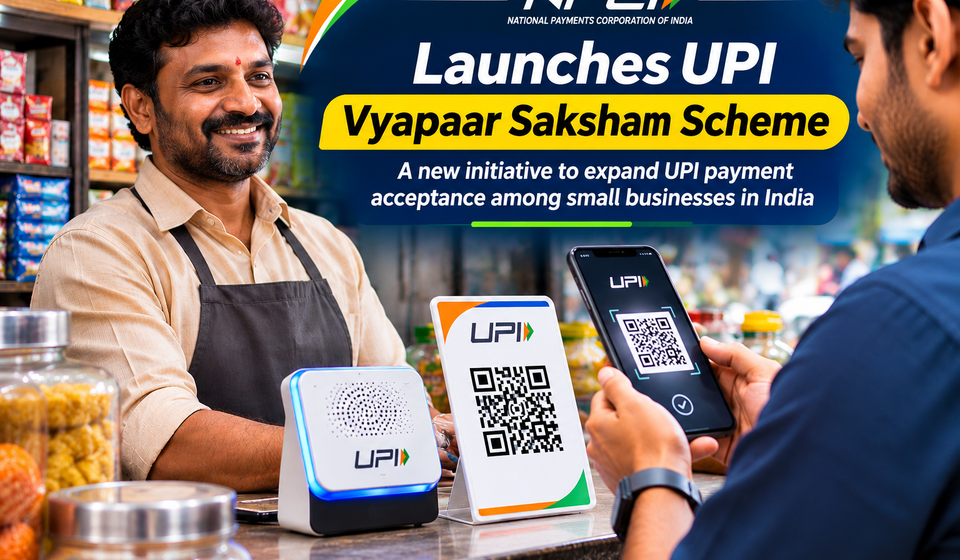
NPCI Introduces UPI Vyapaar Saksham Scheme for Small Merchants
NPCI Introduces UPI Vyapaar Saksham Scheme: Banks to Get ₹300 per QR Code and ₹750 per Soundbox
The National Payments Corporation of India (NPCI) has introduced a new initiative called the UPI Vyapaar Saksham Scheme to expand digital payment acceptance among small businesses across India. The scheme will encourage banks and payment service providers to onboard more small merchants by offering financial incentives for deploying physical UPI QR codes and soundboxes.
Announced through a circular dated November 11, 2026, the initiative focuses on small businesses in Tier 3 to Tier 6 towns, northeastern states, Jammu and Kashmir, and Ladakh. It also covers eligible merchants participating in selected Central Government schemes, including PM SVANidhi and PM Vishwakarma.
Under the new framework, acquiring banks can receive ₹300 for every eligible physical QR code and ₹750 for every eligible soundbox deployed at a newly onboarded small merchant. The scheme also introduces additional incentives linked to UPI transaction growth.
The initiative is designed to strengthen digital payment infrastructure in areas where adoption remains relatively limited. However, there is an important detail: the scheme’s three-year period will begin when the relevant UPI Merchant Discount Rate (MDR) framework takes effect. NPCI has not announced a confirmed implementation date for that framework.
What Is the UPI Vyapaar Saksham Scheme?
The UPI Vyapaar Saksham Scheme is an incentive programme introduced by NPCI to increase UPI acceptance among small merchants.
Although UPI has become a widely used payment method in India, not every small shop has the same level of access to digital payment infrastructure. Businesses in smaller towns and remote locations may face challenges involving device availability, payment acceptance costs, connectivity and awareness.
NPCI wants to address this gap by encouraging banks and other participants in the UPI ecosystem to expand merchant onboarding.
The scheme focuses on three main objectives:
- Increasing the number of small merchants accepting UPI payments.
- Expanding physical QR code and soundbox installations.
- Encouraging existing and newly onboarded merchants to generate more UPI transactions.
Instead of providing a direct cash benefit to every customer, the initiative uses incentives to encourage payment infrastructure deployment and transaction growth. The acquiring banks responsible for onboarding eligible merchants are the primary recipients of the incentives.
This distinction is important for shopkeepers. The announced ₹300 and ₹750 amounts are incentives for eligible acquiring banks, not automatic cash payments to merchants for installing a QR code or soundbox.
Who Is Eligible for the UPI Vyapaar Saksham Scheme?
The scheme primarily targets small merchants with an annual turnover of up to ₹40 lakh in the preceding financial year, according to reporting on NPCI’s circular.
It also identifies specific regions where digital payment acceptance infrastructure will receive particular attention.
The targeted areas include:
- Tier 3 to Tier 6 cities and towns.
- Northeastern states.
- Union Territories of Jammu and Kashmir and Ladakh.
- Eligible small merchants covered under notified Central Government schemes.
Merchants associated with government programmes such as PM SVANidhi and PM Vishwakarma are also included, subject to the scheme’s eligibility conditions.
The geographical focus is significant because smaller towns and underserved regions may have fewer physical payment acceptance devices than major urban markets.
By encouraging banks to install more QR codes and soundboxes in these locations, NPCI aims to make digital payments easier for local shops, street vendors and other small businesses.
However, meeting the turnover requirement alone does not guarantee eligibility. Merchants must also satisfy the applicable geographical, transaction and other conditions under the scheme.
₹300 for QR Codes and ₹750 for Soundboxes
The most visible part of the scheme is its incentive for deploying UPI acceptance devices at new small merchants.
Under Component A, acquiring banks can receive:
| Deployment | Incentive |
|---|---|
| Eligible physical UPI QR code | ₹300 |
| Eligible soundbox | ₹750 |
| Both QR code and soundbox | ₹1,050 |
The incentive structure is intended to encourage banks to expand their merchant networks beyond major cities.
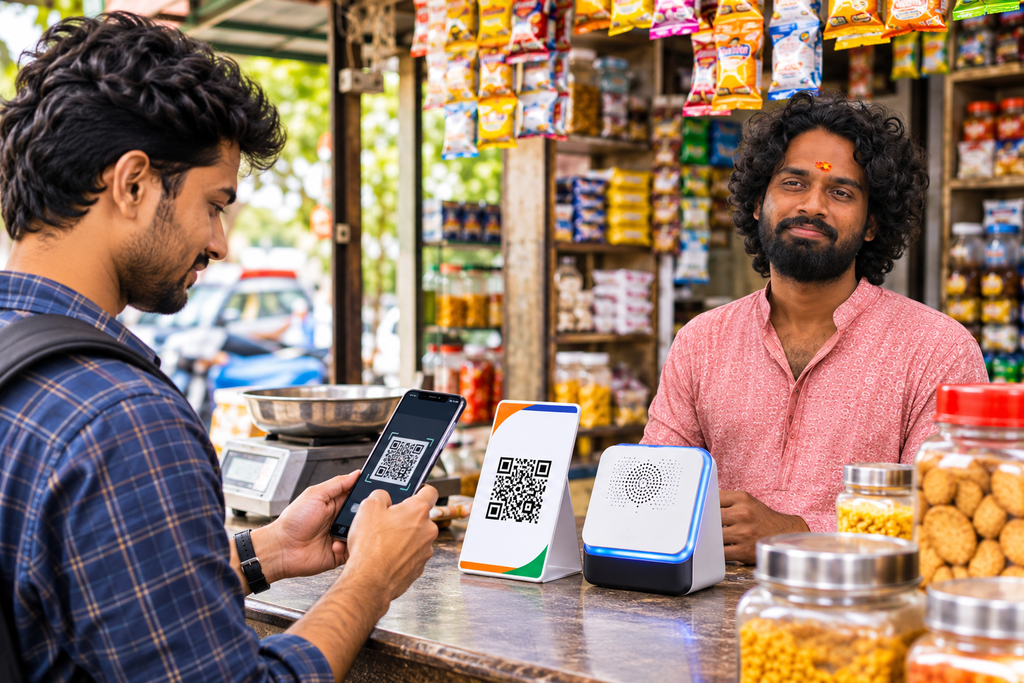
A physical QR code allows customers to scan and make payments directly from their UPI applications. A soundbox provides an audio confirmation when a payment is received, helping shopkeepers verify transactions without constantly checking their phones.
For small retailers handling multiple customers, this can make payment verification more convenient.
However, the incentives are subject to conditions. According to the reported framework, an eligible newly onboarded merchant must record at least 25 eligible transactions in two out of three months, with a minimum monthly transaction value of ₹5,000.
This condition is intended to encourage actual usage rather than simply increasing the number of QR codes installed.
NPCI Divides the Scheme Into Three Incentive Components
The UPI Vyapaar Saksham Scheme has three components, each designed to address a different part of merchant digital payment adoption.
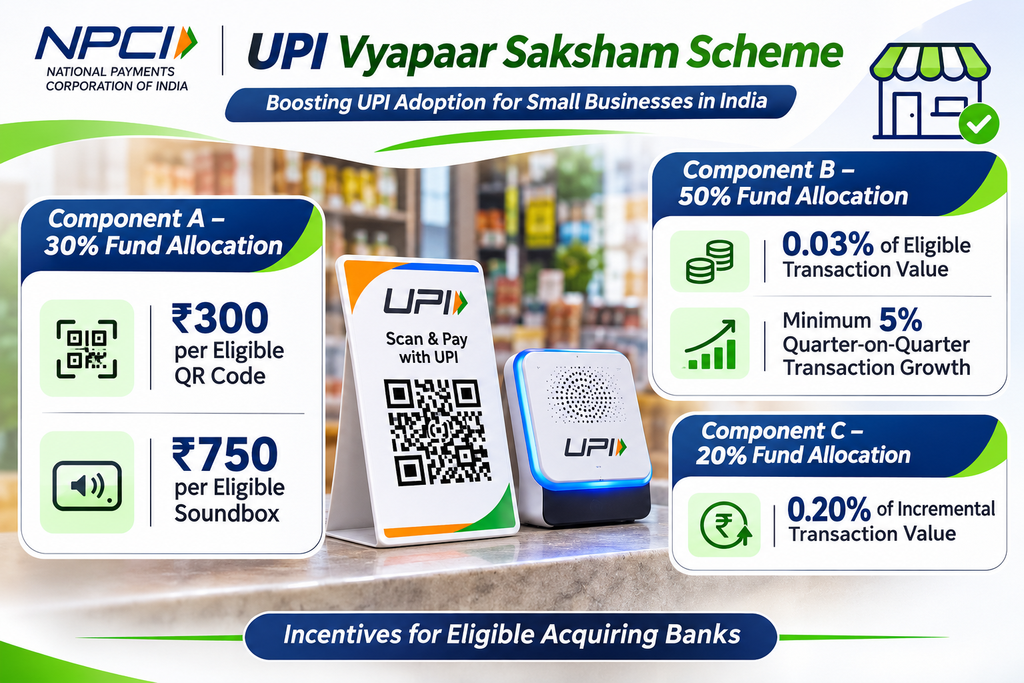
The fund allocation is divided as follows:
Component A: New Merchant Onboarding – 30%
The first component accounts for 30% of the incentive fund.
It focuses on expanding the number of small merchants accepting UPI payments. Acquiring banks can receive ₹300 for each eligible physical QR code and ₹750 for each eligible soundbox deployed at a newly onboarded merchant.
The merchant must meet the specified transaction conditions, including at least 25 eligible transactions in two out of three months and a minimum monthly transaction value of ₹5,000.
This component directly addresses the availability of digital payment acceptance infrastructure.
Component B: Transaction Growth – 50%
The second component receives the largest allocation, accounting for 50% of the fund.
Its objective is to encourage more UPI transactions at existing and newly onboarded eligible small merchants.
Under this component, the acquiring bank must achieve at least 5% quarter-on-quarter growth in eligible transaction volume to qualify.
The incentive is calculated at 0.03% of the aggregate eligible transaction value. Merchants in the targeted geographical areas can attract an additional 50% incentive over the base rate.
This approach encourages banks to focus not only on installing QR codes but also on ensuring that merchants actively use their digital payment facilities.
Component C: Incremental Transaction Growth – 20%
The third component receives the remaining 20% of the fund.
It focuses on additional transaction growth among eligible merchants in targeted geographical areas.
The incentive is calculated at 0.20% of the incremental value of eligible transactions compared with the previous quarter. This is provided in addition to the applicable incentive under Component B.
The component is intended to reward further increases in transaction value, particularly in regions where digital payment adoption needs additional support.
How Will the Scheme Be Funded?
One of the most important aspects of the new initiative is its funding mechanism.
According to reporting on NPCI’s circular, the scheme will use contributions from Merchant Discount Rate collections rather than relying on a separate government budget allocation.
Participating UPI ecosystem members, including issuing banks, acquiring banks, payer payment service providers and UPI application providers, are expected to contribute 5% of their respective MDR share to the scheme’s fund.
The contribution excludes MDR earned from transaction categories that are not eligible under the scheme.
This funding model connects the revenue generated through eligible merchant payment transactions with the expansion of digital payment infrastructure.
The arrangement also explains why the scheme’s start date is linked to MDR implementation. Its three-year duration will begin when the relevant MDR framework takes effect, rather than simply from the date NPCI issued its November circular.
What Is MDR and Why Does It Matter for UPI?
Merchant Discount Rate, commonly known as MDR, is a fee associated with processing digital payments. It is generally charged to merchants for accepting payments through certain payment methods.
For years, UPI person-to-merchant payments in India have operated under a zero-MDR framework, helping encourage digital payment adoption among retailers and customers.
However, payment ecosystem participants have raised concerns about the costs of maintaining payment infrastructure, including QR networks, transaction processing and soundbox services.
The proposed MDR framework has therefore become an important part of discussions about the long-term economics of UPI.
The UPI Vyapaar Saksham Scheme is connected to this development because it uses a portion of MDR collections to encourage wider merchant acceptance.
There is an important distinction: the scheme’s announcement does not mean every UPI payment will immediately become chargeable. The applicable MDR rules and their implementation date are separate matters. Users and merchants should not assume that ordinary UPI payments will automatically attract a new fee because NPCI has introduced this incentive programme.
When Will the UPI Vyapaar Saksham Scheme Start?
NPCI issued the circular on November 11, 2026, and the scheme was reported publicly on November 12.
However, the three-year scheme period will begin from the date the relevant UPI MDR framework takes effect.
As of November 14, 2026, a confirmed implementation date for that framework has not been announced in the available reports.
Some media coverage has discussed possible dates for the MDR rollout, but these should not be treated as official confirmation.
Merchants and acquiring banks will need to wait for the applicable implementation instructions before assuming that incentives are available for new installations or transactions.
The scheme is therefore an important policy development, but its operational timeline depends on the next announcement concerning MDR implementation.
The initiative could have a meaningful impact on small businesses, particularly in areas where digital payment acceptance infrastructure is less widespread.
For shopkeepers, accepting UPI payments can reduce dependence on cash and make it easier for customers to complete transactions. A QR code provides a simple way to receive payments, while a soundbox helps confirm successful transactions through audio notifications.
For banks, the incentives create a financial reason to expand merchant onboarding and encourage greater transaction activity.
The scheme could also support street vendors, neighbourhood shops, small service providers and traditional businesses that may not have access to the same payment infrastructure as larger retailers.
However, successful implementation will depend on more than the number of QR codes installed. Merchants need reliable connectivity, accessible payment services, transparent charges and support when transactions fail.
The transaction-based incentive components are important because they encourage active use rather than simply counting new installations.
UPI Vyapaar Saksham Scheme: Key Details at a Glance
| Detail | Information |
|---|---|
| Scheme name | UPI Vyapaar Saksham Scheme |
| Introduced by | National Payments Corporation of India (NPCI) |
| Circular date | November 11, 2026 |
| Public announcement | November 12, 2026 |
| Primary objective | Expand UPI acceptance among small merchants |
| Eligible merchant turnover | Up to ₹40 lakh in preceding financial year |
| QR code incentive | ₹300 per eligible physical QR code |
| Soundbox incentive | ₹750 per eligible soundbox |
| Component A allocation | 30% |
| Component B allocation | 50% |
| Component C allocation | 20% |
| Funding mechanism | Contributions from MDR collections |
| Contribution | 5% of respective eligible MDR shares |
| Scheme duration | Three years from relevant MDR implementation |
| Target areas | Tier 3–6 centres, Northeast, J&K and Ladakh |
| India-wide implementation date | Not yet confirmed |
Expert Analysis
The UPI Vyapaar Saksham Scheme links merchant onboarding incentives with actual digital payment activity.
Its focus on smaller towns and underserved regions could help extend UPI acceptance beyond major urban markets.
However, the scheme’s effectiveness will depend on MDR implementation, merchant participation and reliable payment infrastructure.
The key development to watch is whether the incentives translate into sustained transaction growth rather than simply more QR code installations.
Conclusion
NPCI’s UPI Vyapaar Saksham Scheme is a new initiative aimed at strengthening digital payment acceptance among small merchants across India. By offering acquiring banks ₹300 for eligible physical QR code deployments and ₹750 for soundbox installations, the scheme encourages the expansion of payment infrastructure in smaller towns and underserved regions.
Its three-part incentive structure also rewards transaction growth, giving banks a reason to support active UPI usage rather than focusing only on merchant onboarding.
However, the scheme’s three-year period is linked to the implementation of the relevant UPI MDR framework. Until that framework takes effect, the operational start date remains uncertain.
For India’s small businesses, the initiative could improve access to digital payment facilities. Its real impact will become clearer once implementation begins and more merchants start participating.
Frequently Asked Questions
1. What is the UPI Vyapaar Saksham Scheme?
It is an NPCI initiative designed to increase UPI payment acceptance among small merchants through incentives for QR code and soundbox deployment and transaction growth.
2. How much incentive is available for a UPI QR code?
Acquiring banks can receive ₹300 for each eligible physical QR code deployed at a newly onboarded small merchant.
3. How much incentive is available for a soundbox?
The incentive is ₹750 for each eligible soundbox deployed at a newly onboarded small merchant.
4. Who is eligible under the UPI Vyapaar Saksham Scheme?
The scheme targets small merchants with annual turnover of up to ₹40 lakh in the preceding financial year, subject to additional eligibility and geographical conditions.
5. Which areas will the scheme cover?
It focuses on Tier 3 to Tier 6 centres, northeastern states, Jammu and Kashmir, Ladakh and eligible merchants under notified Central Government schemes.
6. Does NPCI give ₹300 directly to shopkeepers?
No. The announced QR code and soundbox incentives are intended for eligible acquiring banks, not automatic direct payments to shopkeepers.
7. How is the UPI Vyapaar Saksham Scheme funded?
It will be funded through contributions from participating UPI ecosystem members, with each contributing 5% of its respective eligible MDR share.
8. When will the scheme start?
Its three-year duration will begin when the relevant UPI MDR framework takes effect. A confirmed implementation date has not been announced in the available reports.
9. Will this scheme make all UPI payments chargeable?
No such conclusion should be drawn. The incentive scheme is linked to MDR collections, but its announcement does not mean all UPI transactions will immediately attract fees.
Suggestions:
Apple Pay in India: Launch Date, Banks and UPI Support
TRAI Network Anubhav: Check Jio, Airtel & BSNL Network Quality with 3 Speed Metrics
Jio Voice-Only Plans: Best Recharge Options Starting at ₹147
Source:
ETBFSI – NPCI scheme incentives and eligibility
Inc42 – Scheme funding and incentive structure
Gadgets 360 – Scheme details and expected implementation
The Head and Tale – UPI MDR implementation context
Economic Times – NPCI merchant payment initiative