
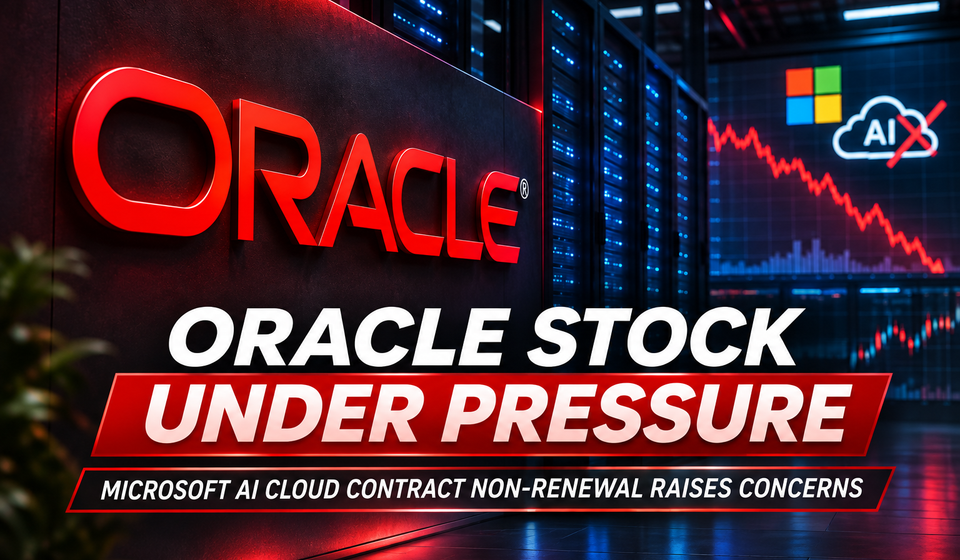
Oracle Stock Nears $100 After Microsoft AI Cloud Deal Exit
Oracle (ORCL) Stock Faces Pressure Near $100 After Microsoft AI Cloud Deal Non-Renewal
Oracle shares are facing renewed pressure after reports that Microsoft is winding down its agreement to rent AI computing capacity from Oracle Cloud Infrastructure (OCI). The development has raised questions about Oracle’s ability to retain major customers for its AI infrastructure and added to investor concerns about the company’s heavy spending on data centres.
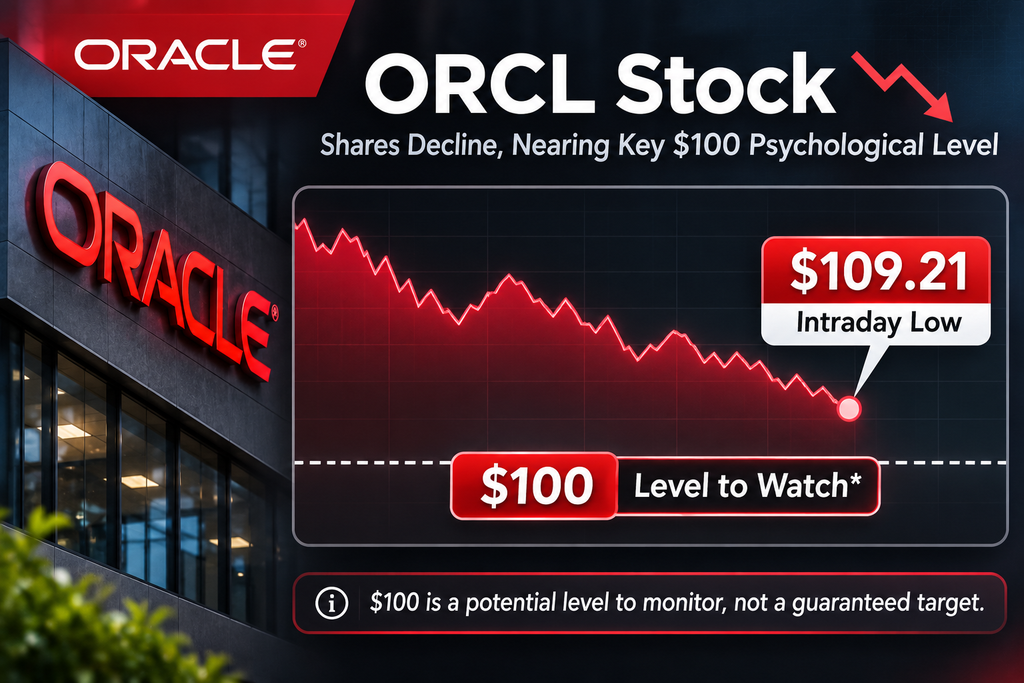
Oracle stock reportedly touched $109.21 on November 6, 2026, its lowest level in 52 weeks, before recovering to close around $116. The possibility of a move towards the psychologically important $100 mark has now become a focus for market watchers.
However, the $100 level is a potential downside area discussed by market commentators, not a confirmed target or a certainty. Oracle says demand for its AI infrastructure remains strong, including for earlier-generation GPUs.
Why Is Oracle Stock Falling?
The immediate trigger is Microsoft’s decision not to renew a multi-year agreement to rent AI computing capacity from Oracle.
The agreement dates back to 2023, when Microsoft needed additional computing resources to support its AI-powered Bing experience. Instead of relying entirely on its own infrastructure, Microsoft rented computing capacity from Oracle.
According to Bloomberg’s reporting, Microsoft has been gradually switching off the rented capacity because the servers used older generations of Nvidia GPUs that no longer met its changing technical requirements.
The original contract’s financial value has not been disclosed. Microsoft has not publicly explained the decision in detail, while Oracle has pushed back against concerns about demand for its infrastructure.
The market reaction reflects more than the loss of one customer. Investors are also questioning whether ORCL can maintain the growth expectations built around its AI cloud business.
ORCL Stock Falls Towards the $100 Level
Oracle shares came under pressure during the November 5–6 trading sessions as investors reacted to broader weakness in technology stocks and reports about Microsoft’s cloud agreement.
Market reports show that ORCL touched approximately $109.21 on November 6, before recovering and closing around $116.
The move placed the stock close to the $100 psychological price level. A further decline could bring that level into focus, although the stock does not have to reach it.
Here is the recent price context reported by market sources:
| Market detail | Reported figure |
|---|---|
| November 6 intraday low | $109.21 |
| November 6 closing price | Around $116 |
| Potential psychological level | $100 |
| June 2026 peak cited by market reports | Around $248 |
The figures are historical market data from the cited reports, not live quotes.
A fall from approximately $116 to $100 would represent a further decline of around 14%. That calculation illustrates why investors are watching the level, but it should not be interpreted as a forecast.
Why the Microsoft Deal Matters to Oracle
Oracle has positioned its cloud infrastructure business as a major part of its long-term AI strategy.
Companies developing advanced AI models need enormous computing resources to train models, run inference workloads and serve customers. This has created opportunities for cloud providers that can supply large numbers of high-performance GPUs.
Microsoft’s agreement was one example of how ORCL could benefit from that demand.
However, the reported non-renewal raises an important question: can Oracle continue attracting customers for its existing infrastructure when major AI companies are looking for newer hardware?
The concern is particularly relevant because data centres require substantial investment. ORCL must pay for facilities, power, networking equipment, cooling systems and processors before it can generate revenue from customers using that capacity.
If a major customer leaves, the company needs to find replacement demand to keep the infrastructure commercially productive.
That does not automatically mean Oracle will lose money on the hardware. Other customers may have different performance requirements and could still find older GPUs useful.
The uncertainty is about how quickly Oracle can replace the demand and whether it can maintain attractive rental rates.
Oracle Says Demand for AI Infrastructure Remains Strong
Oracle has pushed back against the negative interpretation of Microsoft’s decision.
The company said demand for its AI infrastructure remains strong, including for earlier-generation GPUs. It has also indicated that customers continue to renew some older GPU capacity at higher prices.
This is an important part of the investment debate.
Microsoft’s requirements are not necessarily representative of every AI customer. Different organisations use different models, applications and computing workloads. Some may not need the latest generation of processors to operate their services efficiently.
If ORCL can lease the capacity to other customers, the impact of Microsoft’s decision could be limited.
But investors will want more than a general statement about demand. They will be looking for evidence that ORCL can maintain infrastructure utilisation, pricing and cloud revenue growth.
Oracle’s Bigger Challenge: AI Infrastructure Spending and Debt
The Microsoft development comes at a time when investors are already examining Oracle’s large AI infrastructure commitments.
Building AI data centres is expensive. The company needs to invest heavily before all the infrastructure becomes operational and begins generating revenue.
This creates pressure on cash flow and financing requirements, particularly when projects depend on long-term customer commitments.
Oracle’s broader AI strategy has attracted attention because of its large infrastructure ambitions and major cloud agreements. However, the scale of those commitments also raises questions about how much capital the company needs and how quickly those investments will produce returns.
In September 2026, Oracle announced plans to raise substantial funding through debt and equity to support its infrastructure expansion. That announcement contributed to investor concerns about financing costs and the company’s ability to manage its capital requirements.
The Microsoft agreement is therefore part of a bigger market discussion: whether the rapid expansion of AI infrastructure will generate enough profitable demand to justify the investment.
Could ORCL Fall Below $100?
The $100 level is attracting attention because it is a round-number price level and represents a possible next downside area if selling pressure continues.
Some technical market commentary has identified the possibility of further declines if ORCL shares fail to stabilise around recent lows. However, technical levels are not guarantees, and different analysts may identify different support zones depending on their charts and timeframes.
Three factors could influence the stock’s next move.
1. Whether Oracle Finds Replacement Customers
The first major factor is whether ORCL can lease the computing capacity previously used by Microsoft to other customers.
If demand remains strong and the company can maintain pricing, the impact of the non-renewal may be less serious than investors initially fear.
If capacity remains unused or rental prices weaken, concerns about returns on infrastructure investment could increase.
2. Microsoft’s Wider Cloud Strategy
Microsoft’s decision also needs to be considered alongside its broader review of external cloud partnerships.
The company has been working with several infrastructure providers, including CoreWeave, Nebius and Nscale. It is reportedly reviewing project timelines, costs and technical requirements across these relationships.
If other customers or cloud providers report similar changes in AI infrastructure demand, investors may start viewing the issue as a wider industry trend rather than an isolated Oracle development.
3. Oracle’s Financial Performance
Oracle’s upcoming financial results will be important for assessing whether concerns about its AI infrastructure business are affecting actual performance.
Investors will be watching cloud infrastructure growth, customer commitments, capital expenditure, debt levels and free cash flow.
The company’s ability to turn its AI infrastructure investments into sustainable revenue and cash generation could matter more over time than the short-term reaction to one contract.
Bullish and Bearish Factors for Oracle Stock
The outlook is not entirely negative. Oracle still has a substantial enterprise software business and continues to position itself as a major AI infrastructure provider.
| Potentially positive factors | Potential risks |
|---|---|
| Oracle says AI infrastructure demand remains strong | Microsoft is reportedly not renewing its agreement |
| Older GPUs may attract other customers | Newer GPUs could make older infrastructure less competitive |
| Existing enterprise software business | High infrastructure investment requirements |
| Continued AI cloud expansion opportunities | Debt, financing and cash-flow concerns |
| Potential replacement customers | Uncertainty around the returns from AI data centres |
The balance between these factors will help determine whether ORCL shares stabilise or face further pressure.
Investors following ORCL should focus on developments that provide evidence about Oracle’s actual business performance rather than reacting only to headlines.
The most important indicators include:
- Cloud infrastructure revenue: Whether ORCL continues to deliver strong growth in its cloud business.
- Infrastructure utilisation: Whether existing GPU capacity is being used by paying customers.
- Replacement contracts: Whether ORCL announces new customers or renewals that offset Microsoft’s reduced demand.
- Capital expenditure: Whether infrastructure spending continues to rise faster than the company’s ability to generate cash.
- Free cash flow and debt: Whether ORCL can finance its expansion without creating unsustainable financial pressure.
These indicators will help investors distinguish between a temporary share-price reaction and a more serious deterioration in Oracle’s business outlook.

Expert Analysis
Microsoft’s decision has increased scrutiny of Oracle’s AI infrastructure strategy, but one non-renewed agreement does not establish a collapse in demand.
The bigger concern is whether ORCL can keep expensive computing capacity fully utilised as GPU technology advances.
Oracle’s ability to secure replacement customers, manage debt and convert AI investment into cash flow will be critical.
The $100 level is worth monitoring, but the company’s financial performance matters more than any single share-price threshold.
Conclusion
Oracle shares are facing pressure following reports that Microsoft is winding down its AI cloud computing agreement with the company. The stock touched approximately $109.21 on November 6 before recovering, bringing the $100 level into focus for investors.
The development has raised questions about Oracle’s ability to retain major AI customers, the commercial value of older Nvidia GPUs and the returns from its substantial data-centre investments.
However, ORCL maintains that demand for its AI infrastructure remains strong. The company may also be able to lease existing capacity to other customers.
For now, the key issue is whether ORCL can demonstrate that its AI infrastructure expansion is generating sustainable revenue and cash flow. A move towards $100 remains a market risk scenario, not a confirmed outcome.
Frequently Asked Questions
1. Why is Oracle stock falling?
ORCL shares came under pressure after reports that Microsoft is winding down its agreement to rent AI computing capacity from Oracle. Broader concerns about AI infrastructure spending, debt and technology-sector volatility have also affected sentiment.
2. Could Oracle stock fall to $100?
It is possible, but not guaranteed. The $100 level is a psychological price area being watched by market commentators. The stock’s direction will depend on market sentiment, financial results and developments in Oracle’s AI cloud business.
3. What happened between Microsoft and Oracle?
Microsoft reportedly declined to renew a multi-year agreement to rent AI computing capacity from ORCL. The infrastructure used older-generation Nvidia GPUs that reportedly no longer met Microsoft’s changing requirements.
4. Did Microsoft cancel all its Oracle services?
There is no confirmation that Microsoft is ending every relationship with ORCL. The report concerns a specific agreement to rent AI computing capacity.
5. Is Oracle still seeing demand for AI infrastructure?
Oracle says demand remains strong, including for earlier-generation GPUs. Whether it can replace Microsoft’s demand with other customers will be important to watch.
6. What should investors watch before buying ORCL shares?
Investors should examine Oracle’s cloud revenue growth, infrastructure utilisation, free cash flow, debt, capital expenditure and new AI customer agreements. This article is informational and not personalised investment advice.
Suggestions:
John Langford Leaves Microsoft After AI Frontiers Group Restructuring
China AI Stock Crash: Massive $480 Billion Market Loss
AMD Hits $1 Trillion Market Cap for the First Time
Source:
Reuters – Microsoft Winding Down Oracle AI Cloud Deal
Yahoo Finance – Oracle Stock and Microsoft’s AI Deal
24/7 Wall St. – Oracle Shares and Older Nvidia GPUs
The Wall Street Journal – Oracle Stock Slides as AI Trade Swoons
Investopedia – Investor Concerns About Oracle’s AI Spending