

John Langford Leaves Microsoft After AI Frontiers Group Restructuring
John Langford Exits Microsoft as AI Frontiers Group Comes to an End
A major change has taken place inside Microsoft’s AI research organisation. John Langford, a prominent machine-learning researcher and one of the founding leaders of AI Frontiers, has left Microsoft and declared the research group finished. The development follows an organisational change in September 2026, when AI Frontiers was moved from Microsoft Research into Microsoft AI.
John Langford says the transition created a mismatch between the group’s research-focused ambitions and Microsoft AI’s emphasis on scaling models. His departure has also raised questions about the future of research projects developed by the team, including AutoGen and Fara.
However, there is an important distinction: Langford has declared AI Frontiers over, but Microsoft has not publicly announced that the group has been formally shut down. Its Microsoft Research page still describes the September move as a transition into Microsoft AI.
Why Did John Langford Leave Microsoft?
John Langford explained his decision in a blog post titled The End of AI Frontiers, published on November 6, 2026. He described a disagreement over how AI research should be organised and prioritised after the September restructuring.
According to John Langfor, the former Inflection leadership at Microsoft AI followed a philosophy centred on scaling models rather than pursuing fundamental research. He described the approach as focused on scaling and “aggressively not research”.
His concern was that the group’s work had become difficult to integrate into Microsoft AI’s priorities. He said the team struggled to get its innovations used or even seriously considered.
John Langford also explained why returning to Microsoft Research was not an attractive option. He questioned whether research conducted there would have a meaningful path into real-world products and expressed concern that the organisation’s internal culture had changed.
These are Langford’s personal assessments of the restructuring and Microsoft’s research environment. Microsoft has not publicly confirmed his interpretation of the disagreement.
What Was Microsoft’s AI Frontiers Group?
AI Frontiers was established inside Microsoft Research in 2023, following the release of ChatGPT. John Langford and several colleagues believed that AI research needed more organised collaboration to compete with the rapid progress being made across the industry.
The group reportedly had approximately 50 members. Rather than relying entirely on individual researchers pursuing separate ideas, it aimed to bring people together around coordinated research projects.
Its work covered several areas:
- Advanced machine-learning research.
- AI agents capable of completing tasks.
- Multi-agent orchestration systems.
- Computer-use agents.
- More efficient approaches to training and developing AI models.
- Research into the reliability and capabilities of agent-based systems.
John Langford said the group had made meaningful progress despite its relatively small size and limitations around computing resources.
Its work was not restricted to publishing research papers. The team also developed software frameworks, agent systems and shared infrastructure intended to support other Microsoft Research teams.
AI Frontiers worked on several projects that contributed to Microsoft’s broader AI research efforts. Some of these projects have already attracted attention from developers and researchers.
1. AutoGen: A Framework for Multi-Agent AI
One of the group’s best-known contributions was AutoGen, a programming framework for building applications powered by multiple AI agents.
Instead of relying on a single AI assistant to complete every task, AutoGen allows developers to create systems in which multiple agents communicate, collaborate and handle different responsibilities.
For example, a developer could build a workflow where one agent researches information, another analyses the results and a third prepares a report.
AutoGen helped popularise multi-agent development and became an important part of Microsoft’s open-source AI ecosystem.
However, there is a significant update for developers: Microsoft’s GitHub repository now marks AutoGen as archived and no longer actively maintained by Microsoft. The company recommends its newer Microsoft Agent Framework for new projects. This is an important distinction between the historical contribution of AI Frontiers and the current maintenance status of its software.
2. Fara: An AI Agent for Computer Use
Another important project associated with AI Frontiers was Fara, Microsoft’s computer-use agent.
Computer-use agents are designed to interact with graphical interfaces, allowing AI systems to perform actions such as navigating websites, clicking buttons, entering information and completing multi-step workflows.
This area of research is important because it moves AI beyond answering questions or generating text. An agent that can operate a computer could potentially help users complete practical tasks across different applications.
Fara was part of the group’s broader effort to improve the capabilities of AI agents and make them more useful in real-world environments.
3. Next Latent, Dion3 and Full Bandwidth Transformer
AI Frontiers also explored fundamental improvements to AI model capabilities.
John Langford specifically highlighted three research directions:
- Next Latent: An objective designed to enable extrapolation in AI models.
- Dion3: Research into an optimised or improved version of the Muon optimisation method.
- Full Bandwidth Transformer: An approach that uses recursion to improve how models process information and increase their capabilities efficiently.
These projects illustrate why Langford considered the group a research organisation rather than simply a team focused on building larger AI models.
The Full Bandwidth Transformer was particularly relevant to his argument about efficiency. Langford pointed to experiments from ByteDance that, in his interpretation, suggested a related approach could potentially deliver capabilities comparable to a model twice its size.
He argued that improvements in training and inference efficiency could have substantial financial value for companies investing heavily in AI infrastructure. However, this comparison was his interpretation of the research, not a confirmed commercial result from Microsoft.
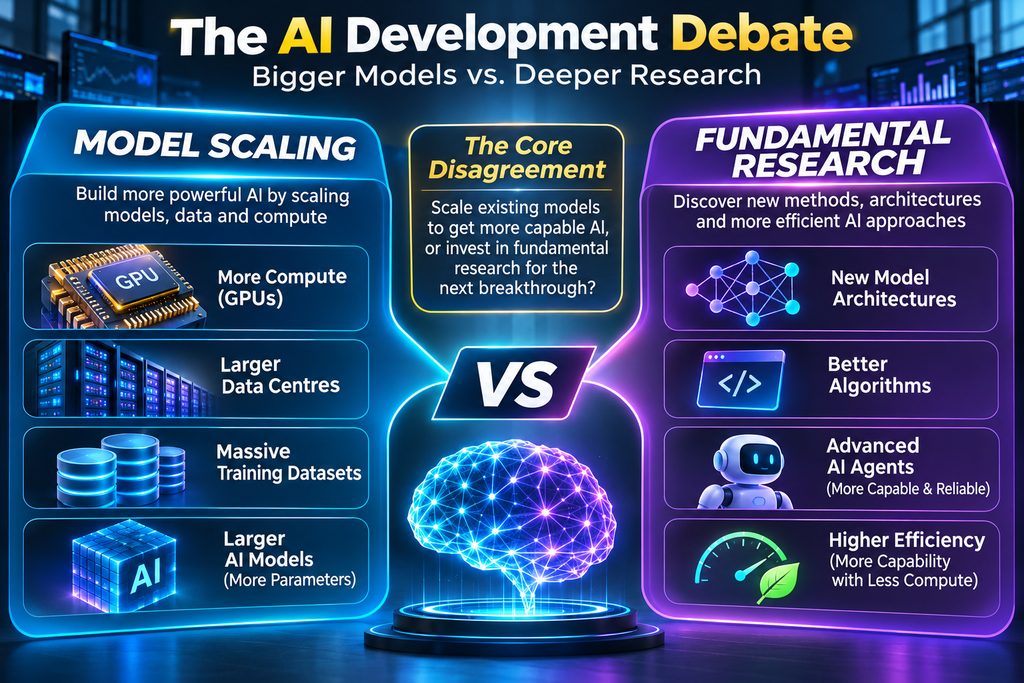
Microsoft AI’s Scaling-First Strategy Explained
At the centre of the disagreement is a larger debate within the artificial intelligence industry: should companies prioritise building larger models, or invest more heavily in new research methods that improve efficiency and capabilities?
Scaling generally involves increasing model size, training data and computing resources to improve performance. It has been a major driver of progress in modern AI systems.
John Langford acknowledged that this approach has a business argument behind it. Predicting the returns from larger models can be easier for companies than predicting the outcome of experimental research.
However, he believes that concentrating too heavily on scaling could limit opportunities for fundamental innovation.
His argument is that new training methods, model architectures and optimisation techniques can deliver meaningful improvements without requiring proportionally larger models.
For example, if a research breakthrough allows a model to achieve similar performance with significantly fewer computing resources, it could reduce training costs and inference expenses.
This debate is becoming increasingly important as technology companies spend billions of dollars on AI infrastructure, data centres and specialised processors.
It is worth noting that Langford’s criticism describes his experience with Microsoft AI’s leadership and priorities. It should not be interpreted as proof that Microsoft has stopped conducting AI research across the company.
What Happens to AI Frontiers After the Reorganisation?
This is the biggest unanswered question following Langford’s departure.
Microsoft’s official AI Frontiers page contains an update dated September 14, 2026, stating that the research group became part of Microsoft AI.
The same page says the team would continue pursuing frontier research into agentic systems and AI models within the new organisation. It also lists several of the group’s research contributions.
However, the page does not provide a detailed update about the group’s leadership, remaining staff or how its individual projects are being managed following Langford’s departure.
Langford, meanwhile, said that every other founding member of the AI Frontiers leadership team appeared to have reached a similar decision. He also confirmed that there would be no internships with the group in the coming year.
This creates an important distinction between the founder’s declaration and Microsoft’s official organisational information. Langford considers AI Frontiers finished, but Microsoft has not published a formal closure announcement confirming that all the group’s activities have ended.
John Langford’s exit raises questions about how Microsoft will balance experimental research with the commercial development of AI products.
Microsoft continues to invest in AI models, Copilot, Azure infrastructure and agent-based systems. Its AI operations also include research into model efficiency and agent capabilities.
However, the departure of a founding leader from a research group of approximately 50 people is significant because it highlights the challenges of combining different research cultures within a large technology company.
The situation also matters for developers who have followed projects such as AutoGen and Fara. Their future development, support and integration into Microsoft’s broader AI ecosystem are important questions.
For the wider AI industry, the disagreement highlights two different approaches to progress: improving models by increasing scale and improving them through new research ideas.
Neither approach necessarily excludes the other. The most effective AI systems may ultimately depend on combining larger models with better architectures, more efficient training methods and reliable agent capabilities.
Expert Analysis
John Langford’s departure highlights the tension between short-term AI scaling priorities and long-term fundamental research.
AI Frontiers contributed to important work in multi-agent systems, computer-use agents and model efficiency.
However, its future cannot be judged solely by its founder’s departure, particularly while Microsoft’s official page describes a transition rather than a closure.
The bigger question is whether Microsoft can preserve the group’s research contributions and create a practical path for experimental ideas to reach real products.

Conclusion
John Langford’s exit marks an important moment for Microsoft’s AI research organisation. After helping establish AI Frontiers in 2023, he has left the company following its September 2026 reorganisation into Microsoft AI.
His explanation points to a disagreement over research priorities, particularly the balance between scaling larger models and exploring new approaches to AI development.
The group worked on projects such as AutoGen, Fara, Next Latent and Full Bandwidth Transformer, making its contribution relevant to the wider AI research community.
For now, the formal future of AI Frontiers remains unclear. Langford has declared the group over, but Microsoft has not confirmed a complete shutdown. How the company handles its remaining research, software projects and people will determine the longer-term impact of this development.
Frequently Asked Questions
1. Who is John Langford?
John Langford is a machine-learning researcher associated with Microsoft Research. He helped establish AI Frontiers in 2023 and is known for his work in machine learning, online learning and AI research.
2. Why did John Langford leave Microsoft?
Langford said he left because of differences between AI Frontiers’ research-focused approach and Microsoft AI’s emphasis on scaling models. He also expressed concerns about getting research innovations into real-world use.
3. What is Microsoft AI Frontiers?
AI Frontiers was a research group established within Microsoft Research in 2023. It worked on AI agents, multi-agent frameworks, computer-use systems and fundamental model research.
4. How many people worked in AI Frontiers?
According to Langford, the group had approximately 50 people.
5. Which projects did AI Frontiers develop?
Some of its notable projects and research contributions include AutoGen, Fara, Next Latent, Dion3 and Full Bandwidth Transformer.
6. Is Microsoft officially shutting down AI Frontiers?
Microsoft has not publicly confirmed a formal shutdown. Its official research page says AI Frontiers became part of Microsoft AI in September 2026. Langford separately declared the group over.
7. What happens to AutoGen after Langford’s departure?
Microsoft’s GitHub repository now says AutoGen is archived and no longer actively maintained by Microsoft. The company recommends Microsoft Agent Framework for new projects.
8. What is the difference between AI scaling and fundamental AI research?
AI scaling generally involves increasing model size, training data and computing resources. Fundamental research explores new architectures, algorithms, training techniques and methods that can improve AI capabilities and efficiency.
Suggestions:
Sam Altman Changes X Name to ‘Ram Altman’ After RAM Backlash
OpenAI Engineer Arrested: 5 Key Facts About Hidden Recorder
Anthropic’s Claude Discovers a CRISPR-Like Enzyme System
Source:
John Langford – The End of AI Frontiers
Microsoft Research – AI Frontiers official page
Microsoft AutoGen – GitHub repository and maintenance notice
Background analysis of the AI Frontiers reorganisation
India Today – John Langford’s Microsoft exit