
TRAI Network Anubhav: Check Jio, Airtel & BSNL Network Quality with 3 Speed Metrics
TRAI Network Anubhav Platform: Check Jio, Airtel, Vi and BSNL Network Quality in Your Area
The Telecom Regulatory Authority of India (TRAI) has launched Network Anubhav, a new online platform that helps users compare mobile and broadband network performance across different locations. It brings together network test results, call-quality feedback and TRAI’s independent drive-test data in one place.
The platform also provides web access to TRAI’s Do Not Disturb (DND) services, allowing consumers to manage promotional communication preferences and report spam calls and messages. You can access it at anubhav.trai.gov.in.
What Is the TRAI Network Anubhav Platform?
Network Anubhav is a geospatial and analytical dashboard developed by TRAI. It combines consumer-generated test results from the regulator’s MySpeed and MyCall apps with data from TRAI’s independent drive tests.
Instead of relying only on advertisements or coverage maps published by telecom operators, users can explore network observations collected from different locations. The dashboard separates results by cellular and fixed broadband connections, service provider and technology.
The platform is designed for three main groups:
- Consumers: To explore network performance in their area and make more informed connectivity decisions.
- Telecom operators: To identify locations where call quality, coverage or internet performance may need improvement.
- TRAI: To monitor consumer experience and use aggregated information to support network-quality assessments.
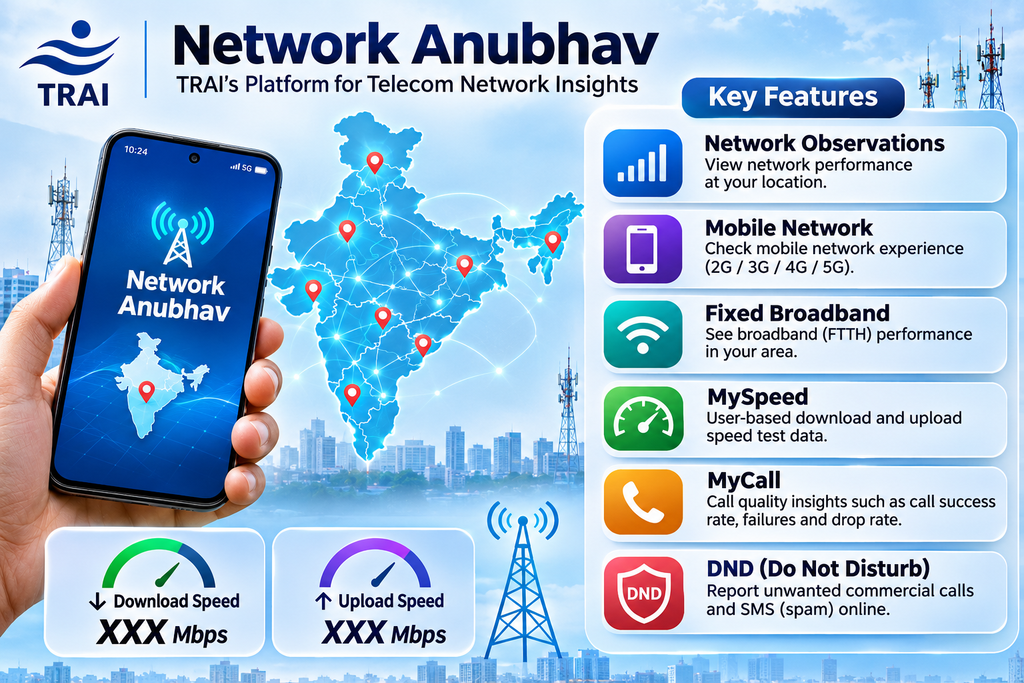
Key Features of the Network Anubhav Portal
1. Compare Network Performance by Location
The main feature is its interactive geospatial dashboard. Users can navigate and zoom into maps to examine network test observations from different locations.
The information can be filtered by service provider and technology. This can help users investigate how different operators perform in a particular area rather than depending on broad national-level network claims.
For example, someone considering a new SIM connection may want to compare the available results for Jio, Airtel, Vodafone Idea (Vi) and BSNL around their home or workplace. The portal can help them explore the observations available for that location.
However, the usefulness of the comparison depends on how much test data has been collected in the selected area.
2. Mobile and Fixed Broadband Information
Network Anubhav does not focus only on mobile internet. Its maps also organise information for fixed broadband connections.
The dashboard includes parameters such as download and upload speeds, with results categorised by connection type, service provider and technology.
This gives users a wider view of connectivity. Someone experiencing slow home broadband, for example, can examine available fixed broadband observations rather than looking only at mobile network results.
3. MySpeed and MyCall Data
The platform brings together results from two existing TRAI applications.
- MySpeed: Allows users to test their internet connection and contributes speed-test results.
- MyCall: Collects consumer feedback about voice-call quality.
By bringing these sources together, Network Anubhav provides a more unified view of internet performance and calling experience.
TRAI also includes results from its independent drive tests. These additional observations help users explore network performance beyond individual app-based tests.
4. Maps, Filters and Downloadable Reports
The dashboard includes filters, map legends, supporting tables and downloadable reports. These tools are intended to make the available information easier to understand.
Users can zoom into locations and examine how test observations are distributed geographically. This is particularly useful because network quality can change significantly between neighbourhoods, roads and buildings.
A telecom operator may perform well in one part of a city but deliver a weaker experience in another. Location-based observations can help reveal those differences.
What Do P50, P80 and P90 Mean?
One important part of the Network Anubhav dashboard is its use of percentile values. These figures help summarise the speeds recorded in a particular area.
| Metric | Meaning |
|---|---|
| P50 | Median speed: half of the recorded tests achieved this speed or higher |
| P80 | For mobile broadband, 80% of tests recorded speeds at or above this value |
| P90 | For fixed broadband, 90% of tests recorded speeds at or above this value |
These measurements should not be confused with a guaranteed internet speed. They represent the results of tests conducted in a particular area, and the actual experience of an individual user can be different.
TRAI has also clarified that user-test figures do not represent a complete assessment of network quality under a standardised methodology. They are useful indicators of other users’ experiences, but should be considered alongside the independent drive-test information.
TRAI Adds Online DND Services to the Platform
Network Anubhav is not limited to network-speed comparisons. It also provides web access to TRAI’s Do Not Disturb services.
Consumers can use the DND interface to:
- Register or manage preferences for promotional communications.
- Report unwanted commercial calls and SMS messages.
- Submit complaints about unsolicited commercial communication.
- Track the status of submitted complaints.
- View consolidated and telecom-service-provider-wise complaint information.
This is a useful addition because consumers no longer need to depend only on app-based access to these facilities. The portal provides a web interface for the available DND services.
How to Check Which Network Is Better in Your Area
If you are planning to change your SIM connection or want to investigate poor internet performance, you can explore the available information through the official portal.
Step 1: Open the official portal
Visit anubhav.trai.gov.in.
Step 2: Explore the network dashboard
Open the network information and map interface to examine the available observations.
Step 3: Select the location and connection type
Explore the relevant area and filter the results by service provider, technology and cellular or fixed broadband.
Step 4: Compare the available results
Review download and upload speeds, call-quality observations and other available network information.
The exact information visible will depend on the data available for the selected location. A location with fewer user tests may provide a less complete picture than an area with more observations.
Can Network Anubhav Help You Choose Between Jio, Airtel, Vi and BSNL?
Potentially, yes. The portal gives consumers a way to investigate network experiences across different service providers in specific locations.
This matters because choosing a mobile network based only on advertised speeds or general coverage claims can be misleading. A provider with strong performance across a city may still have weak coverage in a particular residential area or office location.
Before switching networks, users can examine the available local results and compare them with their own experience.
However, the dashboard should not be treated as a definitive ranking of telecom operators. It does not guarantee that the provider showing the highest recorded speed will deliver the best experience inside every home, office or building.
Signal strength, indoor coverage, network congestion, device compatibility and the time of day can all influence actual performance.
The launch is significant because it gives consumers more access to information about telecom network performance.
Traditionally, users often depend on personal experience, recommendations from friends or coverage information provided by operators when deciding which connection to use. Network Anubhav introduces another source: aggregated observations from consumers and TRAI’s own drive tests.
The platform may also encourage telecom companies to pay closer attention to areas where users report weaker performance. TRAI says service providers can access relevant information through a secure interface, including location, date, time and technical test parameters, to identify places that need further analysis.
TRAI Chairman Anil Kumar Lahoti said the platform is intended to improve transparency, help consumers analyse location-specific network tests and support operators in identifying areas for network optimisation.
Expert Analysis
Network Anubhav is a useful step towards making telecom performance information more accessible to Indian consumers.
Its biggest advantage is the combination of location-based user tests, call-quality feedback and independent drive-test observations.
However, users should avoid treating the displayed figures as guaranteed speeds or a final ranking of operators.
The platform’s long-term value will depend on regular contributions, reliable coverage of locations and how effectively operators act on the findings.

Conclusion
TRAI’s Network Anubhav platform gives consumers a central place to explore mobile and fixed broadband performance, examine call-quality feedback and access DND services online. It can help people make better-informed decisions when comparing telecom providers, particularly when choosing a network for a specific location.
The portal is not a guarantee of future network performance, but it offers an additional source of information beyond operator advertisements and personal recommendations. As more consumers contribute through TRAI’s MySpeed and MyCall apps, the platform could become more useful for understanding network experiences across India.
Frequently Asked Questions
1. What is the TRAI Network Anubhav platform?
Network Anubhav is a geospatial network-performance dashboard launched by TRAI. It brings together user test results, call-quality feedback, independent drive-test information and web access to DND services.
2. When did TRAI launch Network Anubhav?
TRAI launched the platform on November 4, 2026, according to the Ministry of Communications’ announcement.
3. How can I access the Network Anubhav portal?
You can visit the official website at anubhav.trai.gov.in.
4. Can I compare Jio, Airtel, Vi and BSNL?
You can explore the available location-specific observations by service provider and technology. The results depend on the data available for your selected area.
5. Does Network Anubhav show broadband performance?
Yes. Its dashboard includes information categorised as cellular and fixed broadband, including available download and upload speed observations.
6. Can I report spam calls through Network Anubhav?
Yes. The portal provides web access to TRAI’s DND services, including facilities to report unsolicited commercial calls and messages and track complaints.
7. Are the speeds shown on Network Anubhav guaranteed?
No. The displayed figures are based on user tests and other observations. TRAI says user-test values do not provide a comprehensive assessment of network quality under a standardised methodology.
8. How can users contribute data to the platform?
Consumers are encouraged to regularly use TRAI’s MySpeed and MyCall applications. Their contributions can improve the coverage and usefulness of the dashboard.
Suggestions:
DoT Caller Name Rule: 5 Important Changes Coming November 1
Jio 6G Technology: 5 Exciting Developments at IMC 2026
Jio ₹10000 Plan: 3-Year Validity, Unlimited 5G and Benefits
Source:
Government of India – Official Network Anubhav launch announcement
TRAI – Network Anubhav official portal
The Times of India – Network Anubhav launch report