
DoT Caller Name Rule: 5 Important Changes Coming November 1
DoT’s New Caller ID Rule Starts November 1: Names to Show on 4G and 5G Phones
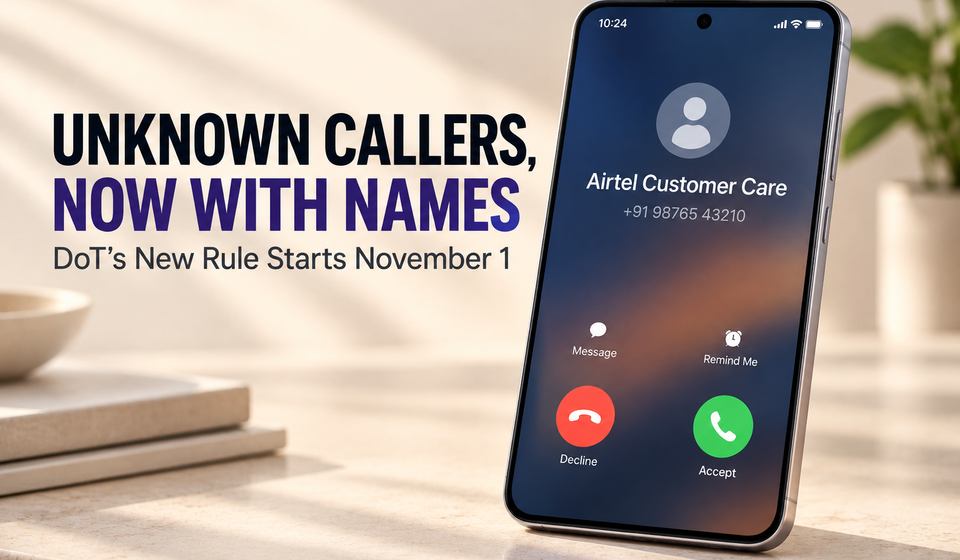
The DoT caller name rule will introduce a new way to identify incoming calls in India from November 1, 2026. Under the Calling Name Presentation (CNAP) system, telecom operators will display the caller’s name alongside their phone number on eligible 4G and newer-generation networks. The move aims to make it easier for users to identify unfamiliar callers without relying solely on third-party caller ID apps. India is preparing for a major change to how incoming mobile calls appear on your phone.DoT caller name rule From November 1, 2026, telecom operators must introduce Calling Name Presentation (CNAP) across their 4G and newer-generation networks, allowing recipients to see a caller’s name alongside the phone number.
The Department of Telecommunications (DoT) issued the direction in a circular dated October 13. The system is intended to make caller identification easier by using information held by telecom operators, rather than relying only on names saved in a phone’s contacts or on third-party caller identification apps.
The DoT caller name rule change will apply across India’s service areas. However, it is important to understand what CNAP will display, how it handles privacy and whether it will cover older networks.
What Is CNAP and How Will It Work?
The DoT caller name rule uses subscriber information recorded by telecom operators to display a caller’s name when an eligible call arrives. This can help users identify unfamiliar numbers without relying entirely on third-party caller ID apps.
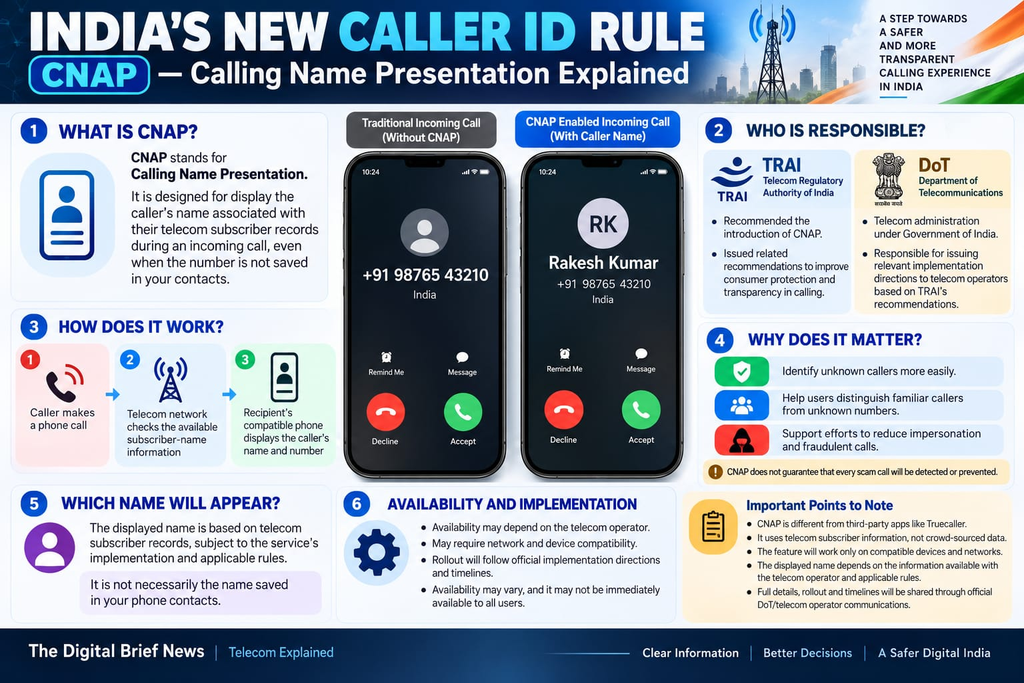
DoT caller name rule Presentation, or CNAP, is a telecom network feature that displays the calling person’s name along with their phone number on the recipient’s phone.
Currently, when someone calls from a number that is not saved in your contacts, your phone may show only the number. With CNAP, the network can also provide the name recorded in the caller’s subscriber details.
The system follows a simple order of preference:
- Saved contact: If the number is already saved in your contacts, your phone’s stored contact name takes priority.
- Unsaved domestic number: The caller’s name recorded by their telecom operator can appear beside the number with DoT caller name rule.
- International call: For an unsaved international number, the display will show “International Call” instead of a caller name under the specified rule.
This means users may be able to identify more incoming callers without manually saving every number.
When Does the New Caller Name Rule Start?
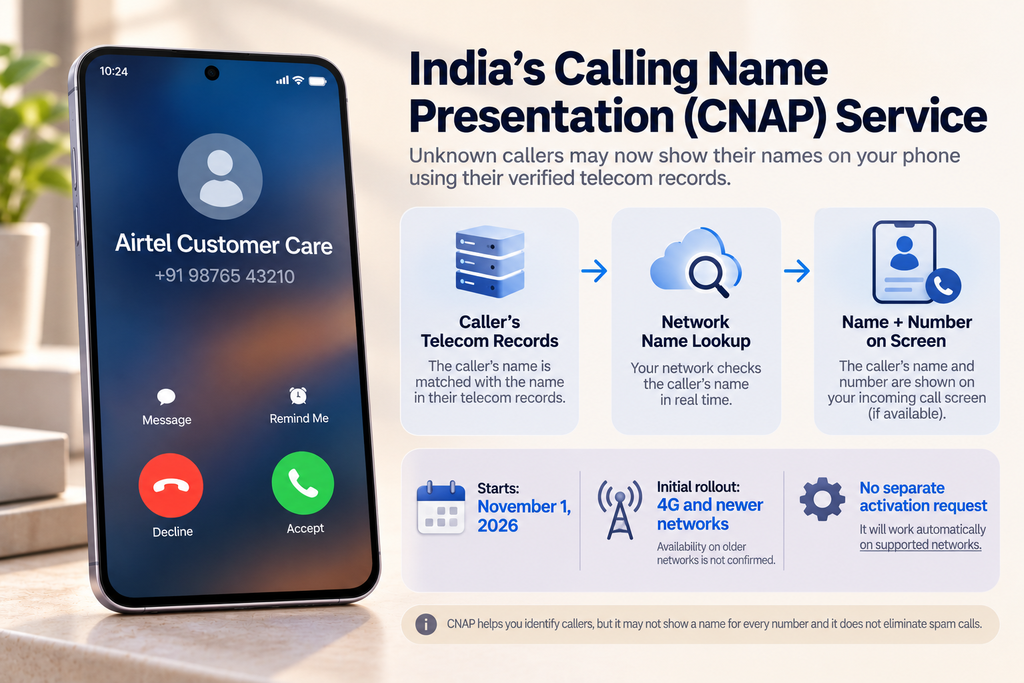
The DoT has directed telecom service providers to introduce CNAP from November 1, 2026, across all service areas for wireless networks using 4G and higher-generation technologies.
Operators have already conducted trials of the service on these networks. The new direction requires providers to make CNAP available without asking each subscriber to submit a separate activation request.
The mandate covers telecom operators authorised to provide access services. It is not limited to a single mobile operator or a particular state.
The rollout is a network-level change, so customers should not need to install a separate app just to receive the name information supplied through CNAP.
Will CNAP Work on Jio, Airtel, Vi and BSNL?
The DoT caller name rule direction applies to telecom service providers holding the relevant access-service authorisation across India. This brings the country’s major mobile operators within the scope of the mandate, including Reliance Jio, Bharti Airtel, Vodafone Idea and BSNL, subject to their applicable authorisations.
The key requirement is that the service be introduced across the relevant 4G and newer-generation networks DoT caller name rule. The circular does not describe CNAP as a feature exclusive to any one operator.
The DoT caller name rule order also does not mean that every call will display a person’s name in every situation. Saved contacts take priority, international calls follow a separate display rule, and users who have activated the Calling Line Identification Restriction (CLIR) facility are excluded from name presentation.
Will the Caller’s Real Name Be Displayed?
For an unsaved domestic number, CNAP will use the caller-name identity recorded in the originating telecom provider’s subscriber database.
That distinction matters. The displayed name is based on telecom subscriber records; it is not necessarily a name independently verified by the person receiving the call. The result may therefore differ from a person’s preferred name or the name by which they are commonly known.
The DoT has also provided a process for eligible business and bulk-connection users to request a preferred name. A business may use a name supported by an eligible registration for DoT caller name rule, such as a trademark registered with the Trade Marks Registry or a trade name registered on the GST portal. Telecom operators must verify the supporting documents before approving the name.
This process is intended to help eligible businesses appear under their recognised registered names rather than only an individual subscriber name.
Will CNAP Reduce Spam and Fraud Calls?
DoT caller name rule Displaying caller names could make it easier for users to assess unfamiliar calls. It may provide useful context when a call comes from a number that is not saved in the recipient’s contacts.
However, CNAP should not be treated as a complete spam-blocking system. Its primary function is to present caller-name information. The DoT direction does not establish that the feature will automatically block unwanted calls or identify every fraudulent caller.
Although the DoT caller name rule may help users recognise more callers, it is not an automatic spam-blocking system.Users should continue to be careful with calls asking for OTPs, banking credentials, payment transfers or other sensitive information. A displayed name alone is not proof that a caller genuinely represents a bank, government department, delivery company or other organisation.
If a call appears suspicious, independently verify the organisation through its official website or customer-care channel rather than relying only on the caller display.
What About Privacy and Caller Name Data?
The DoT’s direction includes safeguards for how CNAP information is handled.
Telecom operators must maintain databases that map subscriber names to their assigned telephone identifiers. When a call arrives, the recipient’s operator can retrieve the relevant name information from the originating operator’s database.
The circular requires a security-by-design approach. The query-response mechanism must prevent the calling-name identity from being retained once the incoming call ends. Operators must also maintain appropriate technical measures and ensure the quality of telecom services.
Users who have activated the Calling Line Identification Restriction facility will not have their names displayed through CNAP, in line with the specified conditions.
The department has also required telecom providers to establish a grievance-redressal mechanism for complaints about the service. These measures will be important if a name is displayed incorrectly or a subscriber has concerns about how their details appear.
Will CNAP Work on 2G, 3G and Landline Connections?
Not as part of the initial mandate described in the October circular.
The DoT caller name rule current direction covers wireless terrestrial networks built using 4G and higher-generation technologies. The DoT said the introduction of CNAP on 2G and 3G networks, as well as public switched telephone networks used for fixed-line services, would be considered separately after further examination.
The DoT caller name rule applies to eligible 4G and newer-generation networks, while the rollout for 2G, 3G and landline services will be considered separately.
The circular does not provide a separate rollout date for those older network technologies or landline services.
Therefore, the November 1 date should be understood in the context of the specified 4G-and-newer network rollout, rather than as confirmation that every type of telephone connection will receive CNAP on the same day.
What Should Mobile Users Do Before November 1?
For most users, no separate activation request is required under the DoT direction for DoT caller name rule. The service is intended to be provided by telecom operators by default.
You can still take a few practical steps:
- Keep your phone’s contact list up to date so saved names appear as expected.
- Check your operator’s official announcements for implementation details.
- Remember that the displayed name comes from subscriber records or your saved contacts, depending on the situation.
- Never share OTPs, PINs, passwords or banking information simply because a caller name appears on screen.
- Use your operator’s official grievance channel if you notice an incorrect name or another CNAP-related problem.
The DoT caller name rule actual display may depend on how the service is implemented across networks and devices, so users should avoid assuming that a name shown on screen proves a caller’s identity.
Conclusion
The DoT’s CNAP mandate is an important change to caller identification in India. From November 1, 2026, operators must introduce the service on 4G and newer-generation networks for DoT caller name rule, showing names alongside numbers for eligible incoming calls without requiring a separate request from each user.
The feature could make unfamiliar calls easier to assess, while the order also includes provisions for privacy, business-name verification and complaints. But CNAP is not a guarantee against spam or fraud, and its initial rollout does not include a confirmed common launch date for 2G, 3G and landline networks.
Frequently Asked Questions
1. What is CNAP?
CNAP stands for Calling Name Presentation. It is a telecom feature that displays the caller’s name along with their phone number during an incoming call.
2. When will the new caller name rule start in India?
The DoT has directed telecom operators to introduce CNAP on 4G and newer-generation networks from November 1, 2026.
3. Will users need to activate CNAP manually?
No separate subscriber request is required under the direction. Telecom operators must provide the service by default on the covered networks for DoT caller name rule.
4. Will CNAP work on Jio, Airtel, Vi and BSNL?
The direction applies to telecom service providers authorised to provide access services across India. Major operators fall within its scope, subject to the applicable authorisations and covered networks.
5. What name will appear for an unsaved number?
For an unsaved domestic number, CNAP will present the caller-name identity recorded in the originating telecom operator’s subscriber database.
6. Will international callers’ names appear?
For an unsaved international call, the specified display is “International Call” rather than the caller’s name.
7. Does CNAP automatically block spam calls?
No. CNAP presents caller-name information. It should not be treated as an automatic spam-blocking service or a guarantee that a call is safe.
8. Will CNAP work on 2G, 3G and landline phones from November 1?
The DoT caller name rule initial direction covers 4G and newer-generation wireless networks. The DoT said 2G, 3G and fixed-line implementation would be considered separately.
9. Can a caller hide their name?
Users who have activated the Calling Line Identification Restriction (CLIR) facility are excluded from name presentation under the DoT’s specified conditions.
10. Can a business display its registered brand name?
Eligible business and bulk-connection users may request a preferred name supported by qualifying registration documents for DoT caller name rule. The telecom operator must verify the documents before approving it.
Recommendations:
OPPO Pad Mini: 5 Powerful Features to Know Before Launch
ColorOS 17 Rollout Starts October 29: Is Your Phone Eligible?
Apple HomeView: 7 Impressive Features and India Price
Sources:
Ministry of Communications’ DoT
TRAI — CNAP recommendations
The Indian Express — DoT caller-name order