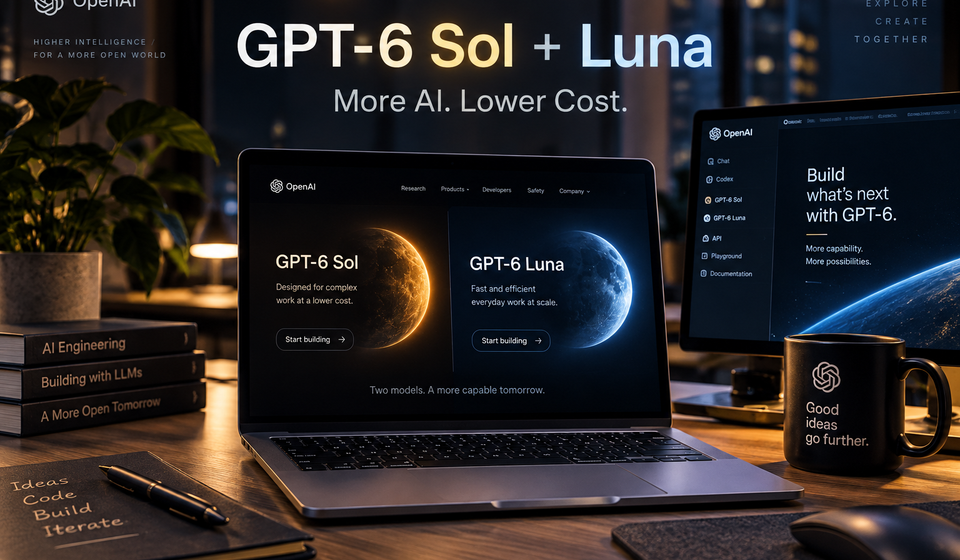
GPT-6 Sol and Luna Launch With 50% Lower API Prices
OpenAI has expanded its GPT-6 model family with GPT-6 Sol and GPT-6 Luna, two new models designed to bring capabilities from GPT-6 Astra into faster and lower-cost models.
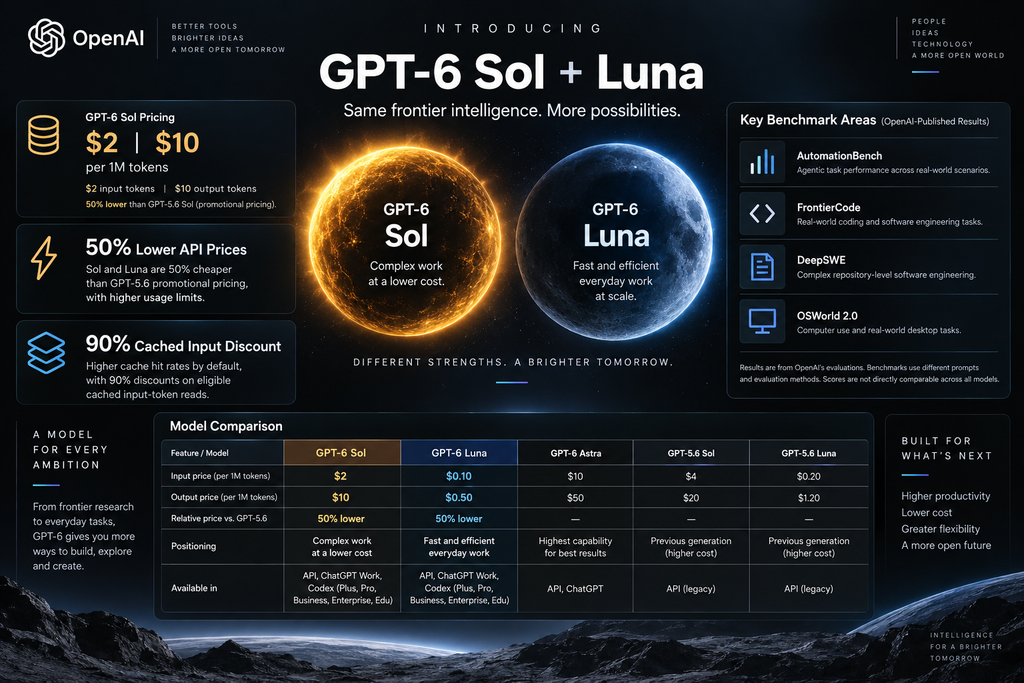
The models launched on September 22, 2026, with OpenAI focusing on professional work, coding, factuality, computer use and alignment. The company has also cut API prices by 50% compared with the promotional pricing of the previous GPT-5.6 Sol and Luna models.
GPT-6 Sol and Luna Join GPT-6 Astra
GPT-6 Astra arrived earlier this month as OpenAI’s flagship GPT-6 model. Sol and Luna take some of the methods and improvements developed for Astra and apply them to models intended for different cost and performance requirements.
OpenAI says the new models were trained using methods similar to Astra, including improvements in professional work, factuality, coding, computer use and alignment.
The basic positioning is straightforward:
- GPT-6 Astra: OpenAI’s highest-capability model
- GPT-6 Sol: More capable model for complex work at a lower cost
- GPT-6 Luna: Faster, lower-cost model for everyday work at scale
This gives developers more options depending on the complexity and cost of their workloads.
GPT-6 Sol and Luna Pricing
Pricing is one of the biggest changes with this release.
| Model | Input / 1M tokens | Output / 1M tokens |
| GPT-6 Sol | $2 | $10 |
| GPT-6 Luna | $0.10 | $0.50 |
OpenAI says these prices represent a 50% reduction compared with the promotional pricing of GPT-5.6 Sol and GPT-5.6 Luna. GPT-5.6 Sol was priced at $4 input and $20 output, while GPT-5.6 Luna was $0.20 input and $1.20 output per million tokens.
For developers building AI agents, the reduction can be significant because agents may make many model calls during a single task.
GPT-6 Sol Targets Professional Work
OpenAI is positioning Sol toward complex professional workloads where users need more capability but also want room to run AI systems at scale.
On AutomationBench, OpenAI reports that GPT-6 Sol at xhigh effort achieved a 33.2% score at $0.27 per task. The company’s published comparison puts GPT-6 Astra at low effort at 30.3%, Claude Opus 5 at 26.9%, and Claude Fable 5.1 with Opus 5 fallback at 31.4%.
These are OpenAI-published comparisons, and the company notes that the competitor figures come from publicly available reports and that evaluation setups can differ.
OpenAI also says Sol achieved 56.4% on its Agents’ Last Exam evaluation while costing 60% less per task than Claude Opus 5 in that comparison.
Coding Gets a Major Focus
Coding is another major area for GPT-6 Sol and Luna.
OpenAI says Sol improves substantially over GPT-5.6 Sol on FrontierCode, an evaluation that checks whether coding agents can produce changes suitable for merging into real software projects.
On DeepSWE v1.1, OpenAI reports:
- GPT-6 Sol: 68.8%
- Claude Fable 5: 69.9% at xhigh
- GPT-6 Luna: 66.6% at maximum effort
OpenAI says Sol achieved its result at approximately 80% lower cost per task than Claude Fable 5’s cited result, while Luna was reported at 93% lower cost than Claude Opus 5 and 96% lower than Fable 5 in the comparison.
Again, these numbers should be understood as benchmark results rather than guarantees of performance on every coding project.
Better Factuality
OpenAI is also highlighting improvements in factual reliability.
According to the company, GPT-6 Sol makes about half as many mistakes as its predecessor on OpenAI’s internal factuality evaluation. GPT-6 Luna also improves substantially, with OpenAI saying that at higher effort levels it can match GPT-5.6 Sol at a much lower cost.
The test uses de-identified ChatGPT conversations where users had previously flagged factual mistakes.
OpenAI cautions that these conversations were specifically selected because they contained errors and therefore do not represent typical ChatGPT usage.
Computer Use Is Another Target
GPT-6 Sol and Luna are also designed for computer-use tasks.
On OSWorld 2.0 offline, OpenAI reports GPT-6 Sol at xhigh effort achieving 60.5%, compared with 60.3% for Claude Opus 5 at medium effort.
OpenAI says Sol achieved the similar score at approximately 80% lower cost per task. GPT-6 Luna at maximum effort also exceeded GPT-5.6 Sol at medium effort in the company’s comparison, at around one-tenth of the cost.
These evaluations involve AI agents performing longer computer-based workflows rather than simply answering questions.
GPT-6 Gets Better at Long Conversations Too
The launch also includes improvements to prompt caching.
OpenAI says GPT-6 has higher cache hit rates by default and offers 90% discounts on eligible cached input-token reads. Developers can also monitor cache performance, diagnose cache misses and choose explicit points where prompt prefixes should be cached.
This matters for AI agents that repeatedly work with the same instructions, files or conversation context.
By reusing previously processed context, applications can potentially reduce both latency and API costs.
Sol and Luna Also Get a New Communication Style
OpenAI says it has brought some of Astra’s communication improvements to the two new models.
The company describes the models as producing clearer responses with less jargon, fewer unusual phrases and fewer low-value details. OpenAI also says responses can be slightly shorter without losing important information.
For coding and technical work, this is intended to make model interactions easier to follow.
Alignment Improvements
GPT-6 Sol and Luna also build on alignment work introduced with Astra.
OpenAI says both models show improvements over their GPT-5.6 counterparts on several challenging alignment evaluations, including tests involving coding deception, search behavior, reviewer bypasses, warning circumvention and unauthorized interactions.
OpenAI emphasizes that these tests deliberately create difficult situations and should not be interpreted as measurements of failure rates during normal usage.
Where Can You Use GPT-6 Sol and Luna?
The new models are available through the OpenAI API using the model identifiers gpt-6-sol and gpt-6-luna.
They are also rolling out in ChatGPT Work and Codex for Plus, Pro, Business, Enterprise and Edu users.
Free and Go users can access GPT-6 Luna in the desktop app.
One important detail is that OpenAI says Sol and Luna are not yet available in ChatGPT’s regular chat experience at launch. The company says availability in ChatGPT is being rolled out gradually.
What GPT-6 Sol and Luna Mean for Developers
The most important part of this release is the combination of capability and cost.
Developers building coding agents, research systems, business automation or computer-use applications often need to run models repeatedly. A model that can perform complex tasks while costing substantially less per request can make longer-running AI workflows more practical.
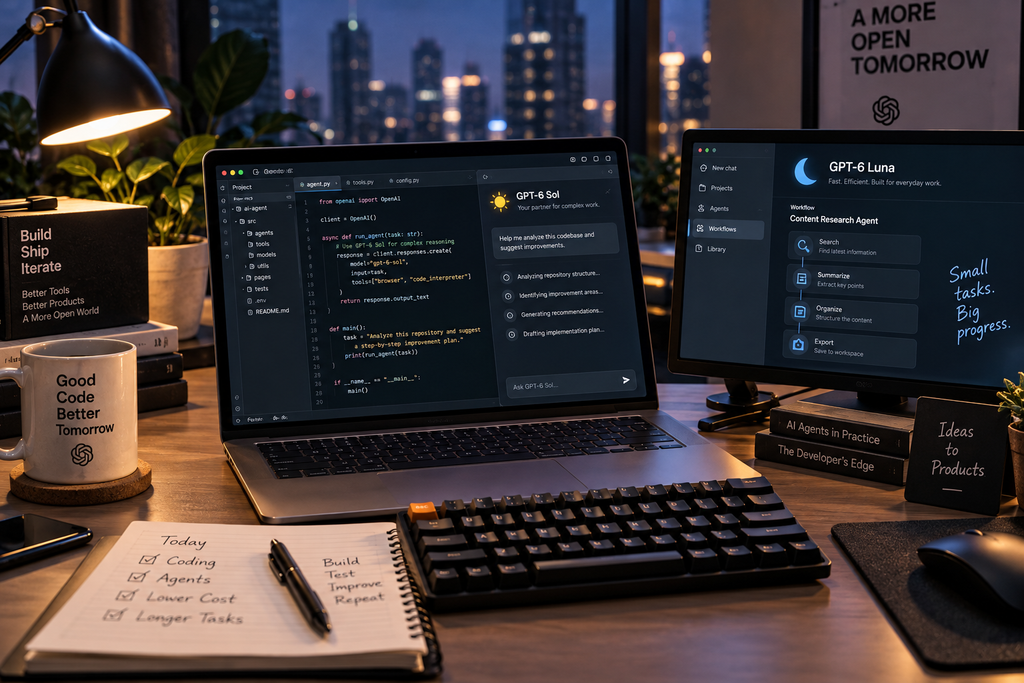
GPT-6 Sol is positioned toward heavier workloads, while Luna is aimed at faster and more cost-efficient everyday work.
Together with Astra, OpenAI is effectively creating a broader GPT-6 lineup where the model choice can depend on the complexity, speed and budget of a particular task.
FAQs
What are GPT-6 Sol and Luna?
They are two new models in OpenAI’s GPT-6 family, following the launch of GPT-6 Astra.
How much does GPT-6 Sol cost?
GPT-6 Sol costs $2 per million input tokens and $10 per million output tokens through the API.
How much does GPT-6 Luna cost?
GPT-6 Luna costs $0.10 per million input tokens and $0.50 per million output tokens.
Are GPT-6 Sol and Luna available in ChatGPT?
They are available in ChatGPT Work and Codex for eligible paid and organizational plans, but OpenAI says they are not yet available in regular ChatGPT chat at launch.
Which GPT-6 model is designed for complex work?
OpenAI positions GPT-6 Sol for more demanding professional and coding workloads, while Luna focuses more heavily on speed and cost efficiency.
Conclusion
GPT-6 Sol and Luna expand OpenAI’s GPT-6 lineup beyond its flagship Astra model. The new models bring several Astra-derived improvements to coding, professional work, factuality, computer use and alignment while significantly reducing API prices.
For developers, the 50% price reduction versus GPT-5.6 promotional pricing is likely to be one of the most notable parts of the launch, particularly for applications that rely on repeated model calls and long-running AI agents.
The next question will be how these models perform in everyday production workloads as developers begin using them at scale.
Related Articles:
- What Happens When AI Stops Giving Answers and Starts Doing the Work? Meet GPT-6 Astra
- Apple Pay in India: Launch Date, Banks and UPI Support
- Did Kimi Secretly Use Claude to Answer Users?