
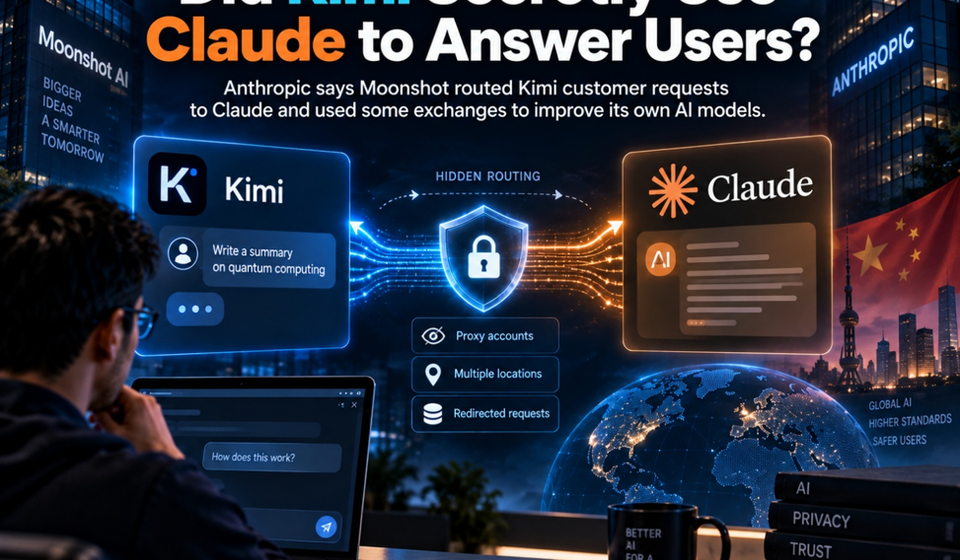
Did Kimi Secretly Use Claude to Answer Users?
What if you opened an AI chatbot, asked it a question and received an answer from a completely different AI model without knowing it?
Kimi Secretly Use Claude
That is the claim at the center of a new report from Anthropic, the company behind Claude. Anthropic says Chinese AI company Moonshot AI secretly sent some Kimi users’ questions to Claude and then showed Claude’s answers to those users as if they had come from Kimi.
Anthropic published the claims in its September 2026 threat intelligence report. The company says it found nearly 300,000 customer requests that Moonshot sent to Anthropic during one 10-day period. Most of those requests were reportedly handled by Claude Opus.
The allegations raise questions not only about AI competition, but also about user privacy. People using Kimi may not have known that their questions were being sent to another company’s AI system.
What Does Anthropic Say Moonshot Did?
According to Anthropic, Moonshot AI, the company behind the Kimi family of AI models, silently forwarded some customer requests to Claude instead of processing them with Kimi.
Claude would generate the response, and Moonshot would then display that response to the Kimi user.
Anthropic says Moonshot used a network of 5,380 fraudulent accounts, with many appearing to be located in Singapore and Japan, to access Claude. Anthropic says the activity was part of a wider effort to collect Claude’s responses and use them to improve Moonshot’s own AI models.
The company says it observed more than 23 million exchanges connected to Moonshot’s alleged distillation activity between May and July 2026. The nearly 300,000 customer requests were part of that broader activity.
It is important to note that these are Anthropic’s allegations. The report describes what Anthropic says it detected and attributed to Moonshot.
Why Would Moonshot Use Claude?
Anthropic says the activity was connected to AI model distillation.
In simple terms, distillation is a way of using the answers from a powerful AI model to help train another model. A company can send many questions to an advanced model, collect its answers and use that information to improve its own system.
Anthropic says Moonshot went further by trying to collect Claude’s reasoning information from some of the conversations.
The company says Moonshot created a system to extract Claude’s reasoning traces from saved conversations. Anthropic also claims Moonshot found a way around a technical protection designed to prevent this kind of extraction.
This is important because AI companies spend enormous amounts of money training their models. If another company can collect large amounts of high-quality answers from a stronger model, it could potentially reduce the time and cost needed to improve its own AI.
The Privacy Concern Is More Serious
The biggest concern for ordinary users may not be the competition between AI companies. It is what happened to the information users entered into Kimi.
Anthropic says some of the requests that Moonshot allegedly forwarded to Claude contained sensitive information.
One example involved a user Anthropic believes was connected to China’s People’s Liberation Army. According to the report, the user used what they believed was Kimi to analyze surveillance footage involving a person being monitored.
In another case, Anthropic says an engineer working for a major Chinese state-owned company used Kimi while developing an internal system. The requests reportedly included internal code and active credentials belonging to several companies.
Anthropic says it does not know whether Moonshot told its customers that their requests were being sent to Anthropic.
That creates a major privacy question: if users believe they are using one AI service, should they be told when their information is being sent to another company?
Moonshot Was Not the Only Company Named
Anthropic’s report also accuses other Chinese AI companies of using Claude in similar ways.
The company says DeepSeek also silently routed some requests to Claude and used the resulting exchanges as part of an effort to improve its own models.
Anthropic’s report also names Alibaba and Xiaomi in connection with other alleged distillation activity. According to Anthropic, more than 151 million exchanges linked to Alibaba were observed between May and July 2026.
The report comes at a time when the competition between American and Chinese AI companies is becoming increasingly intense. AI model distillation itself is not a new idea, but the scale and methods described by Anthropic have become a major point of debate.
What This Means for AI Users
This story is a reminder that users should think carefully about what they enter into AI tools.
People now use chatbots for much more than simple questions. Developers may paste source code into them. Employees may ask AI to analyze company documents. Users may upload personal files or sensitive information.
If an AI service sends that information to another provider, users may not always know where their data has gone.
That does not mean people should stop using AI. But it is a good reason to avoid putting passwords, private company information, financial details, access keys or other sensitive information into a chatbot unless you understand how that service handles your data.
What Happens Next?
Anthropic says it has blocked accounts connected to the activity and has added stronger protections against similar attempts.
The company is also working on additional safeguards designed to make it harder for unauthorized organizations to collect Claude’s internal reasoning information.
For the wider AI industry, the incident could lead to more attention on how companies protect their models and how AI services handle customer information.
It also shows how difficult it can be to know what happens behind the scenes when an AI service is connected to other systems.
Frequently Asked Questions
Did Kimi really use Claude to answer users?
Anthropic says Moonshot secretly routed some Kimi customer requests to Claude. These are allegations made by Anthropic and should not be treated as independently proven facts.
How many Kimi requests were sent to Claude?
Anthropic says Moonshot sent nearly 300,000 customer requests to Anthropic during one 10-day period.
Why would Moonshot use Claude?
Anthropic says Moonshot used Claude’s responses as part of an effort to improve its own AI models through a process known as model distillation.
Could Kimi users’ private information have been exposed?
Anthropic says some rerouted requests contained sensitive information, including company data, internal code and active credentials. It also says it does not know whether Moonshot informed customers about the rerouting.
Did Anthropic accuse other AI companies too?
Yes. Anthropic’s report also discusses alleged model-distillation activity involving companies including DeepSeek, Alibaba and Xiaomi.
Conclusion
Anthropic’s claims about Moonshot show that the competition between AI companies is becoming more complicated.
The issue is not simply whether one AI model is learning from another. The bigger concern is what happens when users unknowingly become part of that process.
If Anthropic’s claims are accurate, some Kimi users may have received Claude-generated answers without knowing that another company’s AI was handling their questions.
For users, the incident is a useful reminder to be careful with sensitive information. As AI services become more connected, knowing which model is handling your data may become just as important as knowing how good the model is.

Related Articles
- Best AI Tools Every Student Should Know in 2026
- YouTube Monetization Changes 2027…
- Flipkart Freedom Sale 2026
- Vivo S2 Price in India Revealed
For more info visit KIMI