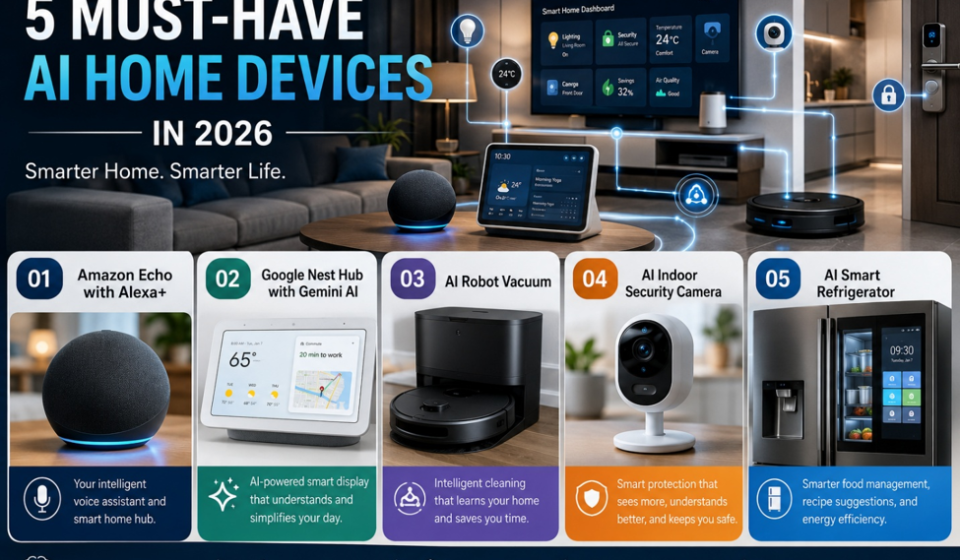
5 Must-Have AI Home Devices in 2026 That Will Make Your Home Smarter
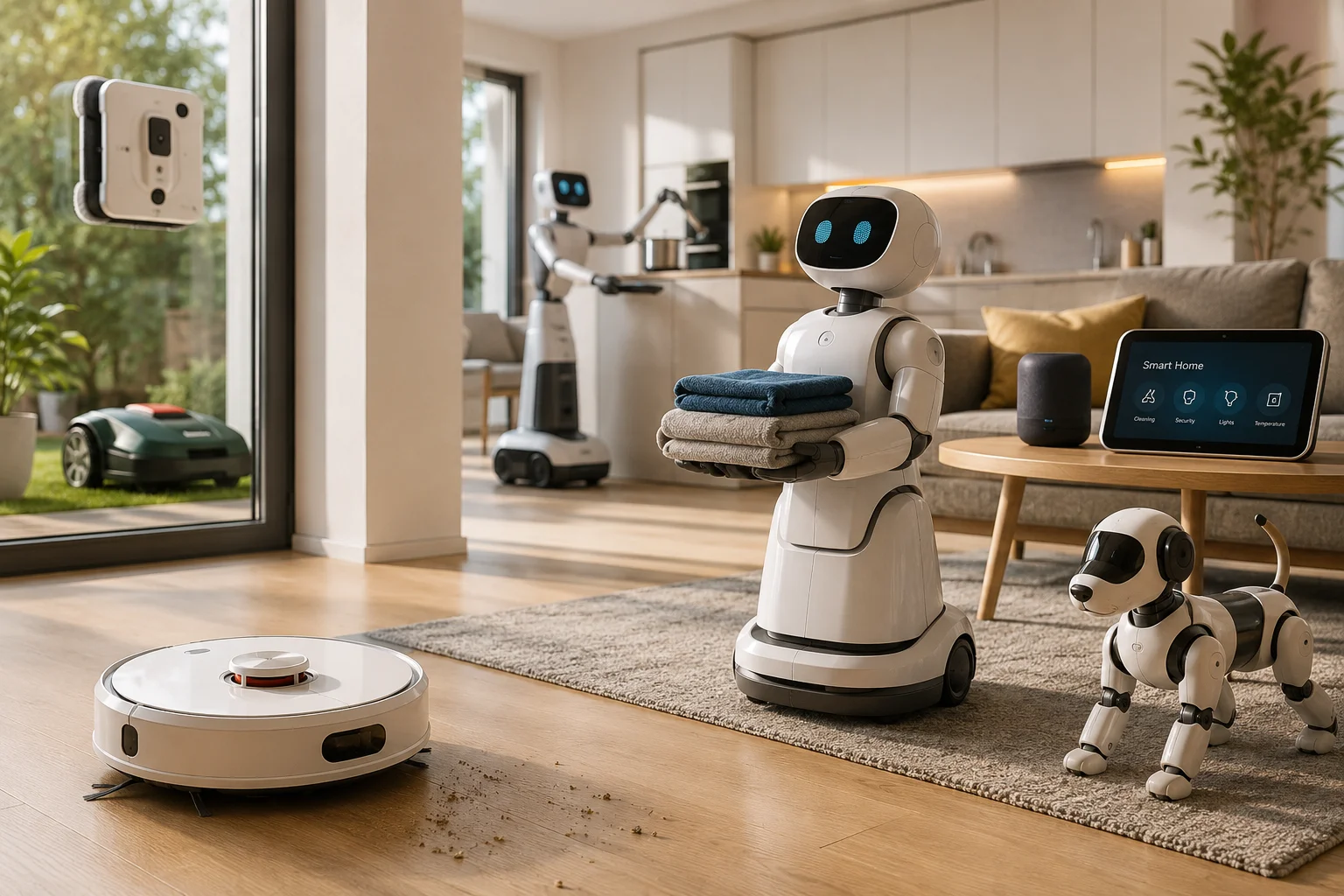
AI Home Devices 2026
Artificial intelligence is no longer confined to smartphones, laptops, or cloud-based chatbots. Over the past few years, AI has quietly entered our homes, transforming everyday appliances into intelligent assistants capable of learning routines, making decisions, automating repetitive tasks, and improving convenience in ways that were unimaginable a decade ago. In 2026, the modern home is becoming an interconnected ecosystem where devices communicate with one another, understand user preferences, and proactively respond to changing conditions without requiring constant human input.
In this guide, we explore the 5 Must-Have AI Home Devices in 2026 that are shaping the future of connected living. Rather than simply listing popular gadgets, this article explains how each device works, why it stands out, who should consider buying it, and how it fits into a modern smart home. By the end of this guide, you’ll understand which AI Home Devices 2026 deserve a place in your home and which technologies are likely to define the next generation of intelligent living.
Why AI Home Devices Are Becoming Essential in 2026
Only a few years ago, the phrase “smart home” usually referred to devices that could be controlled using a smartphone or voice assistant. While that level of automation was impressive at the time, today’s technology has moved far beyond basic remote control. Artificial intelligence has introduced a new level of intelligence that allows devices to think, learn, and adapt instead of simply following commands.
This evolution is one of the biggest reasons why AI Home Devices 2026 are becoming increasingly essential rather than optional. Modern AI systems continuously analyze user behaviour, environmental conditions, and historical data to make informed decisions automatically. Instead of waiting for instructions, AI-powered devices anticipate needs before users even realize they exist.
Convenience remains one of the strongest reasons consumers invest in AI Home Devices 2026. Busy professionals, parents, elderly individuals, and people working from home increasingly rely on AI to handle repetitive tasks such as cleaning, scheduling, monitoring deliveries, managing entertainment systems, and controlling household appliances.
As artificial intelligence becomes deeply integrated into everyday appliances, homes are gradually evolving into intelligent environments capable of improving comfort, safety, efficiency, and productivity with minimal human intervention.
What Makes a Device Truly AI-Powered?
The term “AI-powered” has become one of the most frequently used marketing phrases in the consumer electronics industry. However, not every smart device deserves that label. Many products advertised as AI devices simply follow pre-programmed automation rules without learning or adapting over time.
Understanding this distinction is essential when evaluating AI Home Devices 2026.
Traditional smart devices operate according to fixed instructions. For example, a smart light can switch on at a scheduled time every evening, while a smart plug can activate according to a timer. Although useful, these actions do not involve artificial intelligence because the device is merely following predetermined commands.
The same principle applies to AI-powered robot vacuums. Instead of cleaning rooms randomly, they generate detailed maps of the home, identify furniture locations, recognize obstacles, avoid fragile objects, learn high-traffic areas, and optimize cleaning routes with each session.
Perhaps the most significant characteristic of modern AI home technology is continuous learning. The longer these devices remain in use, the better they understand household routines, preferences, and behavioural patterns. This ongoing improvement transforms AI-powered homes from collections of connected gadgets into intelligent living environments that become increasingly personalized over time.
Amazon Echo with Alexa+: The AI Assistant That Becomes the Brain of Your Smart Home
Among all AI Home Devices 2026, few products have influenced smart home adoption as much as Amazon’s Echo lineup. What began as a voice-controlled smart speaker has evolved into one of the most capable AI-powered home assistants available today. With the introduction of Alexa+, Amazon has significantly expanded the intelligence of its ecosystem, transforming Echo devices from simple voice assistants into proactive home management systems.
This deeper contextual understanding represents one of the biggest advancements in AI Home Devices 2026. Alexa+ doesn’t simply execute commands; it understands routines, preferences, and household behaviour. Over time, it learns frequently used commands, preferred lighting settings, entertainment habits, shopping preferences, and daily schedules, making interactions increasingly personalized.
Beyond voice assistance, Alexa+ acts as the central hub connecting hundreds of compatible smart home products, including lighting systems, thermostats, security cameras, smart plugs, televisions, speakers, appliances, and robot vacuums. Instead of managing separate applications for every device, homeowners can control their entire smart home through one intelligent assistant.
Another major advantage is automation. Alexa+ can create routines that respond to triggers such as motion detection, sunrise, sunset, weather changes, location, or voice commands. These routines reduce manual interaction while improving convenience throughout the home.
For families already invested in Amazon’s smart home ecosystem, Alexa+ remains one of the most compelling AI Home Devices 2026 because of its mature platform, broad compatibility, and expanding AI capabilities. Rather than functioning as a single gadget, it serves as the intelligent control centre that connects every other smart device into one seamless ecosystem.

Google Nest Hub with Gemini AI: The Smart Display That Understands You
If Amazon has focused on making Alexa the central controller for smart homes, Google has taken a different approach by integrating its latest artificial intelligence capabilities into the Nest ecosystem. With the arrival of Gemini-powered experiences, the Google Nest Hub has evolved from a smart display into an intelligent home assistant capable of understanding conversations, managing household routines, and delivering contextual assistance that feels far more natural than previous generations.
As AI Home Devices 2026 continue to become more intelligent, the biggest improvement is not necessarily faster hardware or better displays. Instead, the real advancement lies in how these devices understand people. Gemini enables the Nest Hub to process longer conversations, remember context, interpret complex requests, and provide responses that are significantly more helpful than traditional voice assistants.
Privacy also remains an important consideration. Google continues to expand privacy controls, allowing users to manage voice recordings, review activity history, and customize how personal information is used across connected devices. As adoption of AI Home Devices 2026 grows, transparency around data collection is becoming just as important as the intelligence these systems provide.
AI Robot Vacuum: Intelligent Cleaning That Learns Your Home
Vacuum cleaners have undergone one of the most remarkable transformations in the smart home industry. Early robotic vacuums followed random movement patterns, frequently became stuck under furniture, missed large portions of rooms, and required constant supervision. Today’s AI-powered robot vacuums bear little resemblance to those early models. Thanks to advances in artificial intelligence, machine learning, computer vision, and LiDAR mapping, they have become one of the most practical AI Home Devices 2026 for modern households.
Imagine a family with children and pets. The dining area may require daily cleaning after meals, while guest bedrooms might only need attention once every week. Instead of requiring manual programming, AI-powered systems recognize these patterns automatically and optimize cleaning schedules accordingly. This adaptive behavior is one of the defining characteristics of AI Home Devices 2026, separating true artificial intelligence from traditional automation.
Integration with voice assistants further enhances convenience. Users can simply request a specific room to be cleaned or temporarily avoid areas where family members are working. Through compatibility with platforms like Alexa and Google Home, robot vacuums become an integral part of broader smart home automation routines.
AI Indoor Security Cameras: Smarter Protection That Knows the Difference Between a Visitor and a Threat
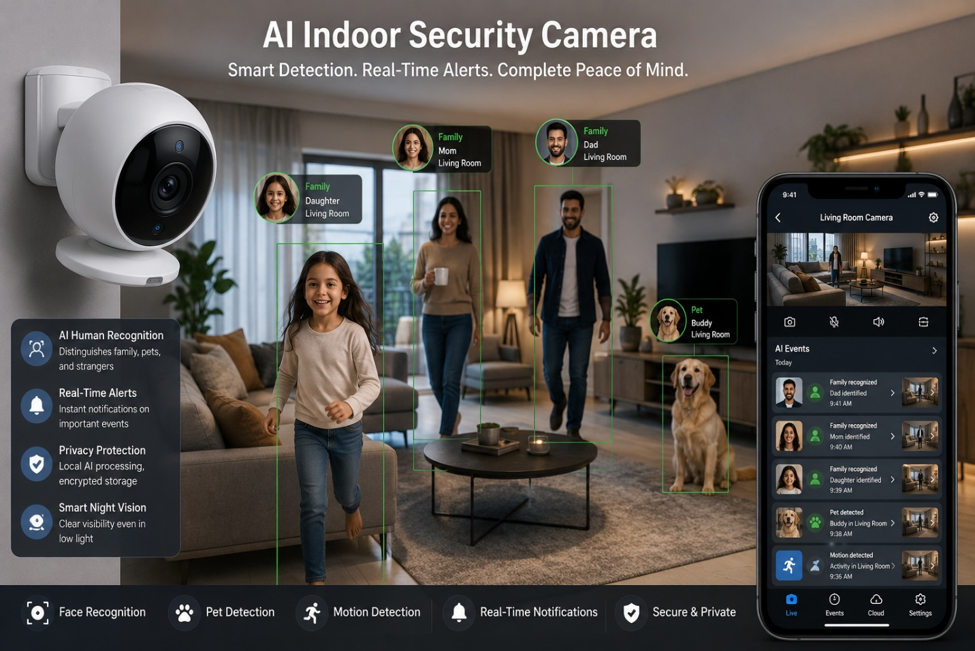
Home security has evolved dramatically over the past decade. Traditional CCTV systems continuously recorded footage but offered little intelligence beyond capturing video. Homeowners often had to sift through hours of recordings or respond to frequent false alerts triggered by pets, moving trees, or changing weather conditions. In contrast, today’s AI Home Devices 2026 are transforming home security by combining advanced computer vision, machine learning, and real-time analytics to provide far more accurate and meaningful protection.
Imagine leaving for work and receiving a notification that simply says, “Motion detected.” Without additional context, it is impossible to know whether the movement was caused by your child returning home, a pet walking through the room, or an unexpected visitor. AI-powered cameras eliminate this uncertainty by providing intelligent alerts such as “Package delivered at the front door,” “Known family member entered the living room,” or “Unknown person detected near the entrance.” This level of contextual awareness represents one of the biggest advantages of AI Home Devices 2026.
AI Smart Refrigerators: The Kitchen Appliance That Thinks Ahead
Among all AI Home Devices 2026, few appliances demonstrate the practical benefits of artificial intelligence as effectively as the modern smart refrigerator. Traditionally, refrigerators performed a single task: keeping food fresh. Today’s AI-powered refrigerators, however, are evolving into intelligent kitchen assistants capable of managing groceries, reducing food waste, suggesting recipes, monitoring energy consumption, and even helping families plan meals more efficiently.
One of the most practical applications of AI Home Devices 2026 is intelligent recipe generation. Rather than searching the internet every evening for dinner ideas, AI refrigerators can recommend meals using ingredients already available inside the appliance. If vegetables, eggs, chicken, cheese, and herbs are detected, the refrigerator may suggest multiple recipes while highlighting ingredients that should be used first to minimize spoilage.
Voice assistant integration further enhances convenience. Homeowners can ask about shopping lists, check ingredient availability, set expiration reminders, or control refrigerator functions using natural language through connected smart home ecosystems. As AI Home Devices 2026 become increasingly interconnected, refrigerators are no longer isolated appliances but active participants in a larger intelligent home network.
Although AI refrigerators remain among the more expensive AI Home Devices 2026, they represent a glimpse into the future of intelligent kitchens where appliances actively assist with nutrition, meal planning, inventory management, and household organization rather than simply performing mechanical functions.
Image Placeholder: AI smart refrigerator displaying grocery inventory, recipe suggestions, family calendar, and energy optimization dashboard on a touchscreen.
Which AI Home Device Should You Buy First?
Choosing your first AI Home Devices 2026 investment depends less on buying the most expensive gadget and more on identifying which technology solves your biggest everyday challenge.
Rather than viewing these technologies as isolated gadgets, the true strength of AI Home Devices 2026 lies in how they work together. When connected within a unified smart home ecosystem, they create an intelligent environment that anticipates needs, automates repetitive tasks, improves energy efficiency, enhances security, and allows homeowners to focus more on living and less on managing their homes.
The Future of AI Home Devices in 2026 and Beyond
The rapid evolution of artificial intelligence is transforming homes into intelligent living environments rather than collections of connected gadgets. While today’s smart homes can already automate lighting, security, cleaning, entertainment, and climate control, the next generation of AI Home Devices 2026 is expected to become even more proactive, personalized, and autonomous.
This level of contextual intelligence is exactly where AI Home Devices 2026 are heading. Rather than responding to commands, they will anticipate needs through continuous learning.
Sustainability will become another defining feature of future AI Home Devices 2026. Artificial intelligence will automatically optimize electricity consumption based on occupancy patterns, renewable energy availability, electricity pricing, and weather forecasts.
Although many of these innovations are still developing, current products already demonstrate the direction in which smart homes are moving.
Are AI Home Devices Safe?
As adoption of AI Home Devices 2026 continues to grow, one of the most common questions consumers ask is whether these devices are truly safe.
However, smart home security remains a shared responsibility.
When configured properly, today’s premium AI Home Devices 2026 offer security levels that are suitable for most households while continuing to improve through regular software updates.
Buying Guide: How to Choose the Right AI Home Devices in 2026
Selecting the best AI Home Devices 2026 is not simply about purchasing the most expensive products. Instead, homeowners should focus on choosing devices that work together within a compatible ecosystem while addressing their daily needs.
Consumers should look for devices that demonstrate genuine machine learning, computer vision, natural language understanding, predictive automation, or adaptive learning rather than simple scheduled routines.
Finally, buyers should consider long-term software support.
Final Verdict
Artificial intelligence is no longer a futuristic concept reserved for research laboratories or technology enthusiasts. It has become an increasingly practical part of everyday life, changing how homes are cleaned, secured, organized, and managed.
The rise of AI Home Devices 2026 represents more than another wave of consumer electronics. It reflects a broader shift toward intelligent living environments that continuously learn from homeowners, automate repetitive tasks, improve energy efficiency, strengthen home security, and simplify daily routines.
Related Articles:
Best AI Tools Every Student Should Know in 2026
For more info visit AI Devices