HP Appoints Emma Walmsley as CEO: Start Date & Key Challenges
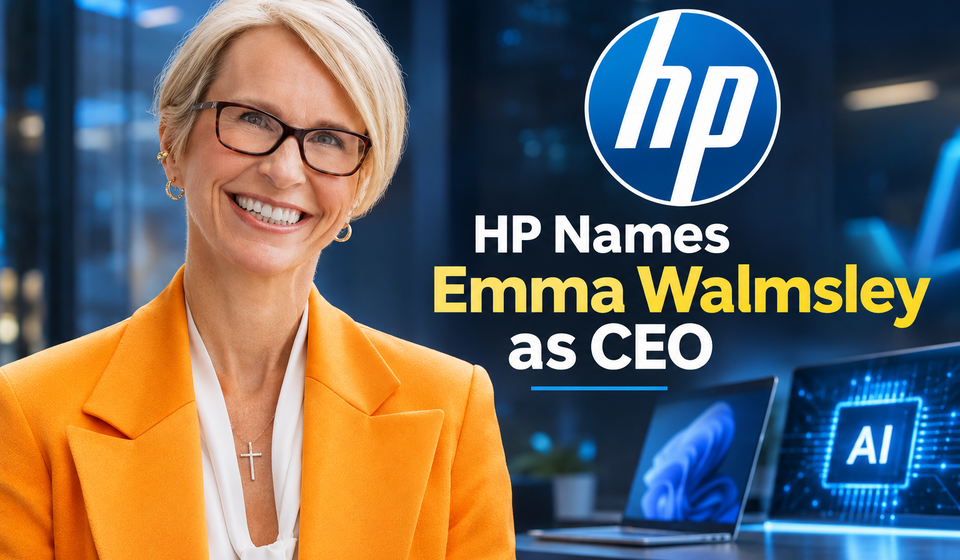
HP has appointed former GSK CEO Emma Walmsley as its next Chief Executive Officer, marking a major leadership change for one of the world’s biggest PC and printing companies. She will officially take charge on January 4, 2027, succeeding interim CEO Bruce Broussard, who will become Chair of HP’s Board of Directors.
Walmsley brings extensive experience in leading global businesses, having served as GSK’s CEO and spent seven years on Microsoft’s Board of Directors. However, her appointment comes at a challenging time for HP, with rising memory costs, pressure on PC shipments and growing competition in AI-powered computers.
Why has HP chosen a former pharmaceutical executive to lead its technology business? What experience does she bring, and what challenges will she face? Here’s everything you need to know about Emma Walmsley’s appointment, her career and what her leadership could mean for HP’s future.
HP’s Leadership Transition: What Changes in January 2027?
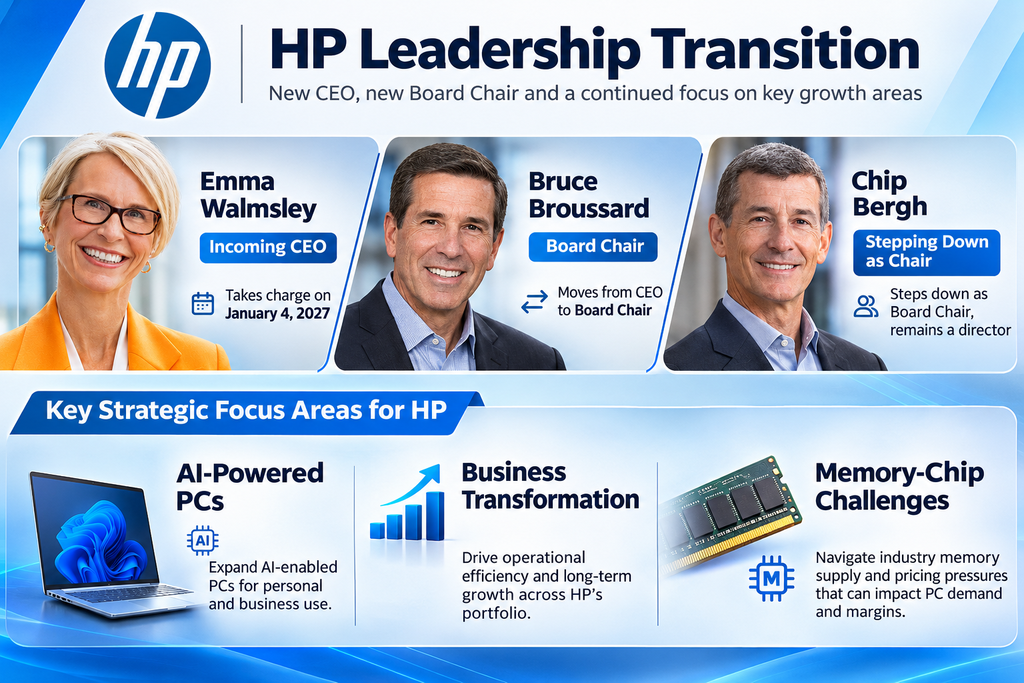
The appointment will take effect on January 4, 2027. Until then, Bruce Broussard will continue serving as HP’s interim CEO. On the same date, he will move into the position of Chair of the Board, replacing Chip Bergh.
The transition follows a period of leadership change at HP. Enrique Lores, who previously led the company, left in February 2026 to become CEO of PayPal. Broussard was appointed interim CEO while HP’s board conducted a search for a permanent replacement.
The new arrangement separates two important responsibilities:
- Emma Walmsley: Will lead HP’s business operations and overall corporate strategy as CEO.
- Bruce Broussard: Will become Chair of the Board, providing board-level leadership and guidance.
- Chip Bergh: Will step down as Chair but remain on HP’s board as a director.
Bergh has served as HP’s board chair since 2017. The company says its board unanimously approved Walmsley’s appointment following a comprehensive global search.
This arrangement also gives Walmsley access to an experienced board chair during her transition into the technology industry.
Who Is Emma Walmsley? A Look at Her Career
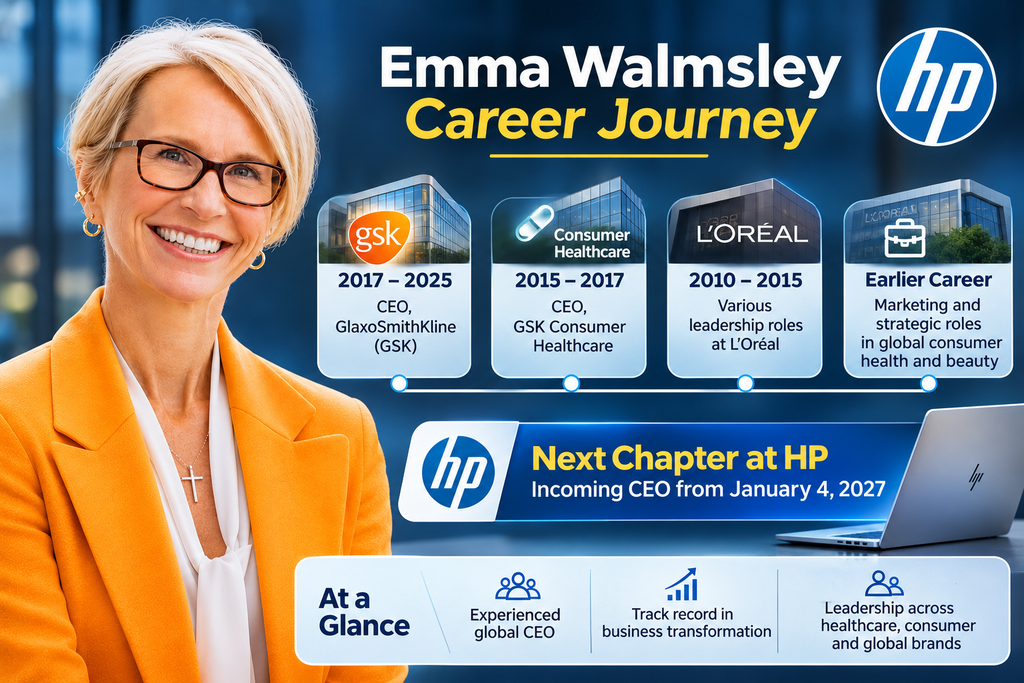
Emma Walmsley is a British business executive best known for leading GSK, one of the world’s major pharmaceutical companies. She served as GSK’s Group CEO from April 2017 through December 2025, becoming the first woman to lead the company.
Her professional background is particularly interesting because she did not build her career in the traditional technology or computer hardware industry. Instead, she spent years working in consumer businesses before moving into pharmaceutical leadership.
Her career can be divided into three important stages.
1. Seventeen Years at L’Oréal
Before joining GSK, Walmsley spent 17 years at French cosmetics company L’Oréal. During this period, she held several management and leadership positions across international markets.
Her experience involved building and managing major consumer businesses, developing commercial strategies and working with global teams.
This background gave her experience in understanding customer behaviour, managing international operations and developing products for large consumer markets.
These skills could be relevant to HP, which sells computers, printers, accessories and related services to consumers and businesses around the world.
2. Leading GSK’s Major Business Transformation
Walmsley joined GSK in 2010 and eventually became CEO of GSK Consumer Healthcare in 2015. She was appointed Group CEO in April 2017.
One of the most significant developments during her leadership was the separation of GSK’s consumer healthcare business, which became Haleon as an independent company.
The separation allowed GSK to sharpen its focus on biopharmaceuticals, including specialty medicines and vaccines. The company also worked to strengthen its research and development pipeline and financial position.
This experience is important when considering why HP selected her. Leading a large international business through a major structural transformation requires decisions about investment, business priorities, organisational structure and long-term growth.
HP has not announced that it plans to undertake a similar corporate separation. However, Walmsley’s experience managing significant organisational change may be valuable as the company reviews its future priorities.
3. Seven Years on Microsoft’s Board
Another important part of Walmsley’s background is her connection to the technology industry.
She has served as an independent director on Microsoft’s Board of Directors for seven years. This gives her exposure to a major technology company and its approach to artificial intelligence, cloud computing, enterprise software and digital transformation.
However, it is important to distinguish board experience from operational experience. Walmsley has not previously led a major PC or hardware manufacturer.
Her Microsoft board position may help her understand the broader technology landscape, but leading HP will require a different level of operational knowledge involving hardware development, manufacturing, component procurement and global distribution.
Why Did HP Choose a Former Pharmaceutical CEO?
At first glance, appointing a former pharmaceutical company CEO to lead a computer manufacturer might seem like an unusual decision.
HP operates in a highly competitive technology market, where companies such as Dell, Lenovo, Apple and ASUS compete across different categories of personal computers and related products.
However, HP’s decision appears to place considerable importance on Walmsley’s experience in leading a large organisation through major changes.
According to HP’s announcement, the board was looking for a leader who could bring its businesses, capabilities and employees together while identifying new opportunities in the AI era.
Her experience at GSK demonstrates an ability to manage a large international organisation, change business priorities and oversee a significant corporate transformation.
There is also a potential advantage in bringing an outside perspective. A CEO who has spent most of her career outside the PC industry may approach existing business challenges differently.
That does not automatically mean the appointment will be successful. Walmsley will still need to understand HP’s technology portfolio, customers, supply chain and competitive position before making major strategic decisions.
The company has selected a leader with transformation experience, but the real test will be how effectively that experience translates into the technology sector.
HP’s AI Strategy: The Biggest Priority for the New CEO
Artificial intelligence is becoming one of the most important areas of competition in the computer industry. Manufacturers are increasingly introducing AI-enabled laptops and desktops designed to run supported AI workloads locally.
HP is also positioning itself around this transition.
The company’s announcement specifically refers to the opportunity created as AI moves to the edge. In simple terms, edge AI means running more AI processing directly on devices such as computers rather than relying entirely on remote cloud servers.
For HP, this creates several opportunities:
- AI-powered PCs: Developing computers with dedicated AI hardware and software capabilities.
- Business productivity: Offering devices and services that help organisations use AI in everyday workflows.
- Connected experiences: Improving how computers, software, accessories and services work together.
- Enterprise customers: Helping businesses modernise their computing environments as AI adoption increases.
Walmsley has already gained exposure to the technology industry through her Microsoft board position. However, HP’s announcement does not provide a detailed roadmap of the AI products or business changes she will introduce after taking charge.
Her challenge will be to turn the growing interest in AI computers into sustainable demand and revenue, rather than relying only on the popularity of AI as a selling point.
Memory Chip Shortage and Rising PC Costs: A Major Challenge
Walmsley is arriving at a difficult time for the global PC industry.
Demand for memory components is being affected by the rapid expansion of AI data centres. These facilities require large quantities of advanced memory and computing hardware, creating pressure across parts of the semiconductor supply chain.
The resulting supply constraints and higher component costs could affect PC manufacturers, including HP.
Reuters reported that HP’s third-quarter 2026 results showed a 16% decline in PC shipments, even though PC revenue increased by 18%. The difference reflected a shift towards higher-priced products, including AI PCs.
Reuters also reported that HP expected industry-wide PC unit volumes to decline by a mid-single-digit percentage in fiscal 2027. The company had not provided a financial outlook for that year in its September filing. Reuters+1
This creates several challenges for the incoming CEO:
- Managing component costs: Higher memory prices could increase the cost of manufacturing laptops and desktops.
- Protecting profitability: HP needs to balance competitive product pricing with its operating margins.
- Maintaining demand: More expensive computers could make some customers delay their upgrades.
- Growing AI PC sales: HP needs to demonstrate why customers should pay more for AI-enabled devices.
- Managing supply: Securing sufficient components will remain important for product availability and delivery schedules.
These issues will require close coordination between HP’s leadership, suppliers, product teams and commercial partners.
Walmsley’s experience in managing a large company through structural change could be useful, but the memory shortage is a specific operational challenge that will require deep industry expertise.
HP Shares Rise After the CEO Announcement
Investors responded positively to the leadership announcement.
According to Reuters, HP shares rose approximately 6.6% during trading after the company announced Walmsley’s appointment on November 4, 2026. The market reaction suggests that investors welcomed the board’s decision, particularly her experience leading GSK through a major transformation.
However, a short-term share-price increase should not be interpreted as proof that the company’s future performance will improve.
Investors will ultimately judge the appointment through HP’s financial results, PC market performance, AI product adoption and ability to manage rising costs.
Walmsley’s leadership will therefore be evaluated on what she delivers after taking charge, not simply on the announcement itself.
What Emma Walmsley’s Appointment Means for HP Customers
For ordinary customers, the CEO appointment does not immediately change HP’s laptop or printer products.
There is no announcement of an immediate change to existing product lines, prices, warranty policies or customer support services as part of this leadership transition.
However, the decisions made by the new CEO could influence HP’s longer-term product direction.
Customers may see greater emphasis on AI-powered computers, productivity software, business devices and connected services. HP may also need to reconsider product pricing and configurations if memory and other component costs remain high.
For businesses, the most important changes could involve enterprise computing, device management and AI-enabled workplace solutions.
For consumers, the key question is whether HP can continue offering competitive laptops and desktops while adding genuinely useful AI capabilities.
It is too early to predict specific product changes. Those decisions will become clearer after Walmsley officially takes over in January 2027.
Conclusion
HP’s appointment of Emma Walmsley as its next CEO marks an important change in the company’s leadership as the PC industry moves towards an increasingly AI-driven future.
Her experience leading GSK through a major transformation, combined with seven years on Microsoft’s board, gives her a different perspective from a traditional hardware-industry executive.
However, she will take charge at a challenging time. Rising memory costs, pressure on PC shipments and growing competition in AI-enabled computers will require careful strategic and operational decisions.
Bruce Broussard will become Chair of HP’s Board on January 4, 2027, while Walmsley takes over as CEO. The leadership transition is now confirmed, but the direction of HP’s next chapter will depend on the decisions she makes after assuming the role.
For now, the biggest question is whether her experience in transforming a global pharmaceutical business can help HP strengthen its position in the rapidly changing computer industry.
Frequently Asked Questions
1. Who is the new CEO of HP?
HP has appointed Emma Walmsley, the former CEO of GSK and a member of Microsoft’s Board of Directors, as its next Chief Executive Officer.
2. When will Emma Walmsley become HP’s CEO?
She will officially take over as HP’s CEO on January 4, 2027.
3. Who is the current interim CEO of HP?
Bruce Broussard has served as HP’s interim CEO since February 2026. He will become Chair of the Board when Walmsley takes over.
4. Why did HP appoint Emma Walmsley?
HP highlighted her experience leading large international organisations, managing significant business transformations and identifying new growth opportunities. Her seven years on Microsoft’s board also provide exposure to the technology sector.
5. Did Emma Walmsley previously work at Microsoft?
No. She has served as an independent director on Microsoft’s Board of Directors for seven years. She was not a Microsoft CEO or employee based on the company’s announcement.
6. What did Emma Walmsley do at GSK?
She served as GSK’s Group CEO from April 2017 through December 2025. During her tenure, she led a major transformation, including the separation of its consumer healthcare business into Haleon.
7. Is Emma Walmsley HP’s first female CEO?
No. She is expected to become HP’s third full-time female CEO, according to reporting on the appointment.
8. Will HP launch new AI laptops under Emma Walmsley?
HP has not announced any specific new laptop launches under her leadership. However, the company has identified AI-enabled devices as an important opportunity for its future growth.
Suggestions
- Dell 14S Launched in India at ₹79,990: Specs and Features
- ASUS Zenbook 14 (2026) India Launch: 33-Hour Battery & AI Features
- Lenovo Yoga Pro 9n & Yoga 9n 2-in-1: 7 Powerful Features
Source
HP Official Announcement – Emma Walmsley Appointed CEO