

How to Choose the Best Mobile Phone for Different Needs: A Complete Smartphone Buying Guide (2026)
Introduction
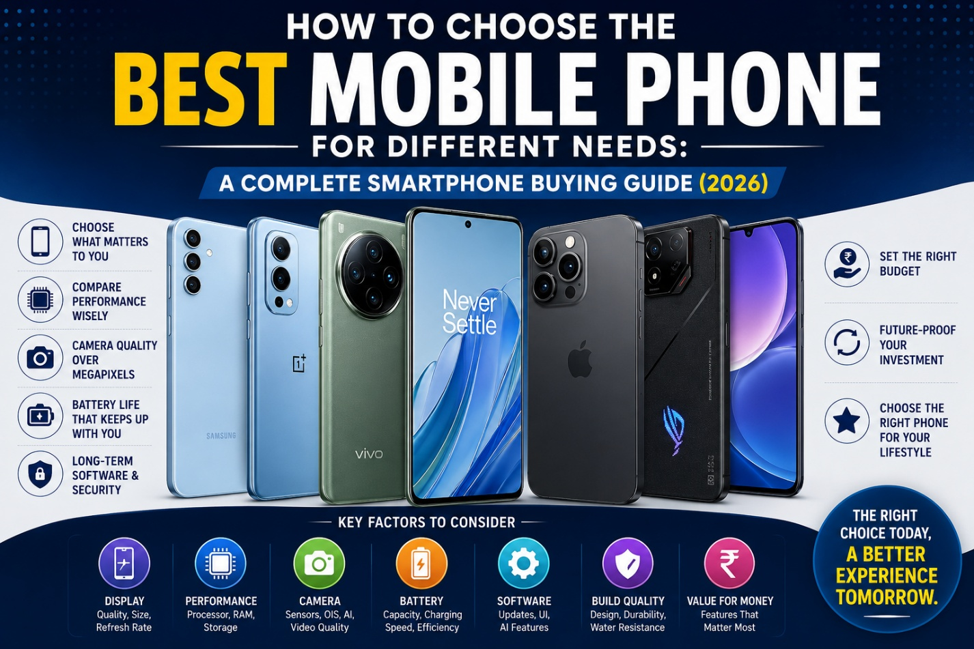
Buying a smartphone in 2026 is no longer as simple as choosing the latest model or the device with the highest megapixel camera. The smartphone industry has evolved rapidly, with manufacturers offering dozens of devices across different price segments, each promising faster performance, better cameras, longer battery life, advanced artificial intelligence, and premium designs. While this gives consumers more choices than ever before, it also makes finding the Best Mobile Phone significantly more challenging. Best Mobile Phone
Today, a smartphone is much more than a communication device. It has become a personal assistant, entertainment hub, professional workstation, gaming console, navigation system, digital wallet, and camera—all packed into one compact device. Whether you’re attending online classes, editing videos, managing business meetings, creating social media content, or simply staying connected with friends and family, choosing the Best Mobile Phone directly impacts your daily experience.
One of the biggest mistakes buyers make is selecting a smartphone based only on specifications or marketing advertisements. A phone with a powerful processor may not necessarily have the best battery life. A device with a 200MP camera may not always produce better photos than one with a 50MP sensor. Similarly, paying more for flagship features that you may never use often results in unnecessary spending.
The key to finding the Best Mobile Phone is understanding your own requirements first. Students, gamers, photographers, business professionals, senior citizens, and content creators all have different expectations from their smartphones. A gaming enthusiast will prioritize graphics performance and cooling, while a professional may value battery life, software stability, and security. Someone interested in photography will naturally focus on camera quality, while frequent travellers may prefer durability and long battery backup.
This comprehensive Smartphone Buying Guide 2026 is designed to help readers make informed purchasing decisions based on real-world usage rather than marketing hype. Instead of overwhelming you with technical specifications, this guide explains which features truly matter, how they affect everyday performance, and how to identify the Best Mobile Phone for your lifestyle and budget.
Why Choosing the Right Smartphone Matters More Than Ever
Smartphones have become one of the most frequently used devices in our daily lives. From morning alarms to late-night entertainment, they remain in our hands for several hours every day. Because of this constant usage, choosing the Best Mobile Phone is no longer just about owning the latest gadget—it is about investing in a device that improves productivity, communication, and entertainment for several years.
Modern smartphones are expected to handle a wide variety of tasks simultaneously. Users switch between video calls, social media, banking apps, gaming, photography, GPS navigation, document editing, and AI-powered applications throughout the day. A phone that performs well in one area but struggles in another may quickly become frustrating to use.
Budget is another important consideration. Many buyers assume that expensive smartphones automatically provide the best experience. In reality, several mid-range smartphones now offer flagship-level performance, excellent cameras, premium displays, and reliable battery life at significantly lower prices. Understanding which features genuinely matter allows buyers to invest wisely rather than simply purchasing the most expensive device available.
Artificial Intelligence has also transformed the smartphone industry. AI-powered features now improve photography, optimize battery life, translate conversations in real time, summarize notifications, remove unwanted objects from images, and even assist with writing emails or documents. These intelligent capabilities have become an important factor when choosing the Best Mobile Phone, as software innovation increasingly complements hardware improvements.
Another reason to choose carefully is software support. A smartphone that receives regular operating system updates and security patches remains useful for a longer period. Long-term software support not only introduces new features but also improves device security and overall performance. For users planning to keep their phones for three to five years, software updates are just as important as hardware specifications. Best Mobile Phone
Ultimately, the Best Mobile Phone is not necessarily the one with the highest benchmark scores—it is the one that consistently delivers a smooth, reliable, and enjoyable experience based on your individual needs.
Display: The Feature You’ll Use Every Single Day
When purchasing a smartphone, many buyers immediately focus on the processor or camera. However, the display is actually the component users interact with the most. Whether reading messages, watching movies, editing photos, gaming, or browsing social media, the display determines how enjoyable the overall experience feels. Choosing the Best Mobile Phone therefore begins with understanding display technology.
Most modern smartphones use either LCD, OLED, or AMOLED panels. LCD displays remain common in entry-level devices and provide decent colour reproduction and brightness. OLED and AMOLED displays, however, deliver significantly richer colours, deeper blacks, higher contrast, and better energy efficiency. Premium smartphones increasingly feature AMOLED displays because they produce more vibrant visuals while also improving battery life.
Refresh rate has become another important specification. Traditional smartphones operated at 60Hz, meaning the screen refreshed sixty times per second. Today’s smartphones commonly offer 90Hz, 120Hz, or even 144Hz refresh rates, resulting in smoother scrolling, more responsive gaming, and fluid animations. While casual users may find 90Hz sufficient, gamers and power users will appreciate the responsiveness offered by 120Hz displays.
Brightness is equally important, particularly for outdoor visibility. Smartphones with higher peak brightness remain easier to read under direct sunlight, making navigation, photography, and content consumption more comfortable. Buyers should also consider display protection technologies such as Corning Gorilla Glass, which help reduce damage from accidental drops and scratches.
Screen size is another personal preference. Compact smartphones around 6.1 inches remain comfortable for one-handed use, while larger displays between 6.6 and 6.9 inches provide a more immersive experience for gaming, video streaming, reading, and multitasking. Rather than choosing the biggest display available, buyers should select a screen size that suits their daily usage.
For anyone searching for the Best Mobile Phone, investing in a high-quality display ensures that every interaction with the device feels smoother, clearer, and more enjoyable.
Processor and Performance: The Engine Behind Every Smartphone
A smartphone’s processor determines how efficiently it performs everyday tasks, handles demanding applications, and remains responsive over time. While camera quality and display often receive the most attention, the processor is the foundation that powers the entire user experience. Choosing the Best Mobile Phone therefore requires understanding which processor best matches your usage.
In 2026, Qualcomm Snapdragon, MediaTek Dimensity, Apple A-series, and Google’s Tensor processors dominate the smartphone market. Each platform offers unique advantages depending on the device and price category.
Qualcomm Snapdragon processors continue to be popular for their excellent balance of performance, gaming capability, AI processing, and power efficiency. Many flagship Android smartphones rely on Snapdragon chips because they consistently deliver smooth multitasking, fast app launches, and excellent gaming performance.
MediaTek’s Dimensity series has evolved significantly in recent years. Modern Dimensity processors now compete directly with premium Snapdragon chipsets while offering impressive AI capabilities and battery efficiency. Several mid-range and flagship smartphones now feature MediaTek processors that comfortably handle gaming, photography, video editing, and demanding applications. Best Mobile Phone
Apple’s A-series processors remain among the fastest mobile chips available. Combined with Apple’s software optimization, they provide exceptional long-term performance, making iPhones a strong option for users invested in the Apple ecosystem.
Google’s Tensor processors focus heavily on Artificial Intelligence. Rather than competing solely through benchmark numbers, Tensor-powered devices emphasize AI-assisted photography, voice recognition, live translation, and intelligent software features that improve everyday usability.
Beyond processor brands, buyers should also consider RAM and storage configurations. Modern smartphones with 8GB or 12GB of RAM provide smooth multitasking for most users, while gamers and professionals may benefit from higher capacities. Storage options of 256GB or more offer greater flexibility for storing photos, videos, games, and applications without constantly worrying about available space.
Ultimately, the Best Mobile Phone is not always the one with the fastest benchmark score. Instead, it is the device whose processor, software optimization, RAM, and storage work together to deliver reliable real-world performance that remains smooth and responsive for years to come.
Camera: Why Image Quality Matters More Than Megapixels
For many buyers, the camera is one of the biggest deciding factors when purchasing a smartphone. Social media, video creation, online meetings, travel photography, and family memories have made smartphone cameras more important than ever. However, one of the most common misconceptions is that a higher megapixel count automatically means better photos. In reality, finding the Best Mobile Phone for photography depends on several factors working together rather than a single specification.
A smartphone with a high-quality 50MP sensor can often capture more natural and detailed images than a phone advertising a 200MP camera. Sensor size, image processing, lens quality, and software optimization play a much larger role in overall image quality. This is why flagship smartphones from Apple, Samsung, Google, and other leading brands consistently produce excellent photographs despite using different camera resolutions. Best Mobile Phone
Another important feature is Optical Image Stabilization (OIS). OIS physically stabilizes the camera lens, reducing blur caused by hand movements. This results in sharper photos, improved low-light performance, and smoother video recording. Electronic Image Stabilization (EIS) further enhances video stability, making it especially useful for vloggers and content creators.
Modern smartphones also include ultrawide, telephoto, and macro cameras. An ultrawide lens allows users to capture landscapes and group photos without stepping back, while telephoto cameras provide optical zoom without sacrificing image quality. Macro cameras are useful for close-up photography, although many flagship smartphones now use their ultrawide sensors for macro shots instead of dedicated macro lenses.
Artificial Intelligence has also transformed smartphone photography. AI now automatically recognizes scenes, adjusts exposure, improves portrait effects, enhances night photography, and removes unwanted objects from images. These software improvements allow even casual users to capture professional-looking photographs without manual adjustments.
If photography is one of your priorities, the Best Mobile Phone is not necessarily the one with the highest megapixel count but the one that consistently produces balanced colours, accurate skin tones, excellent dynamic range, and reliable video performance in different lighting conditions.
Battery Life and Charging: Power That Lasts Throughout the Day
Battery life has become one of the most important aspects of modern smartphones. From online meetings and GPS navigation to gaming, streaming, and social media, smartphones are expected to remain active throughout the day without requiring constant charging. Choosing the Best Mobile Phone therefore means paying close attention to battery capacity, charging technology, and overall power efficiency.
Most modern smartphones now feature batteries ranging from 5,000mAh to over 6,000mAh. While larger battery capacities generally provide longer usage times, battery optimization depends equally on processor efficiency, software management, and display technology. A well-optimized smartphone with a smaller battery may outperform another device with a larger battery but inefficient software. Best Mobile Phone
Fast charging has also become a major consideration. Charging technologies between 45W and 100W allow many smartphones to regain a significant percentage of battery life within minutes, making them especially useful for users with busy schedules. Premium smartphones increasingly support wireless charging as well, providing greater convenience at home or in the office.
Battery health should not be overlooked either. Intelligent charging features available on many smartphones learn your charging habits, reduce unnecessary battery stress, and help extend long-term battery lifespan. Buyers planning to use their smartphones for several years should consider these software features just as seriously as battery capacity itself.
The Best Mobile Phone for battery life is one that consistently delivers reliable all-day performance while maintaining long-term battery health through intelligent software optimization.
Software and AI: The Features That Define Long-Term Experience
Hardware may attract attention during the buying process, but software determines how enjoyable a smartphone remains after months or even years of use. Smooth performance, regular updates, security patches, and intelligent features all contribute to the overall user experience. Choosing the Best Mobile Phone therefore requires evaluating software support alongside hardware specifications.
Android smartphones vary considerably depending on the manufacturer. Some brands offer clean, minimal interfaces that closely resemble stock Android, while others include additional customization features, productivity tools, and ecosystem integration. Buyers should choose software that matches their personal preferences rather than assuming one interface is universally better.
Software update policies have become increasingly important. Many manufacturers now promise several years of Android updates and security patches, helping smartphones remain secure, compatible with new applications, and feature-rich for longer periods. Long-term software support increases the value of a smartphone and delays the need for expensive upgrades.
Artificial Intelligence has become another defining feature of modern smartphones. AI-powered writing assistance, live language translation, intelligent search, call summaries, voice transcription, battery optimization, and advanced photo editing have significantly expanded what smartphones can accomplish. As AI continues evolving, choosing a smartphone with strong software support ensures access to future innovations that extend beyond hardware improvements. Best Mobile Phone
The Best Mobile Phone is therefore one that combines dependable hardware with long-term software updates, useful AI features, and a user interface that remains fast, secure, and intuitive.
Which Smartphone Should You Buy?
The answer depends entirely on your lifestyle and daily requirements.
Students generally benefit from smartphones that offer reliable performance, long battery life, quality displays, and affordable pricing. Business professionals often prioritize software stability, productivity features, security, and dependable battery backup for meetings and travel. Gamers should focus on flagship processors, high-refresh-rate displays, advanced cooling systems, and larger batteries capable of supporting extended gaming sessions.
Photography enthusiasts should prioritize sensor quality, Optical Image Stabilization, reliable video recording, and AI-assisted image processing rather than simply comparing megapixel numbers. Content creators benefit from smartphones capable of recording high-resolution videos, handling demanding editing applications, and maintaining consistent performance under heavy workloads. Best Mobile Phone
Senior citizens often appreciate smartphones with clean software, clear displays, dependable battery life, and simplified user interfaces that emphasize ease of use over advanced features.
Rather than chasing the latest flagship device, buyers should identify which features they actually use every day. This practical approach makes it much easier to find the Best Mobile Phone within any budget.
Common Mistakes to Avoid When Buying a Smartphone
Many buyers make purchasing decisions based solely on advertisements or impressive specification sheets. While marketing often highlights megapixels, benchmark scores, or charging speeds, these specifications rarely tell the complete story.
Ignoring software updates is one of the biggest mistakes. A smartphone receiving regular updates remains secure and useful for much longer than a device with outdated software support. Another common mistake is buying more performance than necessary. Casual users rarely need flagship processors if their primary activities involve messaging, browsing, streaming, and photography.
Similarly, many buyers overlook display quality, battery optimization, and after-sales service while focusing only on cameras or processor names. Choosing a balanced smartphone almost always provides a better long-term experience than selecting a device with one standout specification but several compromises. Best Mobile Phone
Final Verdict
Finding the Best Mobile Phone in 2026 is no longer about purchasing the most expensive device or the one with the highest specifications. The ideal smartphone is the one that matches your lifestyle, daily usage, and long-term expectations.
A quality display improves every interaction. A capable processor ensures smooth performance. Reliable cameras preserve important memories. Long battery life supports productivity throughout the day. Regular software updates keep the device secure and future-ready, while Artificial Intelligence enhances photography, communication, and overall usability.
Before making a purchase, evaluate how you actually use your smartphone rather than focusing solely on marketing claims. Whether you are a student, gamer, professional, traveller, photographer, or content creator, selecting a smartphone that aligns with your real-world needs will provide the best value over time.
By understanding the features that truly matter, buyers can confidently choose the Best Mobile Phone that delivers excellent performance, reliability, and user experience for years to come.
Frequently Asked Questions
What is the most important feature when buying a smartphone?
There is no single most important feature. The right choice depends on your priorities, including display quality, processor performance, camera capabilities, battery life, software support, and budget.
How much RAM is enough in 2026?
For most users, 8GB RAM provides excellent performance, while gamers, creators, and power users may benefit from 12GB or 16GB RAM.
Is a 200MP camera better than a 50MP camera?
Not necessarily. Sensor quality, image processing, lens performance, and software optimization have a much greater impact on image quality than megapixel count alone.
Should I prioritize battery capacity or fast charging?
Both matter. A balanced smartphone should offer reliable all-day battery life along with fast charging for added convenience.
How long should a smartphone receive software updates?
A smartphone with at least four to seven years of operating system and security updates offers better long-term value and remains secure for a longer period.
Related Articles:
Best AI Tools Every Student Should Know in 2026
Vivo S2 Price in India Revealed
For more info visit Mobiles