
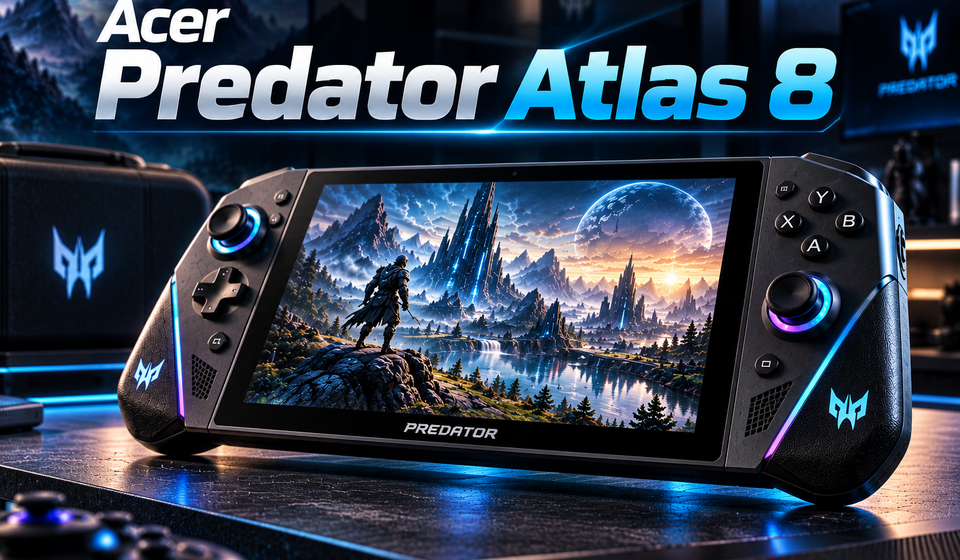
Acer Predator Atlas 8 Packs an 8-Inch 120Hz Display, Intel Arc Graphics and an 80Wh Battery
Acer is expanding its Predator gaming lineup beyond traditional laptops with the Predator Atlas 8, a new Windows-based gaming handheld designed to bring a full PC gaming experience into a portable form factor.
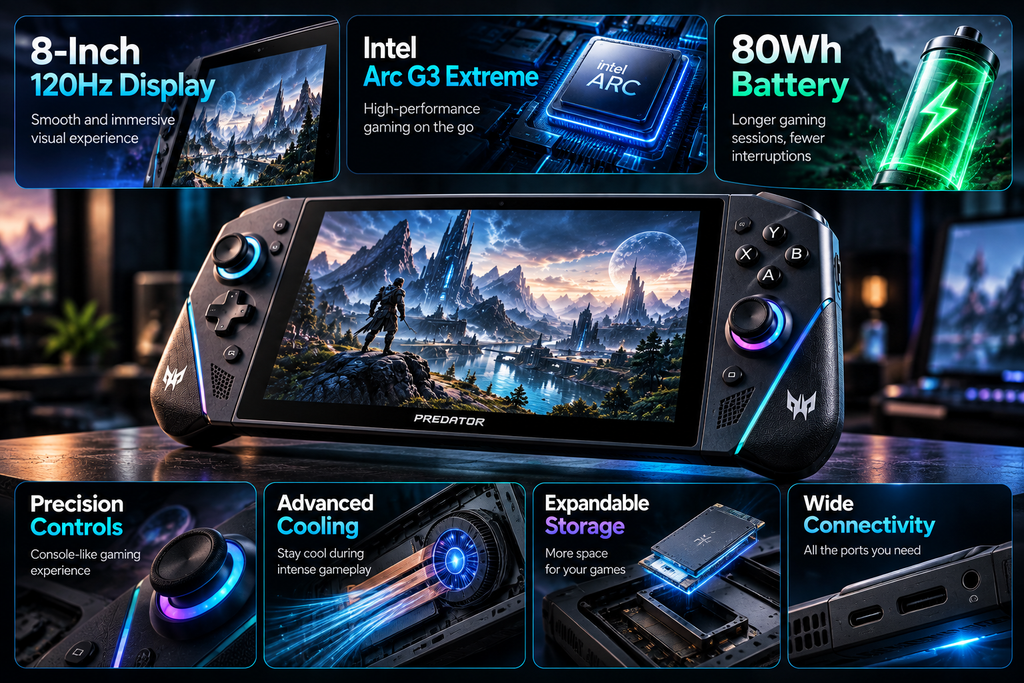
The handheld combines an 8-inch WUXGA touchscreen, Intel’s new Arc G-Series processors, up to Intel Arc B390 graphics, as much as 24GB of LPDDR5X memory, up to 1TB of PCIe Gen4 storage and an 80Wh battery.
Acer has also given the Atlas 8 a more aggressive cooling system than many conventional handheld PCs. Its Predator AeroBlade setup uses two fans, including a thin metal fan, while the device includes Hall-effect triggers, adjustable trigger switches, macro buttons and TMR joysticks on select configurations.
The Predator Atlas 8 is scheduled to become available in North America, EMEA and Australia from October 2026. Acer says exact specifications, prices and availability can vary by region.
What Is the Acer Predator Atlas 8?
The Predator Atlas 8 is a Windows 11 Home gaming handheld rather than a conventional closed gaming console.
That distinction matters because the device is designed to provide access to the broader PC gaming ecosystem. Users can run Windows applications and PC game launchers instead of being restricted to a single console platform.
Acer is positioning the Atlas 8 as a portable gaming PC with dedicated controls, a larger display than many compact handhelds and enough hardware headroom for demanding games.
The device also includes access to Xbox Game Pass offers in supported markets, giving users another way to access PC games.
Intel Arc G3 Series Powers the Handheld
The biggest hardware change in the Predator Atlas 8 is its move to Intel’s new Arc G-Series processors.
Acer offers the handheld with Intel Arc G3 processor options, with the top configuration using the Intel Arc G3 Extreme processor and integrated Intel Arc B390 graphics.
Lower configurations can use Intel Arc B370 graphics.
The platform also supports Intel XeSS 3, an AI-powered upscaling technology designed to help improve gaming performance and image quality in supported titles.
Instead of simply increasing raw hardware power, the combination of the processor and graphics architecture gives the Atlas 8 access to newer rendering and upscaling technologies intended for modern PC games.
Up to Intel Arc B390 Graphics
Graphics performance is especially important in a handheld because the system has to balance gaming performance against power consumption and thermal limits.
The highest-end Predator Atlas 8 configuration combines the Intel Arc G3 Extreme processor with Intel Arc B390 graphics.
Acer says the graphics platform supports ray tracing and Intel XeSS 3. These technologies can help compatible games produce more detailed lighting and higher-quality images while using AI-based upscaling to reduce the performance cost of rendering at higher resolutions.
Actual performance will vary depending on the game, graphics settings, drivers and power mode, so the specifications alone do not establish a particular frame rate for individual games.
8-Inch 120Hz Display
The Predator Atlas 8 gets one of its biggest physical advantages from its display.
It features an 8-inch WUXGA panel with a 1920 × 1200 resolution, a 16:10 aspect ratio and a 120Hz refresh rate.
The screen also supports Variable Refresh Rate (VRR), which can help synchronise the display’s refresh rate with the game’s frame output.
The display reaches up to 500 nits of brightness and covers 100% of the sRGB colour space. Acer also uses Corning Gorilla Glass Victus with DXC protection on the screen.
Touch input is supported through 10-point multitouch, so the display can also be used for Windows applications and games that benefit from touch controls.
Up to 24GB RAM and 1TB Storage
Acer offers the Predator Atlas 8 with up to 24GB of LPDDR5X memory running at up to 7467 MT/s.
For storage, the handheld can be configured with up to 1TB of PCIe Gen4 NVMe SSD storage.
The storage uses a standard M.2 2280 slot, giving the Atlas 8 a familiar PC-style storage architecture rather than relying on a proprietary game-storage format.
There is also a UHS-II microSD card reader, allowing users to expand their storage for compatible games and other files.
Predator AeroBlade Cooling Is a Major Feature
Gaming handhelds have to deal with a difficult thermal challenge: they need to dissipate heat while remaining small enough to hold comfortably.
Acer is addressing this with its Predator AeroBlade cooling system.
The Atlas 8 uses two fans. One is a Predator AeroBlade metal fan, while the second uses a conventional plastic design.
The metal fan contains 89 blades, each only 0.1mm thick. Acer says the design can increase airflow by up to 10% compared with its previous generation under its stated testing conditions.
The cooling system also uses Vortex Flow channels inside the chassis to guide air through the device and help move hot air away from internal components.
This approach is particularly important when the handheld is running demanding games for extended periods.
80Wh Battery for Longer Gaming Sessions
Battery capacity is another area where the Predator Atlas 8 stands out.
The handheld can be equipped with an 80Wh battery, while certain configurations use a 60Wh battery.
Acer is also pairing the hardware with Intel Endurance Gaming, which is designed to balance frame rate and power consumption to extend gaming sessions.
However, Acer does not provide one universal battery-life figure for the Atlas 8. Actual endurance will depend on the processor and graphics configuration, game, display settings, power mode and other factors.
The device supports a 65W power adapter, with both USB-C power delivery and a conventional adapter option depending on configuration.
Gaming Controls Are Designed for PC Games
The Atlas 8 is built around a traditional handheld gaming control layout.
It includes ABXY buttons, a D-pad, left and right analog joysticks, bumpers, Hall-effect analog triggers and dedicated menu controls.
Some configurations also include adjustable trigger switches and macro buttons.
Hall-effect triggers are particularly useful for gaming because they use magnetic sensing rather than traditional physical contact mechanisms, potentially reducing some forms of mechanical wear.
The handheld also has dedicated buttons for PredatorSense and the Xbox Game Bar widget, giving users quicker access to system and gaming controls.
PredatorSense Brings PC Controls to the Handheld
Acer is bringing its PredatorSense software to the Atlas 8.
The application can provide system monitoring, performance-mode controls, RGB customisation and access to gaming-related settings.
A dedicated PredatorSense button on the handheld provides quick access without requiring users to navigate through Windows menus every time they want to change a performance setting.
This is important for a Windows handheld because PC gaming often involves adjusting power and performance settings depending on the game being played.
Connectivity Includes Thunderbolt 4 and Wi-Fi 7
The Predator Atlas 8 includes two Thunderbolt 4 ports, giving users high-speed wired connectivity for compatible accessories and displays.
It also includes a microSD card reader and a 3.5mm combination audio jack.
For wireless connectivity, Acer lists Intel Killer Wi-Fi 7 and Bluetooth 5.4.
Wi-Fi 7 support can provide higher throughput and improved wireless efficiency when paired with a compatible network.
The combination of Thunderbolt 4 and Wi-Fi 7 gives the Atlas 8 flexibility beyond handheld gaming, particularly for users who want to connect peripherals or use the device as a compact Windows PC.
Audio and Camera-Free Design
For audio, the handheld has two 2W speakers powered through a Realtek audio solution.
It supports DTS:X Ultra and Hi-Res Audio, while Acer’s PurifiedVoice technology is used for clearer voice pickup through the built-in microphones.
The Atlas 8 has two onboard microphones, making it suitable for voice chat and other communication tasks.
Acer has focused the hardware around gaming rather than adding unnecessary components, keeping the device centred on its display, controls, cooling and PC connectivity.
Acer Predator Atlas 8 Specifications
| Specification | Predator Atlas 8 |
| Operating system | Windows 11 Home |
| Processor | Intel Arc G3 / G3 Extreme |
| Graphics | Intel Arc B370 / B390 |
| Display | 8-inch WUXGA IPS-level |
| Resolution | 1920 × 1200 |
| Aspect ratio | 16:10 |
| Refresh rate | 120Hz |
| VRR | Yes |
| Brightness | Up to 500 nits |
| Touch | 10-point multitouch |
| RAM | Up to 24GB LPDDR5X |
| Storage | Up to 1TB PCIe Gen4 NVMe |
| Battery | Up to 80Wh |
| Cooling | Dual fan, Predator AeroBlade + Vortex Flow |
| Wi-Fi | Intel Killer Wi-Fi 7 |
| Bluetooth | 5.4 |
| USB | 2 × Thunderbolt 4 |
| Audio | 3.5mm jack, 2 × 2W speakers |
| Weight | Under 810g with 80Wh battery |
| Software | PredatorSense |
Acer Predator Atlas 8 Price and Availability
Acer has announced the Predator Atlas 8 for North America, EMEA and Australia from October 2026.
The company has not provided one global price because configurations and availability will differ between markets.
For India, Acer’s Indian website already lists the Predator Atlas family, including the Atlas 8, but a final India retail price and specific local configuration are not established in the information currently available.
That means buyers in India will need to wait for Acer to announce the local configuration, pricing and sales date before making a direct price comparison with other gaming handhelds.
What Makes the Predator Atlas 8 Different?
The Atlas 8 takes a slightly different approach to the gaming-handheld market.
Its 8-inch 120Hz display gives it a larger viewing area, while the Intel Arc G-Series platform brings Intel’s newer graphics architecture into a portable gaming PC.
The cooling system is another major part of the design. Acer has essentially adapted technology from its Predator gaming laptops into a much smaller chassis.
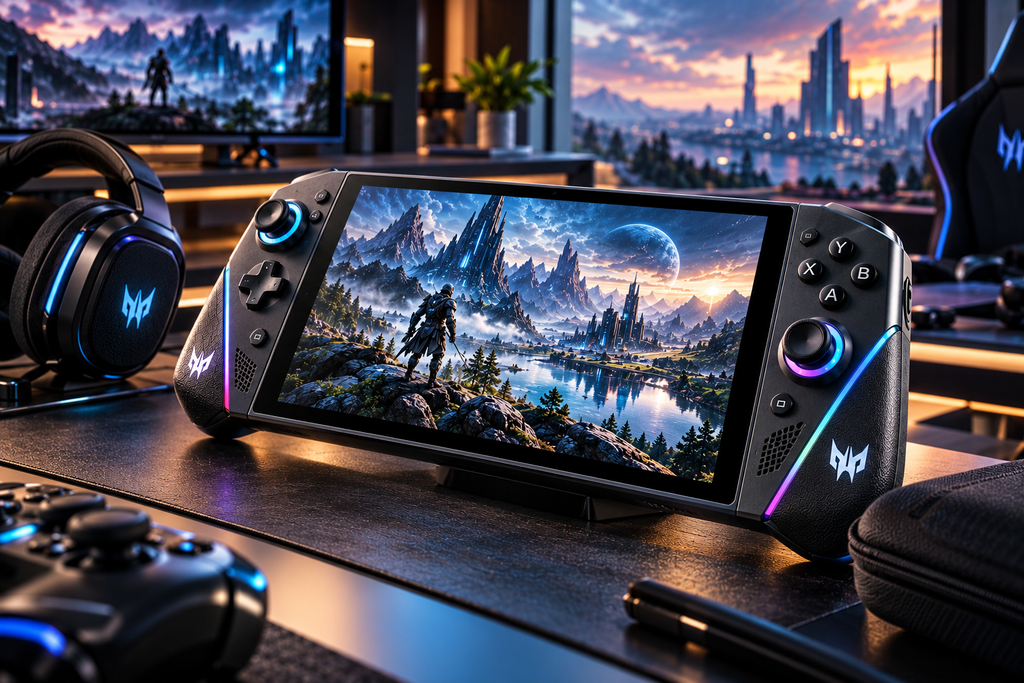
The combination of an 80Wh battery, dual-fan cooling, dedicated controls and Windows 11 makes the Atlas 8 closer to a compact gaming PC than a traditional handheld console.
Final Takeaway
The Acer Predator Atlas 8 is built around a simple idea: bring more of a full PC gaming experience into a handheld device.
With an 8-inch 120Hz WUXGA display, up to Intel Arc G3 Extreme with Arc B390 graphics, 24GB LPDDR5X RAM, 1TB SSD storage and an 80Wh battery, Acer is targeting gamers who want more hardware and flexibility without moving to a conventional laptop.
The Predator AeroBlade cooling system, Thunderbolt 4 connectivity, Wi-Fi 7 and extensive physical controls further reinforce its PC-first approach.
The next important details will be regional pricing and availability. Acer has confirmed an October 2026 rollout across North America, EMEA and Australia, while India-specific pricing and configurations still need to be announced.
Frequently Asked Questions
What is the Acer Predator Atlas 8?
The Acer Predator Atlas 8 is a Windows 11 gaming handheld designed to run PC games and applications in a portable form factor.
What processor does the Predator Atlas 8 use?
It uses Intel Arc G3 processor options, with the highest configuration featuring the Intel Arc G3 Extreme processor.
How large is the Predator Atlas 8 display?
The handheld has an 8-inch WUXGA display with a 1920 × 1200 resolution, 16:10 aspect ratio and 120Hz refresh rate.
How much RAM does the Predator Atlas 8 have?
The Atlas 8 is available with up to 24GB of LPDDR5X RAM.
How large is the Predator Atlas 8 battery?
The highest-capacity configuration has an 80Wh battery, while select models use a 60Wh battery.
When will the Predator Atlas 8 launch?
Acer says the Predator Atlas 8 will become available in North America, EMEA and Australia from October 2026. Regional launch dates and pricing may differ.
Related Articles: