
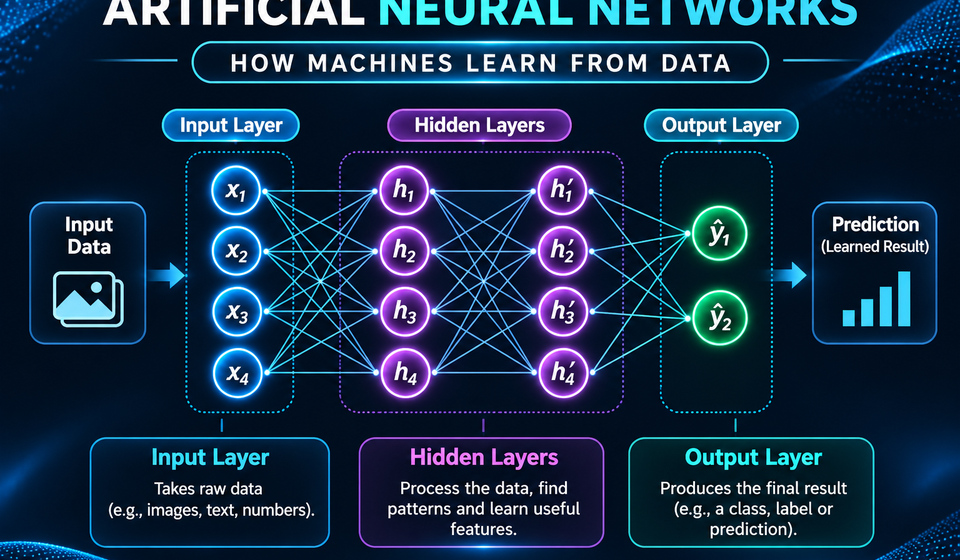
Artificial Neural Networks (ANNs) are one of the key technologies behind modern artificial intelligence. They help computers recognise images, understand language, identify patterns and make predictions by learning from data. Inspired by the way the human brain processes information, these networks use interconnected mathematical units to learn relationships that may be difficult to identify through traditional programming.
From facial recognition and voice assistants to recommendation systems and AI chatbots, neural networks play an important role in many technologies people use every day. But what exactly is an artificial neural network, and how does it learn?
What Is an Artificial Neural Network?
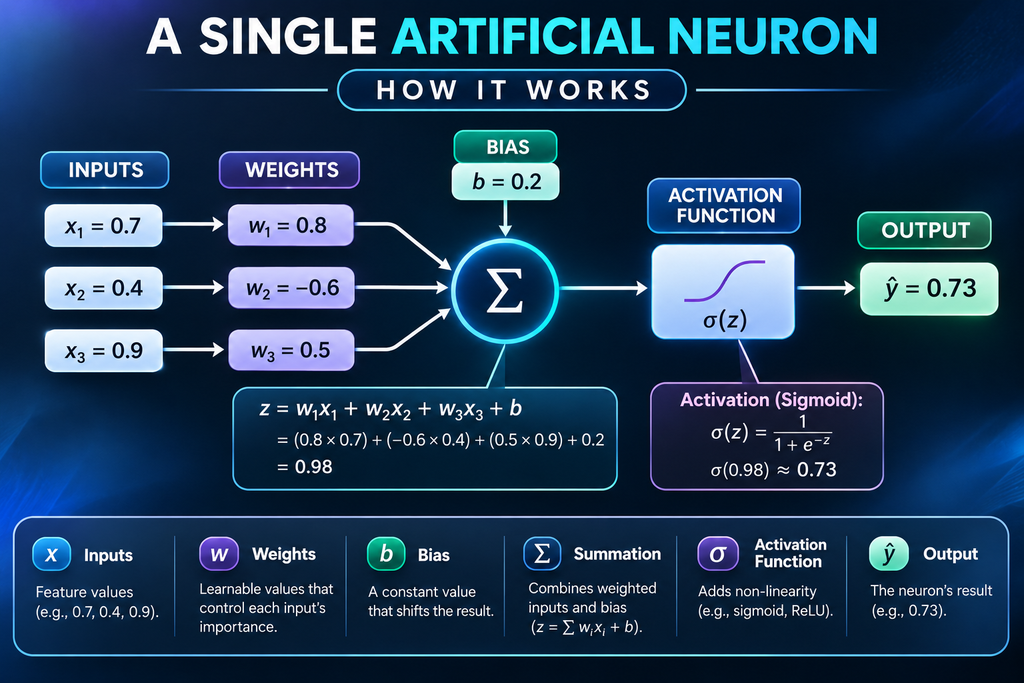
An Artificial Neural Network is a machine learning model inspired by the structure of the human brain. It consists of interconnected processing units called artificial neurons, which work together to analyse information and produce results.
Traditional computer programs generally follow instructions written by developers. Neural networks work differently. Instead of relying only on fixed rules, they learn patterns from training examples by adjusting their internal parameters.
For example, if a neural network is trained using thousands of images of cats and dogs, it can gradually learn to recognise visual differences between the two. After training, it can analyse a new image and predict whether it contains a cat or a dog.
The network does not understand images like a human. It identifies mathematical patterns in the numerical data it receives.
Core Building Blocks of an Artificial Neural Network
An ANN contains several important components that work together to process information.
1. Artificial Neurons
Artificial neurons, also called nodes, are the basic processing units of a neural network.
Each neuron receives numerical inputs, performs a mathematical calculation and passes its output to other neurons. A single neuron performs a relatively simple operation, but thousands or millions of interconnected neurons can learn complex patterns.
2. Weights and Biases
Weights and biases are numerical values that help a neural network learn.
- Weights: Determine how strongly a particular input influences a neuron’s calculation. A larger weight generally means that the input has a stronger influence.
- Biases: Act as additional values that shift the neuron’s calculation, helping it produce more flexible outputs.
During training, the network adjusts these values to improve its predictions. Together, they represent much of what the network learns from its training data.
3. Activation Functions
After processing its inputs, a neuron uses an activation function to calculate its output.
Activation functions introduce non-linearity, allowing neural networks to learn relationships that are more complex than simple linear calculations.
Common examples include:
- ReLU: Allows positive values to pass through while converting negative values to zero.
- Sigmoid: Converts values into a range between 0 and 1.
- GELU: A smooth activation function commonly used in modern neural network architectures.
How Are Neural Network Layers Structured?
Artificial neurons are arranged into layers. A basic neural network generally contains three types.
Input Layer: Receives the information that the network needs to process. For example, an image can be converted into numerical pixel values before entering the network.
Hidden Layers: Process information between the input and output layers. Earlier layers may identify simple patterns, while deeper layers combine those patterns to recognise more complex features.
Output Layer: Produces the final result. Depending on the task, it may provide a category prediction, a probability score or a numerical value.
Networks containing multiple hidden layers are commonly called deep neural networks. The process of training these networks is known as deep learning.
How Does an Artificial Neural Network Learn?
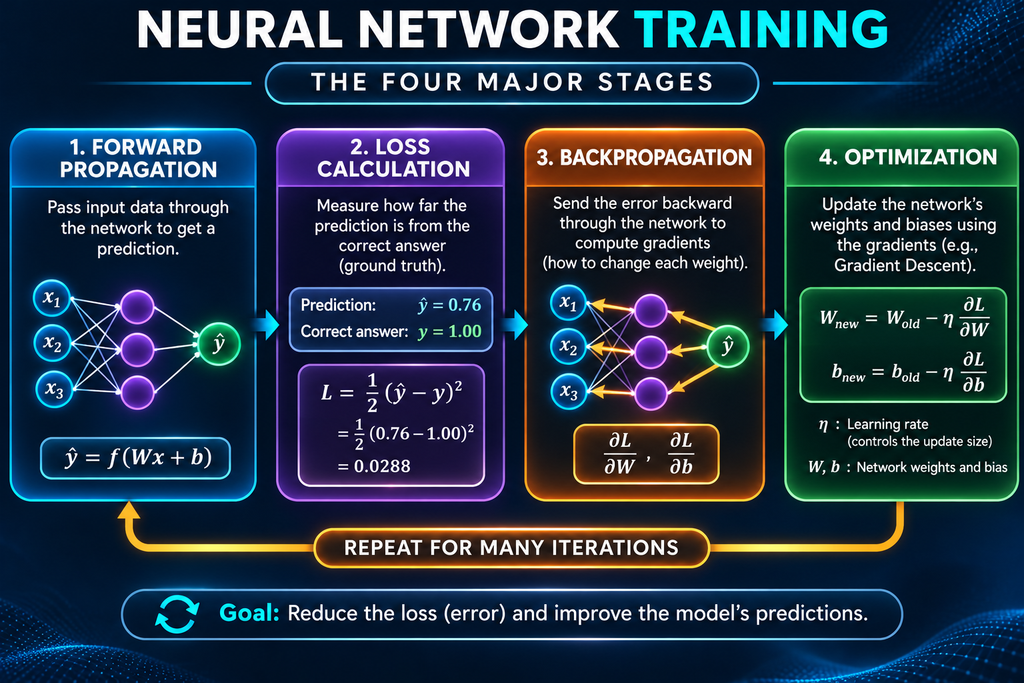
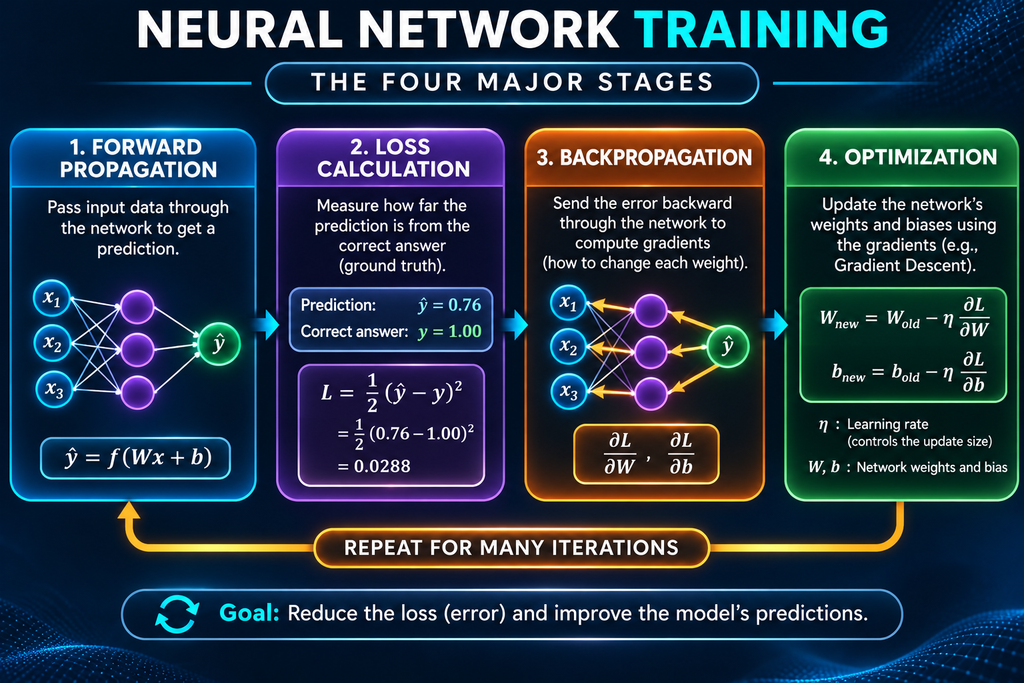
Training is the process through which a neural network improves its ability to make predictions. It repeatedly processes examples, measures its errors and adjusts its internal parameters.
Four major steps are involved:
- Forward Propagation: Training data enters the input layer and moves through the hidden layers until the network produces a prediction.
- Loss Calculation: A loss function compares the prediction with the correct answer and calculates how large the error is.
- Backpropagation: The network calculates how its weights contributed to the error, using mathematical techniques based on calculus.
- Optimization: An optimizer, such as Adam or Stochastic Gradient Descent, updates the weights and biases to reduce the error.
This cycle is repeated across training examples and multiple passes through the dataset, called epochs. Over time, the network can improve its performance on the task.
Major Types of Artificial Neural Networks
Different neural network architectures are designed for different types of problems.
| Network Type | Common Uses | How It Works |
|---|---|---|
| Feedforward / MLP | Tabular data and classification | Information moves in one direction through connected layers. |
| CNN | Images, videos and medical scans | Uses filters to identify visual patterns such as edges, textures and shapes. |
| RNN / LSTM | Time-series data and speech | Uses information from earlier steps to process sequential data. |
| Transformers | Language, code and multimodal AI | Uses self-attention to identify relationships between different parts of the input. |
Transformers are particularly important in modern AI. They power many large language models that can generate text, answer questions, write code and process different forms of information.
Where Are Artificial Neural Networks Used?
Neural networks are used across several industries and everyday technologies.
- Healthcare: Supporting medical image analysis and identifying patterns in patient data.
- Smartphones: Powering facial recognition, voice assistants and image-processing features.
- Banking: Helping identify unusual transactions and potential fraud.
- Entertainment: Recommending movies, music and videos based on user activity.
- Automotive: Supporting object detection and other driver-assistance technologies.
- Generative AI: Helping systems generate text, images, audio and computer code.
Advantages and Limitations of Neural Networks
Neural networks can learn complicated patterns, process large datasets and support tasks that are difficult to solve using fixed rules. They can also improve as they receive suitable training data.
However, they have limitations. Training advanced networks can require substantial computing power, large datasets and time. Their predictions may also be inaccurate when the training data is incomplete or biased. In addition, understanding exactly why a complex network produced a particular result can be difficult.
Conclusion
Artificial Neural Networks form the foundation of many modern machine learning and deep learning technologies. By combining artificial neurons, weights, biases, activation functions and interconnected layers, they can identify patterns and make predictions from complex data.
As AI continues to develop, neural network architectures such as CNNs, RNNs and Transformers will remain important in areas ranging from healthcare and smartphones to generative AI. Understanding how ANNs work provides a useful starting point for learning about artificial intelligence.
FAQs
1. What is an Artificial Neural Network in simple terms?
An Artificial Neural Network is a computer model that learns patterns from data using interconnected mathematical units called neurons.
2. What are the three main layers of an ANN?
The three main layers are the input layer, hidden layers and output layer. They receive data, process information and generate the final result.
3. What is the difference between ANN and deep learning?
ANN is the broader concept of neural networks. Deep learning uses neural networks with multiple hidden layers to learn more complex patterns.
4. Are neural networks used in ChatGPT?
Yes. Modern large language models, including those behind ChatGPT, use Transformer neural network architectures to process and generate language.
Also Read
- Google Gemini 4 Neon Launched: Features, Benchmarks and API Pricing
- WhatsApp View Once Text Messages: 5 Key Details for iPhone Users
- Apple 2027 Launch Plans: iPhone 18e, MacBook Neo 2 and More
Source
1. OpenStax – Introduction to Neural Networks – Read the OpenStax explanation
Covers artificial neurons, weights, biases, activation functions and network layers.
2. OpenStax – Backpropagation – Read about backpropagation and gradient descent
Explains loss calculation, weight adjustments, optimisation and neural network training.
3. Cornell University – Neural Networks – Read Cornell’s neural network guide
Explains neural network architecture, learning, hidden layers and applications.