

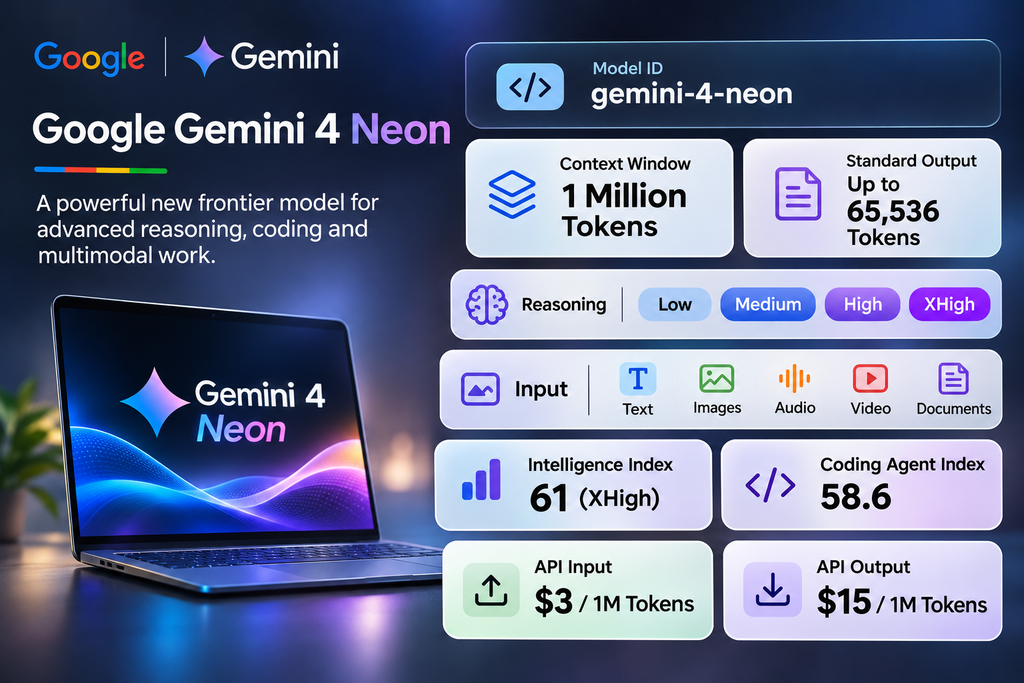
Google DeepMind has introduced Gemini 4 Neon, a new AI reasoning model designed to deliver frontier-level intelligence with faster task completion and improved efficiency. Announced on November 18, 2026, Neon targets software engineering, scientific research and enterprise knowledge work. It offers a 1-million-token context window, four reasoning levels and a reported third-place position on the Artificial Analysis Intelligence Index. The model is positioned between Gemini 4 Hydrogen and Gemini 4 Carbon.
Key Features at a Glance
- Launch date: November 18, 2026.
- Model ID:
gemini-4-neon. - Model architecture: Adapted from Gemini 4 Carbon.
- Context window: 1,048,576 tokens (1 million).
- Output limit: Up to 65,536 tokens in standard synchronous responses.
- Reasoning levels: Low, Medium, High and XHigh.
- Input support: Text, images, audio, video and documents.
- Intelligence Index: 61 at XHigh, ranking third in the reported evaluation.
- Coding Agent Index: 58.6, ranked first in Google’s launch announcement.
- API pricing: $3 per million input tokens and $15 per million output tokens.
- Availability: Gemini app, Google AI Studio, Gemini API, Google Antigravity and Gemini for Business, with access depending on subscription and platform.
What Is Gemini 4 Neon?
Gemini 4 Neon is designed for complex tasks that require reasoning, coding and the use of external tools. Google describes it as an efficiency-focused model that balances intelligence and speed rather than targeting only the most demanding long-running tasks.
It sits between two other models in the Gemini 4 family. Gemini 4 Hydrogen focuses on everyday tasks and faster execution, while Gemini 4 Carbon is intended for difficult, long-horizon projects. Neon aims to provide a middle option for developers and businesses that need strong reasoning across frequent workloads.
Google says Neon is adapted from Gemini 4 Carbon, although its parameter count and training compute have not been disclosed.
Technical Specifications and Reasoning Capabilities
One of Gemini 4 Neon’s biggest features is its unified 1-million-token context window. This allows it to process large collections of information, including documents, images, audio and video, within a single context.
Standard synchronous responses support up to 65,536 output tokens. Google also documents a background Long Decode option that can extend output up to the full 1-million-token limit.
The model supports four configurable reasoning levels:
- Low: For simpler tasks that need less reasoning.
- Medium: For tasks requiring a balance between speed and depth.
- High: The default API reasoning level.
- XHigh: For more demanding, multi-step reasoning tasks.
Gemini 4 Neon also supports function calling, structured outputs, code execution, computer use, file search, URL context and Google Search and Maps grounding. These capabilities make it suitable for agent-based workflows where an AI model needs to use tools rather than simply generate text.
Its knowledge cutoff is March 2026, according to the Google DeepMind model card.
Benchmark Performance: Coding, Science and Knowledge Work
Google positions Gemini 4 Neon as a strong model for professional and technical workloads. On the Artificial Analysis Intelligence Index v5.0.1, it scores 61 at XHigh and ranks third overall in the reported evaluation. Its High-level score is 60.
For coding, Google reports a score of 58.6 on the Artificial Analysis Coding Agent Index, placing Neon first in that index at launch. It also scores 65.2% on Terminal-Bench 4.1 and 46.2% on FrontierCode 2.0 at its default High setting.
The model also shows results across research and business tasks:
- Vals Index: 70.9%, ranking second.
- AutomationBench: 56.3%, ranking first.
- Agents’ Last Exam: 75.8%.
- Terminal-Bench Science: 70.5%.
- RiemannBench: 84%.
- HLE-Diamond: 71.3%.
These results cover coding, automation, scientific reasoning and complex knowledge work. However, benchmark scores are not a guarantee of performance on every real-world task. Some results also depend on the evaluation setup and reasoning level used.
Gemini 4 Neon API Pricing and Model Comparison
Google’s standard API pricing for Neon is $3 per million input tokens and $15 per million output tokens. Cached input costs $0.15 per million tokens, representing a 95% discount compared with standard input pricing.
Batch and Flex processing are listed at $1.50 per million input tokens and $7.50 per million output tokens.
| Model | Main Purpose | Standard API Price (Input / Output per 1M tokens) |
|---|---|---|
| Gemini 4 Hydrogen | Everyday tasks and fast execution | $1.50 / $7.50 |
| Gemini 4 Neon | Coding, reasoning and knowledge work | $3 / $15 |
| Gemini 4 Carbon | Complex, long-horizon tasks | $2 / $10 until Nov 30; $4 / $20 from Dec 1 |
Carbon’s lower introductory pricing runs through November 30, 2026. Its standard rates are scheduled to increase from December 1. This means Neon is currently more expensive per token than Carbon’s promotional rate, but will be cheaper than Carbon’s standard rate after the increase.
Google also reports that Neon delivers a 32% lower cost per task than Carbon at the default High reasoning level. Actual costs depend on the task, token usage and configuration.

Availability: Where Can You Access Gemini 4 Neon?
Gemini 4 Neon is rolling out across Google’s consumer and developer platforms. It is available through the Gemini API in Google AI Studio and Gemini for Business. Google AI Pro and Ultra subscribers can also access it through the Gemini app and Google Antigravity, subject to platform-specific availability.
For developers, the API and AI Studio provide ways to integrate the model into applications and workflows. Businesses can use it for document analysis, research, coding and other tool-based tasks.
Access is not identical across every subscription tier. Free-tier users should not assume that Neon is available to them through the Gemini app.
Conclusion
Google Gemini 4 Neon brings a new efficiency-focused option to the Gemini 4 family. With a 1-million-token context window, four reasoning levels, strong reported coding benchmarks and support for agentic tools, it targets developers, researchers and businesses handling demanding workloads.
Its $3 input and $15 output pricing places it above Hydrogen but below Carbon’s upcoming standard pricing. For users who need more reasoning capability than an everyday model without always relying on the most expensive frontier option, Neon is designed to fill that gap.
FAQs
1. When was Google Gemini 4 Neon launched?
Google DeepMind announced Gemini 4 Neon on November 18, 2026. Its rollout is taking place across supported Google platforms.
2. What is the context window of Gemini 4 Neon?
Gemini 4 Neon supports a unified context window of up to 1,048,576 tokens, or approximately 1 million tokens.
3. How much does Gemini 4 Neon cost?
Its standard API pricing is $3 per million input tokens and $15 per million output tokens. Cached input costs $0.15 per million tokens.
4. Where can users access Gemini 4 Neon?
It is rolling out through the Gemini app, Gemini API, Google AI Studio, Google Antigravity and Gemini for Business. Access depends on the platform and subscription tier.
Suggestions
- Salesforce Layoffs: Shocking Job Cuts Hit US & India Teams 2026
- GTA 6 Launches in India: Exciting Price, Release Time & 212GB Storage Details
- Xiaomi Watch S5 41mm Launched Globally : Price and Specs
Source
- Google Blog – Introducing Gemini 4 Neon
- Google DeepMind – Gemini 4 Neon Model Card
- Google AI – Gemini API Pricing