
Jio 6G Technology: 5 Exciting Developments at IMC 2026
Jio 6G Technology: 5 Major Developments That Could Shape India’s Next Network
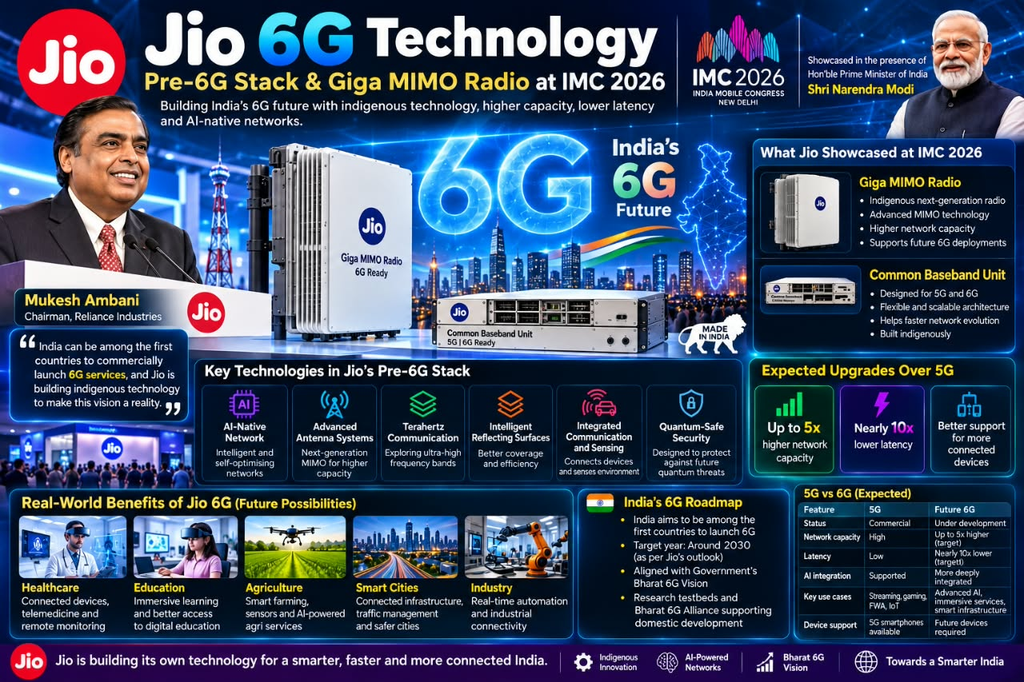
Reliance Jio has offered a closer look at its plans for the next generation of mobile connectivity. At the India Mobile Congress (IMC) 2026, the company showcased its pre-6G technology in the presence of Prime Minister Narendra Modi, highlighting India’s ambition to play a larger role in developing future telecommunications infrastructure.
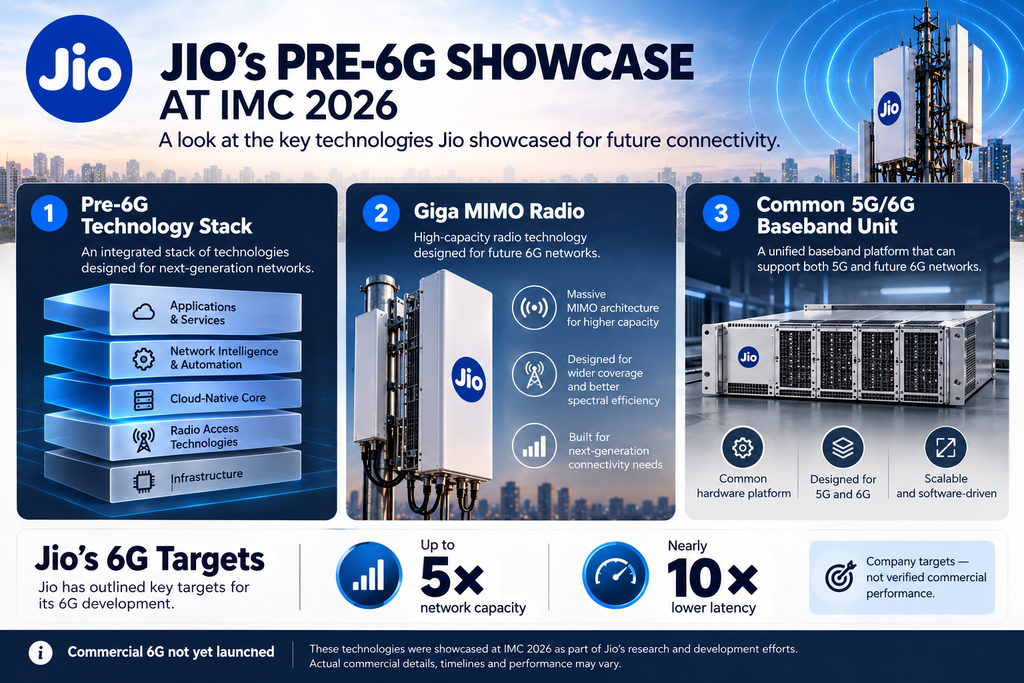
The showcase included three important developments: a proprietary pre-6G technology stack, a Giga MIMO Radio and a common baseband unit designed to support both 5G and 6G networks. Jio also outlined ambitious targets for network capacity and latency as it prepares for the transition to Jio 6G.
But what do these developments actually mean? Could they improve mobile connectivity, make artificial intelligence more responsive or help India become an early adopter of Jio 6G?
Here is a closer look at Jio’s announcement, the technology behind it and the challenges that remain before consumers can use commercial 6G services.
1. Jio’s Pre-6G Technology Stack: Building the Foundation for 6G
One of the main highlights at IMC 2026 was Jio’s proprietary pre-6G technology stack.
A telecommunications network is made up of multiple interconnected components. These include radio equipment that communicates with mobile devices, baseband processing systems, software that manages network operations and core network infrastructure that directs data between users and services.
A technology stack brings together the hardware and software needed to make these components work as a coordinated system.
Jio’s pre-6G work is intended to prepare these systems for the requirements of future mobile networks. Instead of waiting for commercial 6G deployment to begin, telecom companies can research potential technologies, test new architectures and develop intellectual property before the final standards are established.
This is important because 6G is expected to involve more than faster downloads. Research into the next generation includes artificial intelligence integrated into network operations, advanced antenna systems, improved sensing capabilities and ways to connect devices across different environments.
Jio’s official 6G technology overview lists research areas such as ultra-massive MIMO, distributed MIMO, terahertz communication, AI-native air interfaces and intelligent reflecting surfaces. These are research directions, not a list of features confirmed for an upcoming consumer service.
Developing a pre-6G stack could help Jio gain experience with these technologies and prepare its network architecture for future requirements. However, the final commercial design will depend on the evolution of international standards, technical testing and deployment decisions.
2. Giga MIMO Radio: Why Advanced Antennas Matter
Another important part of Jio 6G Technology is the development of advanced radio equipment that could help improve network capacity and use available spectrum more efficiently.
Jio also showcased its Giga MIMO Radio, which the company described as India’s first. The radio unit is a major part of its next-generation connectivity efforts.
To understand its significance, it helps to look at MIMO technology.
MIMO stands for Multiple Input, Multiple Output. It uses multiple transmitting and receiving antennas to improve wireless communication. Depending on the design and operating conditions, this can help a network send data more efficiently, serve multiple users and make better use of available spectrum.
Modern mobile networks must handle large amounts of traffic from smartphones, laptops, connected devices and business applications. As demand increases, the ability to use radio spectrum efficiently becomes particularly important.
Advanced antenna systems can direct radio signals more precisely and support multiple data streams. This can help increase capacity in busy locations, although the actual benefits depend on antenna design, spectrum, signal conditions, network configuration and the number of users being served.
Jio’s Giga MIMO Radio demonstration signals that the company is working on the radio hardware needed for future network generations. However, the public announcement does not provide enough independently verified technical data to establish its final specifications, coverage, power consumption or real-world performance.
For consumers, the important point is that future connectivity improvements will depend on radio infrastructure as well as the smartphones and other devices connected to it.
3. One Baseband Unit for 5G and 6G Could Help With Network Evolution
Another important development is Jio’s common baseband unit, which has been reported as supporting both 5G and 6G networks.
A baseband unit processes digital signals and helps coordinate communication between radio equipment and the wider mobile network. It is a key part of the infrastructure that allows a cellular network to transmit and receive information.
Supporting multiple network generations through a common unit could give operators more flexibility as technology evolves. Depending on the final implementation, it could help simplify parts of infrastructure planning and support a more coordinated transition from one generation to another.
For a telecom operator, this matters because deploying a new network generation requires significant investment. Operators need to consider radio hardware, processing equipment, software, spectrum, sites, backhaul connections and ongoing maintenance.
A design that supports multiple generations could potentially reduce some infrastructure complications. However, no specific cost saving or deployment advantage should be assumed without further technical and commercial details.
There is also an important limitation: a common baseband unit does not mean every existing 5G tower can automatically become a 6G site through a software update. Compatibility will depend on the final standards, radio equipment, processing capabilities and network architecture.
Jio’s development is therefore best understood as an effort to prepare infrastructure for a future transition, rather than a promise of an immediate upgrade for all existing sites.
4. Five Times the Capacity and Nearly Ten Times Lower Latency: What Jio Is Targeting
Jio’s reported 6G ambitions include up to five times the capacity of current 5G networks and nearly ten times lower latency. These are stated targets, not independently verified results from a commercial 6G network.
To understand these figures, network capacity and latency need to be considered separately.
Network capacity describes how much data a network can handle. Greater capacity could help support more users and connected devices, particularly in busy areas where many people are using mobile data simultaneously.
However, five times the capacity does not automatically mean five times faster downloads for every customer. Individual speeds depend on factors such as available spectrum, signal strength, device capabilities, network congestion and the service being used.
Latency refers to the delay between sending data and receiving a response. Lower latency can be useful for applications that need information to travel quickly in both directions.
For example, a remote-control system may need a fast response to a command, while an interactive digital experience may feel less responsive when delays are high. Reducing latency could help future services operate more smoothly, provided the wider system also performs well.
If Jio’s targets are achieved under relevant deployment conditions, they could offer benefits for demanding applications. But the figures should not be treated as guaranteed performance for future subscribers. The baseline used for comparison, test conditions and final network implementation all matter.
5. AI-Native Networks Could Expand What Mobile Connectivity Can Do
Jio 6G vision extends beyond conventional mobile broadband. Its official research overview identifies an AI-native air interface and other technologies intended to support more intelligent and connected systems.
In a traditional network, artificial intelligence may be added to help with particular tasks. An AI-native approach aims to integrate AI more deeply into how the network is designed or operated. Depending on the eventual implementation, this could help with network optimisation, resource allocation and responding to changing traffic conditions.
Jio has also pointed to possible future applications in healthcare, education, agriculture, real-time AI and immersive communication and step a head to Jio 6G. These possibilities illustrate why researchers are looking beyond download speeds alone.
Consider a few examples:
- Healthcare: Connected medical equipment and remote consultation systems could benefit from reliable connectivity and responsive data exchange. The usefulness of any future application would also depend on safety, equipment and clinical requirements.
- Agriculture: Connected sensors and digital monitoring systems could help farmers collect information about field conditions and equipment. Actual benefits would depend on affordable devices, coverage and useful services.
- Education: More responsive networks could support interactive learning experiences, remote collaboration and richer digital content, particularly where infrastructure and devices are available.
- Immersive communication: Future applications could combine high data rates, low latency and advanced visual technologies to make remote interaction more interactive.
These are potential use cases, not services confirmed for launch alongside Jio’s future 6G network. Their success will depend on the technology, costs, supporting applications and practical needs of users.
Jio also lists research into quantum cryptography, joint communications and sensing, and wireless power transfer. These areas show the breadth of its research programme, but they should not be interpreted as guaranteed features of the first commercial 6G services.
Jio 6G expects India could be among the first countries to introduce commercial 6G when global standards are finalised, with 2030 cited as an expected milestone. This is an ambition rather than a confirmed Jio 6G launch date.
Global standards matter because mobile networks need agreed technical specifications so that equipment and devices from different manufacturers can work together. Standards also provide a foundation for operators to plan network deployments and for manufacturers to develop compatible products.
India has its own stated ambition to contribute to the development and deployment of 6G technology by 2030 started with Jio 6G. The government’s Bharat 6G Vision document sets out a goal of positioning India as a leader in future network development.
However, a standards milestone is not the same as a nationwide consumer launch. Commercial deployment would require further work, including trials, suitable spectrum, network equipment, compatible devices and investment decisions. Availability could also vary between locations.
Jio’s pre-6G showcase is evidence of its preparation, but the final rollout timeline remains uncertain.
What Does This Mean for Existing Jio Customers?
For people using Jio’s 4G or 5G services today, the announcement is primarily a look at the company’s longer-term technology plans. It does not confirm a new consumer 6G service, a Jio 6G SIM requirement or an upcoming phone that will work on Jio’s future network.
Customers should continue choosing smartphones and mobile plans based on their present needs, network coverage and budget. It is too early to buy a device solely in anticipation of Jio 6G when final compatibility requirements and commercial availability have not been established.
For businesses, the announcement is an indication that future connectivity planning is already underway. Organisations that depend on mobile networks may eventually benefit from improvements in capacity, latency and network intelligence, but they should wait for concrete specifications and service availability before making investment decisions based on 6G.
Conclusion
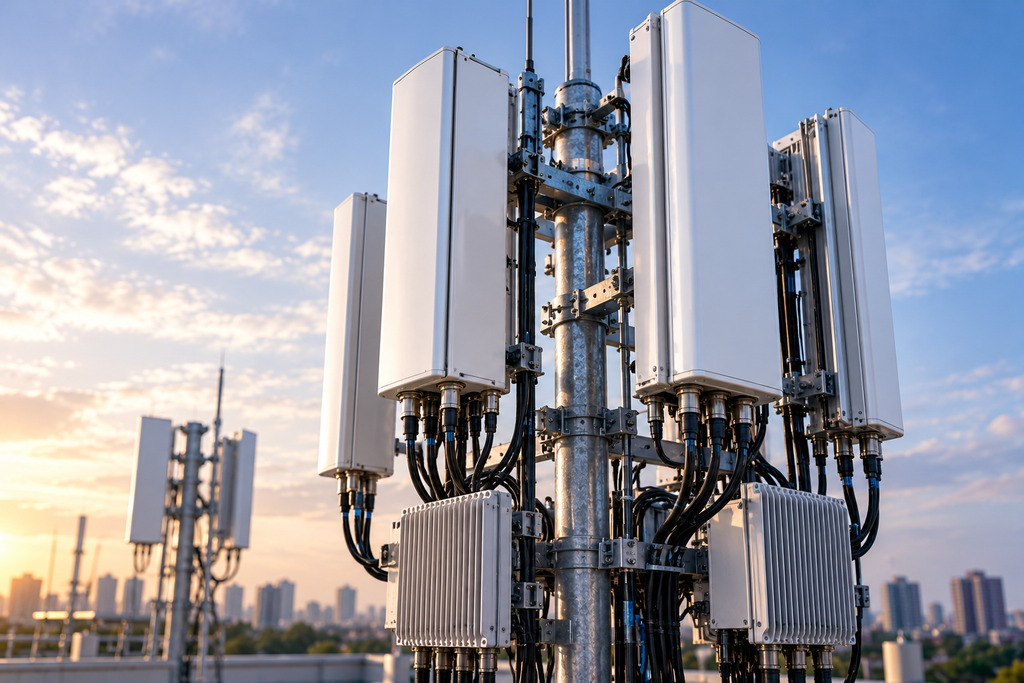
Jio’s pre-6G showcase at IMC 2026 highlights its efforts to prepare for the next generation of mobile connectivity of Jio 6G. Its Giga MIMO Radio, common baseband unit and proprietary technology stack are important developments to watch as research moves towards future network standards.
The larger opportunity is not simply faster downloads. Advanced radio systems, AI-native network design and improved capacity could eventually support new applications across healthcare, education, agriculture and industry.
For now, the distinction between preparation and commercial availability remains essential. Jio 6G has demonstrated its pre-6G work and outlined ambitious targets on Jio 6G, but the final standards, real-world performance and launch timeline still need to become clearer before consumers can assess what 6G will deliver in India.
Frequently Asked Questions
1. Has Jio launched 6G in India?
No. Jio showcased its pre-6G technology stack and Giga MIMO Radio at IMC 2026. This was a demonstration of development work, not a commercial 6G launch.
2. What is Jio’s pre-6G technology stack?
It is a collection of network technologies being developed in preparation for 6G. The stack relates to the hardware and software required to support future telecommunications infrastructure.
3. What is Giga MIMO Radio?
It is radio equipment showcased by Jio as part of its next-generation network work. MIMO technology uses multiple antennas to improve how wireless systems transmit and receive data.
4. Will Jio 6G be five times faster than 5G?
Not necessarily. Jio’s reported target concerns up to five times the network capacity of current 5G systems. Network capacity is different from the download speed an individual user experiences.
5. When will Jio launch Jio 6G?
A confirmed commercial launch date has not been announced in the cited reports. Jio has indicated that India Jio 6G could be among the early adopters after global 6G standards are finalised, with 2030 cited as an expected milestone.
6. Will existing Jio 5G phones support 6G?
That cannot be confirmed yet. Compatibility will depend on final standards and device hardware. Users should wait for official specifications before assuming their current phones will support 6G.
7. What is the purpose of a common 5G and 6G baseband unit?
It is designed to support both network generations. This could give operators more flexibility in infrastructure planning, but it does not mean all existing 5G equipment can automatically be upgraded to 6G.
8. How could 6G benefit ordinary users?
Potential benefits include higher network capacity, lower latency and support for new connected services. The actual experience will depend on the networks deployed, compatible devices, coverage and the services available.
Recommendations :
JBL Tune Beam 2 Ghost Edition: 5 Powerful Features
Samsung Galaxy F70 5G: 5 Exciting Features Before Launch
TECNO Spark 50S 5G: 5 Key Features and Price